

Introduction
Both machines sit in a stainless tank and both turn fast, which is why so many quotes arrive with the names used interchangeably. They are not the same machine and they do not do the same job. One moves a whole batch; the other tears liquid apart in a gap not much wider than a credit card. Choosing the wrong one costs you either money in the motor or quality in the bottle. Here is the difference, mapped to yogurt, juice and plant milk.
Two Different Jobs
A high speed emulsification tank uses an open impeller — usually a saw-tooth disc or a high-efficiency propeller — running at 1,000 to 3,000 rpm. Its job is bulk motion: wet out powders, dissolve solids, keep a slurry moving, prevent settling. Tip speed lands somewhere between 5 and 15 m/s, and the droplets it creates are typically 20 to 50 µm.
A high shear emulsification tank uses a rotor-stator head with a narrow clearance between rotor and screen. Product is drawn in axially and forced out through slots at high velocity, so it passes through the shear zone many times per minute. Tip speeds of 15 to 25 m/s and shear rates in the 10⁴ to 10⁵ s⁻¹ range break droplets down to 2 to 5 µm. That is the regime where a stable emulsion starts to form without a downstream homogenizer.
| Property | High speed tank | High shear tank |
|---|---|---|
| Working principle | Open impeller, bulk circulation | Rotor-stator, localised shear |
| Droplet size | 20–50 µm | 2–5 µm |
| Motor per 1,000 L | 1.5–3 kW | 7.5–15 kW |
| Heat input to product | Low | High — jacket cooling usually needed |
| Air entrainment | Moderate, depends on vortex | High if the head runs near the surface |
Yogurt: High Speed Usually Wins
Yogurt mix needs the solids dissolved, the stabiliser hydrated and the fat evenly distributed before homogenisation and heat treatment. It does not need 3 µm droplets at the mix stage; that happens in the homogeniser downstream, at far higher pressure than any rotor-stator can reach. A high speed tank with a good saw-tooth impeller hydrates stabiliser faster and with less air than a shear head run at full speed.
Where high shear does earn its place in a yogurt plant is fruit preparation and high-solids bases, where you are dispersing pectin or starch into a thick medium that a propeller cannot turn over. Even then, a combination unit — anchor or paddle for bulk flow, shear head for the dispersion step — usually beats a single-purpose machine.
Plant Milk: Shear First, Then Homogenise
Plant-based milk is the case where the two machines are usually both needed, in a specific order. The shear head breaks the ground slurry apart, wets the protein and creates a coarse emulsion. The homogeniser then reduces fat globules to below 2 µm for stability against creaming. Skip the shear step and the homogeniser receives lumps that it cannot break; skip the homogeniser and the shear alone gives you a drink that separates in the bottle within days.
One practical detail: shear heads heat product quickly. A 10,000 L batch with a 22 kW head running 40 minutes can pick up several degrees, which matters if you are trying to keep the slurry below the temperature where protein denatures. Size the jacket for it, or run the shear in short passes.
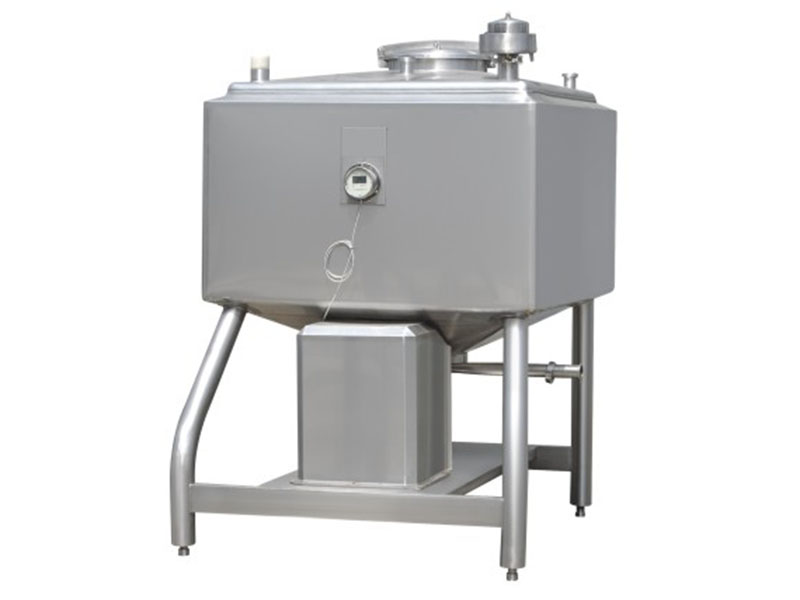
High speed unit: an open impeller for bulk flow and powder wet-out, not for droplet break-up.
Juice and Beverage: Be Careful With Shear
In juice and pulpy beverages, shear is often the enemy. A rotor-stator will strip the pulp and reduce particle size, which changes mouthfeel and can make a cloudy juice look dull or a pulp-containing drink lose its body. High speed agitation is normally enough for reconstituting concentrate, dissolving sugar and blending additives.
The exception is fine emulsions such as flavour oils, omega-3 additions or clouding agents. Those benefit from a shear pass, ideally in a small side vessel rather than the whole batch, so the pulp never sees the shear head.
Selection shortcut: if the quality problem is “not dissolved” or “settling out”, you need bulk flow. If it is “separates in the pack” or “too coarse on the tongue”, you need smaller droplets — shear plus homogenisation.
Sizing the Machine to the Batch
Rotor-stator performance depends on how many times the batch passes through the head, which means turnover rate matters more than motor power. A head that processes 30 m³/h in a 2,000 L batch turns the whole volume over 15 times an hour; the same head in a 10,000 L tank turns it over three times. If the supplier quotes only kW, ask for the circulation rate and the expected number of passes.
For high speed tanks, the opposite is true: impeller diameter and off-bottom clearance decide whether the batch turns over at all. A saw-tooth disc mounted too high creates a vortex and whips air in; mounted correctly it produces a rolling pattern that reaches the tank wall.
If your process is mostly low-viscosity mixing with occasional dispersion, a high speed emulsification tank is the right base unit. If you are making fine emulsions without a homogeniser, start from the high shear emulsification tank. And if you simply need to keep a solution uniform, a standard agitator tank will do it for a fraction of the power.
Mixing & Emulsification
Tell us the product and we will tell you which head you need
Batch size, viscosity, target droplet size and downstream homogenisation — four numbers are enough for Zhongbo to specify the impeller, motor and jacket.
What to Check in the Quote
- Tip speed, not just rpm — the same rpm means very different shear on different head diameters.
- Shaft length and bearing arrangement, especially on a 3,000 L tank where a long unsupported shaft will whip.
- Mechanical seal type and whether it is product-lubricated or needs a barrier fluid.
- CIP coverage of the underside of the head — a rotor-stator hides a lot of surface from a spray ball.
- Whether the head can be lowered or the tank bottom dished to drain around it.
For the wider comparison, including where a standard agitator is genuinely enough, see our article on agitator tank vs high shear emulsification tank. If you are weighing shear against a homogeniser, high shear tank vs homogeniser covers the pressure and droplet-size trade-off in detail.
Frequently Asked Questions
Can a high speed tank be converted to high shear later?
Often yes, if the tank was built with a suitable top plate and the shaft and motor have margin. The head itself is a bolted assembly, so the conversion is mostly a shaft, seal and motor question. Ask for the flange standard and shaft diameter at the quotation stage, and confirm the tank bottom can take the extra weight.
Does higher rpm always mean better emulsification?
No. Beyond a certain point the droplets stop getting smaller because they re-coalesce as fast as they break, and you only add heat. The useful variable is energy density per unit volume combined with enough passes through the shear zone. Running a small head longer usually beats running a big head harder.
Why does my product foam so much in the shear tank?
Air is being drawn in at the surface, usually because the head is too close to the liquid line or the vortex is not broken. Lower the head, add a baffle, or fill the tank higher. In protein systems the foam is also stabilised, so it will not collapse on its own — you have to prevent it forming.
Is a high shear tank a substitute for a homogeniser?
Only for coarse emulsions. A rotor-stator cannot reach the pressures that push fat globules below 1 µm, so a plant milk or a fine beverage cream made only with shear will be less stable over shelf life. For sauces, dressings and fruit bases, shear alone is often enough.
What viscosity can a high shear head handle?
Up to roughly 10,000–20,000 cP for a standard rotor-stator, after which the head cannot draw product in and the motor stalls. Thick pastes need a scraped-surface or anchor agitator with a separate shear loop, not a bigger motor on the same head.
How long should a shear pass take?
For most beverage emulsions, 10 to 20 minutes at full speed gets you to a stable droplet distribution; going to 40 minutes mainly adds heat. Run a small trial, sample at 5-minute intervals and measure droplet size or simply observe separation after 24 hours — the curve flattens sooner than most people expect.
Do I need a jacket on a shear tank?
Assume yes above about 5 kW. Mechanical energy goes into the product as heat, and a 15 kW head running 30 minutes in 2,000 L can raise temperature by several degrees. If the product is heat-sensitive or you are working cold, a dimple jacket with chilled water is cheaper than reformulating.
Which one is easier to clean?
The high speed tank, by a wide margin. An open impeller is visible and sprayable; a rotor-stator has an internal cavity that needs flow through the head to clean. Specify a head that can be flushed through, and include a low-speed rotation during CIP so the solution passes the slots.
Can one tank do both mixing and shearing?
Yes, with a dual-shaft design: a slow anchor or paddle for bulk movement plus a bottom-entry or top-entry shear head. It costs more than either single machine but replaces two vessels, which often pays for itself in a plant with limited floor space and a long CIP schedule.
Does the tank shape matter?
It does. A dished bottom with a bottom-entry head gives better drainability and less dead volume than a flat bottom with a top-mounted unit. Height-to-diameter ratio around 1:1 to 1.5:1 suits most emulsification duties; a tall narrow tank makes the head work harder for the same turnover.
Final Thoughts
The choice comes down to what you are actually trying to change. If solids are not dissolving or a slurry keeps settling, bulk flow is the answer and a high speed head will do it on a fraction of the power. If the product separates in the pack, you need smaller droplets, and that means shear plus homogenisation. Buy for the defect you are fixing, not for the label on the quotation. One trial batch with a sample taken every five minutes will tell you more than any brochure.
Related Resources
Equipment on this site
- Agitator Tank — simple blending when shear is not the limiting factor.
Further reading