
The methods of water treatment include physical treatment, chemical treatment, and biological treatment.
Physical methods include using various filter materials with different pore sizes, using adsorption or barrier methods to remove impurities from water. The most important adsorption method is to use activated carbon for adsorption, and the barrier method is to pass water through the filter material, preventing larger impurities from passing through, thereby obtaining cleaner water.
Industrial Water Treatment Process
Raw water → Raw water tank → Raw water pump → Multi medium filter (quartz sand filter) → Activated carbon filter → Precision filter → High pressure pump → Primary reverse osmosis (RO) device → Purified water tank → Water point

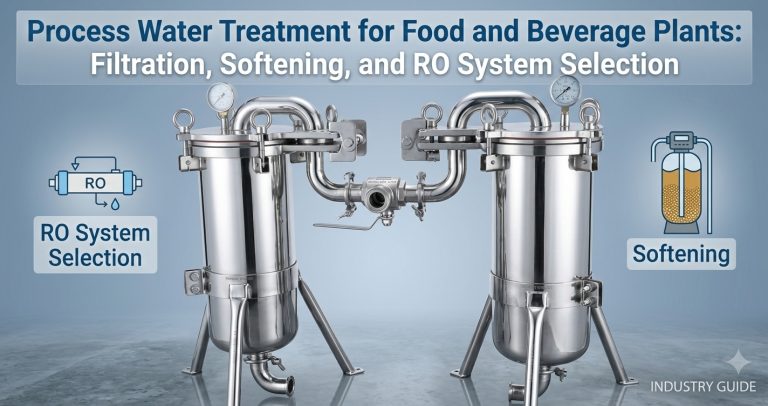
Precision filters (also known as security filters) are generally made of stainless steel for the cylinder shell, and use tubular filter elements such as PP melt blown, wire burned, folded, titanium filter element, activated carbon filter element, etc. as filter elements inside. Different filter elements are selected according to different filter media and design processes to meet the requirements of effluent quality.
Essentially, it consists of two single-basket filters (which can be fitted with mesh baskets or filter bags) connected in parallel, switching between active and standby modes via a three-way valve.
This pure water treatment system uses multi-stage filtration and reverse osmosis technology to effectively remove suspended solids, organic matter, residual chlorine, bacteria, and most dissolved salts from raw water. The treated water is stored in a pure water tank and then delivered steadily to the usage point, ensuring reliable water quality and stable system performance.
In industrial water purification, achieving crystal-clear, contaminant-free water requires a robust multi-media pre-treatment system. Zhongbo Machinery combines the mechanical efficiency of Quartz Sand Filters with the deep adsorption power of Activated Carbon Filters. This integrated filtration engineering serves as a highly efficient primary purification skid, effectively reducing pollution load and providing ultimate protection to subsequent high-sensitivity systems such as reverse osmosis (RO), ultrafiltration (UF), and ion exchangers.
Engineered to handle feed water with high turbidity, our quartz sand filter acts as a powerful mechanical barrier. Utilizing precise hydraulic simulation and a optimized long-diameter cylinder vessel design, it packs layered granular and non-granular quartz sand with a reasonable particle size gradient. Operating under stable process pressure, it delivers outstanding performance in capturing physical suspended impurities.
For chemical compound removal and flavor refinement, our activated carbon adsorption filter is irreplaceable. It deploys high-efficiency coconut shell or nut shell activated carbon with a massive specific surface area greater than 1000 m²/g. This dual-functional design coordinates an upper layer for special mechanical micro-filtration with a lower layer focused on deep molecular adsorption, greatly improving the service life of carbon media.
Delivering food processing solutions and support across the whole production line, we ensure the food safety and operational performance
30 years of experience: our processing components optimize your operations, with tailored suggestions.
We optimize production, supply exact parts, boost productivity, cut energy use, reduce waste, and ensure top food safety.
Before starting, production line planning must consider: daily final product capacity, energy, cleaning and investment costs.
A: What is water treatment equipment?
our water treatment Equipment including two parts: Phisical Filtration and RO membrane
A:
Equipment Protection
Extends the lifespan of UHT/sterilizers: Completely resolves the issues of reduced heat transfer efficiency and clogging in plates/pipelines caused by scale buildup.
Energy Saving and Consumption Reduction
Reduces cleaning frequency: Scale is a primary target in CIP cleaning. Using RO water can decrease the usage and frequency of acid cleaning (nitric/phosphoric acid).
Quality Stability
Eliminates the risk of foreign matter: Prevents scale fragments from breaking off and mixing into the product, which could affect taste or cause physical contamination.
Process Precision
Water for formulations: In the preparation of reconstituted milk and beverages, using RO water eliminates interference from mineral content in the raw water, ensuring consistent product flavor.
A:
1. Deep Purification
Removes dissolved salts (Na⁺, Cl⁻), heavy metals, bacteria, viruses, and organic matter. The produced water is close to “pure water.”
Applications: Dairy plant boiler make-up water, CIP final rinse water, laboratory water.
2. Desalination/Softening
Selectively removes excessive mineral ions from water, reducing water hardness and conductivity.
Purpose: Adjusts process water quality to prevent scaling in equipment.
3. Wastewater Recovery
Extracts usable water from cleaning wastewater (CIP) or whey wastewater, achieving reduction and reuse.
Benefits: Environmental protection and water conservation, reducing water costs and discharge fees.
A:You should consider water quality, processing capacity, filtration requirements, and application standards.
A:Source Factory, competitive price, reputed guarantee, in-time after-sale services.
© 2025 Zhejiang Zhongbo Mechanical Technology Co.,Ltd. | Privacy Policy | SiteMap
We use cookies to improve your experience on our site. By using our site you consent to cookies.