


Introduction
You have a water treatment train, a UV unit, and a filler at the end of it. Somewhere in between sits a small stainless housing most people call the security filter, and it is usually the last thing anyone specifies. Then a heat exchanger on the RO skids scales up, or a UV lamp starts reading low, and it turns out the filter was the wrong rating, in the wrong place, or bypassed. Here is how to decide what it is and where it belongs.
What a Security Filter Actually Is
The term covers a lot of ground in supplier catalogues. Precision filter, security filter, polishing filter, guard filter — in a beverage plant they all describe the same idea: a cartridge housing placed immediately upstream of equipment that cannot tolerate particles. It is not a treatment stage. It does not soften, disinfect or remove dissolved solids. Its only job is to catch what the previous stage let through.
That distinction matters more than it looks. If you expect a security filter to fix a turbidity problem, you will size it for the wrong dirt load, change cartridges every shift, and end up blaming the filter for a carbon bed that is channeling.
Where It Sits in a Beverage or Dairy Water Line
There are four positions worth considering, and each protects something different. Most plants need two of them.
| Position | What it protects | Typical rating |
|---|---|---|
| After multimedia or carbon, before the RO high-pressure pump | Pump wear rings, spiral-wound membrane feed spacers | 5 µm nominal, pleated |
| After carbon, before softening or storage | Carbon fines carrying through to resin and to product | 10–20 µm, high dirt-holding |
| Immediately before UV | Turbidity that shades lamps and drops dose | 1 µm absolute |
| Final point before aseptic filler or ingredient water | The sterile or near-sterile boundary itself | 0.45 µm or 0.2 µm, integrity-tested |
In most dairy and beverage plants the sensible minimum is one at 5 µm ahead of the RO pump and one at 1 µm ahead of the UV. Add the 0.2 µm stage only if you are filling aseptically and can support it with integrity testing; an untested 0.2 µm cartridge is a false sense of security rather than a sterile barrier.
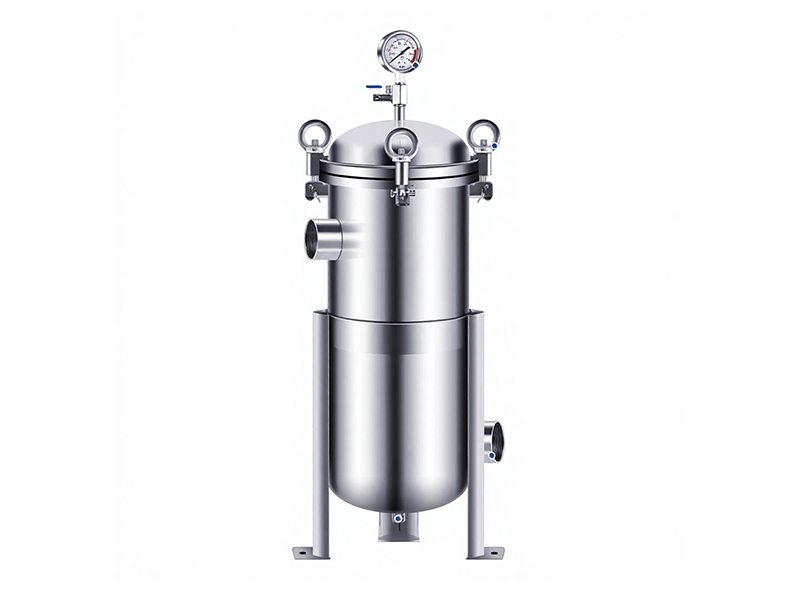
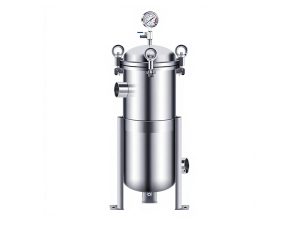
A sanitary cartridge housing: front and rear pressure gauges tell you the dirt load without opening it.
Choosing the Micron Rating
A micron number on its own tells you very little, because nominal and absolute ratings are not the same thing. A 5 µm nominal cartridge might pass a meaningful fraction of particles well above 5 µm; a 5 µm absolute cartridge will not. For a guard filter ahead of a membrane, nominal is usually acceptable. For anything you intend to call sterile, you need absolute ratings plus a test method.
Then work backwards from what the downstream equipment can tolerate. UV transmittance specs, membrane silt density index limits and filler nozzle sizes all give you a number to design to. Picking 1 µm because it sounds finer is how you end up changing cartridges twice a week.
Housing Details That Decide Whether It Stays Clean
A precision filter handles potable or product-contact water, so the housing is part of your hygiene design, not a utility fitting. Look for 316L wetted parts, a sanitary clamp or flange connection rather than threaded ports, a fully draining bowl with a bottom drain valve, a vent at the high point, and a surface finish you can clean. Threaded housings are common on utility water and are a poor choice downstream of a UV unit you plan to sanitise.
- Differential pressure gauges on both sides, or one differential gauge — not a single gauge on the outlet.
- Drain port at the lowest point, sized so the housing empties in under a minute.
- Cartridge seal that does not rely on the bowl thread to compress the O-ring.
- Housing rated for your sanitisation temperature, not just line pressure.
Sizing: Flow, Pressure Drop and Dirt Load
Filter sizing is a pressure drop calculation, not a flow number. As a starting point, a single 10-inch pleated cartridge in water service will pass roughly 1–2 m³/h before the clean pressure drop becomes inconvenient, but the vendor curve is the real answer and it changes with viscosity and rating. Size for the dirty state: if clean differential is 0.15 bar and your change-out threshold is 1.0 bar, you have 0.85 bar of usable dirt capacity.
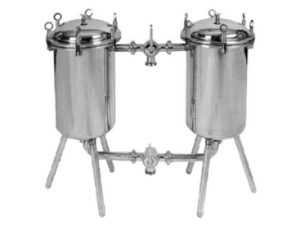
Two cartridges in parallel are often cheaper than one large cartridge over the life of the plant, because you can change one at a time and keep the line running. On a line that must not stop, this is the same argument that pushes people toward a duplex filter arrangement.
Rule of thumb: change cartridges at 0.8–1.0 bar differential, and never later than the point where flow starts to sag. A cartridge run to 2 bar has usually extruded its pleats and is bypassing at the seal.
Sanitisation and Change-Out
Polypropylene and PTFE cartridges will take hot water at 80 °C but not steam. If your sanitisation strategy is steam, you need a stainless or ceramic element, and you should check the housing rating too. Chemical sanitisation with peracetic acid or chlorine is common but shortens element life, and chlorine on polypropylene at high temperature is a bad combination.
Changing a cartridge is a maintenance task with a hygiene consequence. Flush the housing, drain it fully, handle the new element by the end caps, wet the O-ring with clean water rather than grease, and record the differential pressure after restart. If you cannot show a change-out log, you cannot show that the filter was ever doing its job.
Water Treatment
Not sure where the security filter belongs in your train?
Send us your water analysis and a simple line sketch. Zhongbo will mark the filtration stages, micron ratings and change-out points that match your RO, UV and filler.
Mistakes You Can See in Ten Minutes
A bypass line around the housing is the first thing to look for. It is installed “for maintenance” and left open, and the filter becomes decoration. The second is a single pressure gauge, which tells you nothing about dirt load. The third is a 0.2 µm cartridge in a plant with no integrity test and no sanitisation procedure. The fourth is a housing sized on clean pressure drop, tripping the RO feed pump on high differential within a month.
If any of those sound familiar, the fix is usually cheap. A sanitary precision filter with proper gauges, a drain and the right rating will protect a reverse osmosis system for years; the same housing in the wrong place will not.
For the wider picture on how these stages fit together, our guide to process water treatment for food and beverage plants covers the full train, and the double-pass RO benchmarks explain what good water chemistry looks like at the outlet.
Frequently Asked Questions
Can a security filter be installed horizontally?
Most sanitary housings are designed vertical with the bowl down, because that is the only orientation that drains completely. A horizontal housing traps water in the bowl, which is exactly where biofilm starts. If your ceiling height forces a horizontal install, choose a housing with a dedicated low-point drain and prove it drains before you accept it.
Does the filter need to be downstream of the UV instead?
Upstream is the normal choice, because the filter protects the quartz sleeve from fouling and keeps turbidity low enough for the lamp to work. Putting it downstream adds a non-sterile volume after the last barrier, which is the wrong place to introduce one. If you need particulate control after UV, use a second small housing and sanitise it.
How do I know when to change the cartridge if there is no gauge?
You do not, reliably. Without differential pressure you are changing on a calendar, which is either wasteful or late. Fitting a differential gauge is a minor job and the single highest-value change you can make to an existing installation. A calendar schedule is a backup, not a control.
What is the difference between a bag filter and a cartridge filter here?
Bag filters hold far more dirt and are cheaper per change, but they are not available in fine absolute ratings and the bag seal is less reliable at high differential. For 10–100 µm rough duty, bags win. For 1–5 µm guard duty ahead of membranes or UV, pleated cartridges are the better choice.
Is a 0.2 µm filter enough to make water sterile?
Only if it is validated as such: absolute rated, integrity-tested before and after use, sanitised, and installed in a system with no non-sterile dead volume downstream. A 0.2 µm cartridge in a utility housing with threaded fittings gives you filtered water, not sterile water, and the difference matters if it feeds an aseptic filler.
Why does pressure drop rise so fast after a carbon change?
Fresh carbon is dusty. The fines migrate to the guard filter and load it in days. Backwash the carbon bed properly after replacement, run to drain for longer than feels necessary, and expect to change the first cartridge early. If the problem persists past two weeks, the carbon is being over-agitated or the bed is too shallow.
Can one housing serve both RO feed and product water?
It can be piped that way, and it usually should not be. The two duties have different dirt loads, different ratings and different change intervals, so a shared housing forces a compromise on all three. Separate housings also stop an RO feed problem from contaminating a product line.
What finish should the housing interior have?
Mechanically polished to Ra 0.8 µm or better on wetted surfaces is a reasonable target, with smooth welds and no crevices around the cartridge seat. Electropolishing helps on chlorinated or acidic service. The finish matters less than the drainability, but a rough interior will hold soil through a rinse cycle.
Should the filter be included in the CIP circuit?
Product-contact housings should be, with the cartridge removed or a dedicated cleaning element fitted, otherwise you are cleaning around a soil trap. Utility water housings usually are not, and rely on sanitisation instead. Decide which one you have before writing the CIP sequence, because the procedure differs.
How many spare cartridges should a plant keep?
Two full change sets, plus one set for the stage that fouls fastest. Cartridges have a shelf life and O-rings harden, so rotating stock matters. Keeping twenty of everything ties up cash and guarantees half of them expire in the store cupboard.
Final Thoughts
A security filter is a cheap, boring piece of equipment right up to the day it is missing, and then it becomes the reason a membrane stack or a UV lamp fails. Decide what you are protecting, choose the rating that protects it, and put the housing where it can be drained, cleaned and watched. Two gauges and a change-out log will do more for your water quality than a finer cartridge ever will. If you are unsure where the stage belongs, sketch the train and ask someone to check it.
Related Resources
Equipment on this site
- Reverse Osmosis Purification System — single and double-pass RO for beverage water.
Further reading