



Introduction
A plate pasteurizer makes one silent promise: if a plate cracks, raw milk must not end up in the pack. That promise rests on a single number — the pressure difference between the raw and pasteurized sides of the regenerator. Reviewing a design is rarely about whether a differential exists on paper. It is about whether you can prove it, at the right gauge, with the pumps in the right order, at every valve state. Here are the checks worth making before you sign off.
What the Differential Actually Does
Inside a plate pack, raw product and pasteurized product run through alternating channels, separated by roughly 0.5 mm of stainless steel and a gasket. A pinhole in a plate, a gasket that creeps under heat, or a cracked port liner all create a path between the two. You cannot see any of it from the outside.
Pressure is what makes that path predictable. Keep the raw side above the pasteurized side and any leak has one known direction, one known consequence, and one defined response from the safety system. Lose the differential and you no longer know which way product is moving through a defect — which is why the differential is treated as a critical control point rather than a commissioning detail.
What it does not do: the differential does not seal the regenerator, does not compensate for a worn gasket, and does not replace plate inspection. It only guarantees the direction of a failure. Treat any design that relies on it as a substitute for maintenance with suspicion.
Where the Gauges Should Sit
Most arguments about pressure differential start with instrumentation, not with the plates. You need two readings that are referenced to the same physical point in the regenerator, ideally the product inlet of each side. On a plate pasteurizer the practical arrangement looks like this:
- Raw-side gauge tapped on the raw inlet header, downstream of the feed pump and upstream of the first regeneration pass.
- Pasteurized-side gauge tapped between the holding tube outlet and the hot side of the regenerator, before the diversion valve.
- Both taps on the same elevation, same bore, and short enough that product cannot sit in them. A 300 mm instrument leg on a dairy line is a dead-leg with a gauge on the end.
- Diaphragm seals on both, sized for the CIP temperature the line actually reaches, not the nominal 80 °C.
A single differential transmitter reading both taps is better than two separate gauges, provided the transmitter is calibrated as a pair and the low-pressure shutoff takes its signal from the same device. Two gauges read by an operator at two different moments are two different numbers, and inspectors know it.
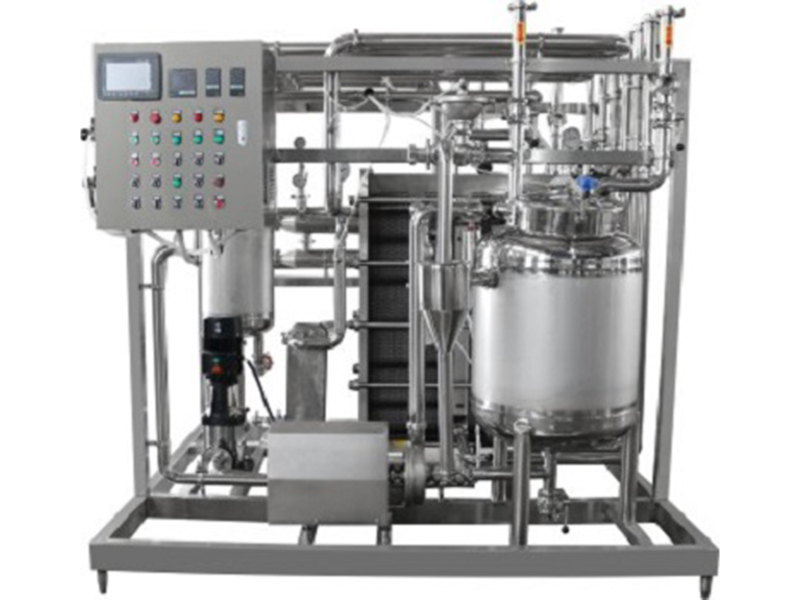
A plate pasteurizer frame: the regenerator sits in the middle of the pack, between the heating and cooling sections.
Reading the Numbers: Minimums and Margins
The US Pasteurized Milk Ordinance sets the floor at 1 psi (about 0.07 bar) in favour of raw product, held throughout the regenerator and at every point in the cycle. That is a legal minimum, not a design target. A 1 psi margin disappears into gauge tolerance and pump switching transients long before anyone notices.
| Application | Typical design differential | What drives the number |
|---|---|---|
| HTST milk, regenerator | 0.5 bar (7 psi) or higher | Covers gauge error, pump changeover, valve travel time |
| UHT with aseptic downstream | 1.0 bar or higher | Sterile barrier must never be pressurised from the raw side |
| High-acid juice, single regeneration pass | 0.3–0.5 bar | Lower viscosity, faster pump transients |
| Cooling section, chilled water | Product above water | Prevents coolant ingress on a plate failure |
Two numbers deserve equal attention: the differential you design for, and the differential at which the plant actually trips. If the low-pressure shutoff is set at 0.5 bar and the plant runs at 0.55 bar, you have built a plant that alarms on a normal weekend. Ask for both settings in writing, plus the deadband.
Pump Order, Valve States and Transients
Steady state is easy. The differential is normally lost during a transition, and transitions are where a design review earns its fee. Walk the sequence with your supplier and check each of these states:
- Start-up. The pasteurized-side pump should not start before the raw-side pump has established pressure. If both ramp together, the first two seconds run backwards.
- Flow diversion. When the diversion valve opens, downstream pressure drops sharply. Confirm the raw-side pressure is maintained during diversion, not only during forward flow — this is the state most often missed in commissioning.
- Homogenizer start. A homogenizer upstream or downstream of the regenerator can pull or push a spike through the pack. Watch the differential trace during the first stroke, not after the machine settles.
- CIP switchover. Cleaning flow often runs at a higher rate than production. If the CIP pump feeds the raw side only, differentials invert during the rinse phase.
- Power failure. Both pumps stop, but not at the same instant. Ask what the differential does in the three seconds after a trip, and whether the diversion valve fails safe.
Design Review
Send us your pasteurizer P&ID and we will mark up the pressure points
Zhongbo engineers review regeneration sections, gauge taps and diversion logic for dairy and beverage lines before the frame is built — so the differential is provable on day one, not after the first inspection.
When the Differential Drops: What Should Happen
A working safety chain has three steps, and each one should be testable in front of a customer or an inspector. First, the low-pressure switch detects the loss. Second, the diversion valve sends flow back to balance tank or drain. Third, the recorder shows the event with a timestamp, so the batch can be traced.
If any link is missing, the differential is decoration. A plant with a gauge but no switch is a plant that depends on an operator noticing. A plant with a switch but no recorder is a plant that cannot prove what happened. During a design review, ask for the trip test procedure and the response time, then ask who signs it.
Pre-Sign-Off Checklist
| Check | Evidence to ask for |
|---|---|
| Gauge locations match the drawing | Tagged P&ID with tap elevations noted |
| Switch setpoint and deadband | Calibration sheet, signed and dated |
| Differential held during diversion | Recorder trace with the valve event marked |
| Start-up and shutdown sequence | Written sequence tested with water |
| Plate integrity inspection interval | Maintenance plan, not a verbal promise |
The same discipline applies whether you buy a new plate pasteurizer or re-commission an existing one. The plate pack is only part of the system; the pumps, valves and instrumentation around it decide whether the differential survives a real production day.
Design Errors That Pass Review but Fail Inspection
Three habits show up again and again on lines that were signed off without argument. The first is a gauge on a long instrument leg, which reads the pressure of whatever is sitting in the leg rather than the pressure in the channel. The second is a differential taken from two different transmitters with different ranges, then compared by the PLC without a common reference. The third is a regeneration section sized for maximum heat recovery, leaving almost no pressure budget — you gain a percentage point of heat recovery and lose the margin that keeps the safety system quiet.
If you are balancing recovery against pressure margin, it helps to calculate the recovery figure first and then check what it costs you in pressure drop. Our guide to thermal regeneration efficiency walks through that trade-off with worked numbers, and the plate vs tubular comparison covers where a plate pack stops being the right answer at all.
Frequently Asked Questions
How often should the differential gauge be calibrated?
Most dairy plants calibrate on a six-month cycle, and always after any work on the plate pack. If your quality system runs to a 12-month interval, make sure the gauge tolerance is small enough that a 1 psi legal minimum is still provable at the end of the interval. A gauge with ±2 percent of full scale on a 10 bar range can hide the entire margin.
Can you run a plate pasteurizer with no regeneration section?
Yes. With no regenerator there is no raw-to-pasteurized interface inside the pack, so the differential requirement between those two streams disappears. You pay for it in energy: a no-regeneration HTST uses roughly twice the heating and cooling load per litre. Small batch plants and high-acid products often accept that trade.
What differential should the cooling section have?
Product pressure should stay above chilled-water pressure, typically by 0.3 bar or more, so a plate failure pushes product into the water circuit instead of pulling coolant into the product. This is separate from the regenerator requirement and often overlooked because the cooling section sits at the cold end of the frame where nobody looks.
Does the 1 psi rule apply to UHT plants too?
UHT lines usually work to a higher figure because the downstream side is a sterile barrier. Aseptic designs commonly specify 1 bar or more between raw and sterile sections, and some add a double-wall or intermediate circuit. Check the requirement with the authority that inspects your plant rather than assuming the HTST figure carries over.
Why does the differential fall during CIP?
Cleaning runs at a different flow rate and often a different routing than production. If the CIP pump feeds only one side of the regenerator, the pressure balance inverts. Either route cleaning solution through both sides at matched flow, or interlock the CIP sequence so the low-pressure switch is bypassed only while the pack is confirmed empty.
How do you test the low-pressure shutoff without wasting product?
Run the test on water before the first production run, then repeat it with product once per campaign. Close the raw-side valve slowly and watch the switch trip, the diversion valve move and the recorder mark the event. The whole test takes minutes on water and gives you a signed trace for the file.
Is a double-wall plate safer than a standard plate?
A double-wall plate has a vented gap between two sheets, so a crack in either sheet leaks to atmosphere rather than into the neighbouring channel. It is the strongest mechanical answer to cross-contamination, but it costs pressure drop and plate area. Many plants use double-wall plates only in the regenerator and standard plates elsewhere.
What belongs in the pasteurizer log?
At minimum: start and end time, holding temperature, holding time, differential reading at start and every hour, diversion events with cause, and the operator signature. If the log has a column for differential but nobody fills it, the column is worse than useless in an audit because it shows you knew what to measure.
Why does the alarm trip when the homogenizer starts?
A homogenizer draws a pressure pulse that travels back through the regenerator. If it sits downstream of the pasteurized side, the first stroke can pull pasteurized pressure below the switch setpoint for a fraction of a second. Add a short delay on the switch, or sequence the homogenizer to start after flow is stable.
Can a differential transmitter replace the two gauges?
It can, and it usually should. A single transmitter with both taps connected reads the true difference, removes operator interpretation, and gives the PLC one signal to interlock. Keep local gauges as a backup for maintenance, but let the transmitter drive the trip and the record.
Final Thoughts
You will not find the differential on a datasheet. It only appears when pumps, valves and gauges are read together, in the order they actually run. Ask for the trip test, watch the recorder through a diversion, and check the standby state nobody thinks about. That is the difference between a pasteuriser that passes inspection and one that still keeps raw milk out of the pack on the day a plate finally cracks. If your line is being built or re-commissioned, it is worth an hour of review now.
Related Resources
Equipment on this site
- Plate Type Heat Exchangers — the plate pack used across heating, regeneration and cooling.
Further reading