Introduction
Mixing equipment plays a critical role in dairy, beverage, food, cosmetic, and other liquid-processing applications. However, not every product requires the same type of mixing.
An agitator tank is generally designed for controlled bulk mixing, blending, and maintaining product uniformity. A high shear emulsification tank, by contrast, generates significantly higher shear forces to disperse, homogenize, or emulsify ingredients.
Choosing between the two depends on factors such as product viscosity, particle size, required dispersion, emulsification performance, and production process.
This guide compares agitator tanks and high shear emulsification tanks to help manufacturers select the right solution for their products.
What Is an Agitator Tank?
An agitator tank is a process vessel equipped with a mechanical agitator that continuously moves the product inside the tank.
Depending on the product and mixing objective, different agitator designs can be used, including:
- Impeller agitators
- Anchor agitators
- Paddle agitators
- Scraper agitators
The main purpose is to achieve uniform mixing while maintaining controlled product movement.
Agitator tanks are commonly used for:
- Liquid blending
- Ingredient dissolution
- Powder incorporation
- Temperature uniformity
- Product holding
- Preventing ingredient sedimentation
For products with relatively low to medium viscosity that do not require intensive emulsification, a conventional agitator can often provide sufficient mixing performance.

What Is a High Shear Emulsification Tank?
A high shear emulsification tank uses a high-speed rotor-stator or similar high-shear mixing mechanism to generate intense localized shear forces.
The high shear zone breaks down droplets and particles into smaller sizes and promotes more uniform dispersion.
The basic principle is:
High-Speed Rotation → Strong Shear → Droplet/Particle Size Reduction → Homogeneous Product
High shear emulsification tanks are particularly useful when the process requires:
- Fine emulsification
- Rapid dispersion
- Particle size reduction
- Stable oil-water mixtures
- Homogeneous high-viscosity products
Compared with conventional agitation, high shear mixing provides substantially more intensive processing in the localized shear zone.

Agitator Tank vs. High Shear Emulsification Tank: Key Differences
Mixing Principle and Shear Force
The most fundamental difference is shear intensity.
An agitator tank primarily relies on bulk fluid circulation. The impeller moves a relatively large volume of product through the vessel, promoting overall mixing.
A high shear emulsification tank generates much stronger localized turbulence and shear.
In simple terms:
Agitator Tank → Bulk circulation and blending
High Shear Tank → Intensive dispersion and emulsification
This difference makes conventional agitation more suitable for general blending, while high shear equipment is better suited to processes where droplet or particle size must be significantly reduced.
Product Viscosity and Particle Size
Product viscosity is an important equipment-selection parameter.
Agitator tanks can handle a broad range of liquid products, but the agitator design must be selected according to viscosity and flow behavior.
Low-viscosity beverages may require relatively simple impellers, while higher-viscosity products may require anchor or scraper agitators to maintain effective circulation.
High shear systems are more appropriate when the process involves:
- Fine particles
- Difficult-to-dissolve ingredients
- Oil-water mixtures
- High-viscosity emulsions
- Products requiring a narrow particle-size distribution
For very viscous products, a high-shear system may also be combined with a conventional agitator so that bulk circulation and intensive shear can work together.
Mixing and Emulsification Performance
Agitator tanks are primarily designed to create uniformity throughout the tank.
They are effective for blending ingredients and maintaining consistent composition, but conventional agitation alone may not produce a fine emulsion.
High shear emulsification tanks provide stronger droplet breakup and dispersion.
For example, when oil and water need to form a stable emulsion, high shear forces can reduce the size of dispersed droplets and improve the uniformity of the mixture.
However, high shear is not automatically better for every product.
Excessive shear can:
- Increase energy consumption
- Generate unwanted heat
- Damage shear-sensitive ingredients
- Affect product texture
- Create excessive foaming in some formulations
Therefore, the required shear level should be determined by the product rather than simply choosing the most powerful mixer.
Typical Applications
The two tank types have overlapping but different application ranges.
| Application | Agitator Tank | High Shear Emulsification Tank |
| Beverage blending | ✓ | ✓ |
| Ingredient dissolution | ✓ | ✓ |
| Syrup preparation | ✓ | ✓ |
| Oil-water emulsification | Limited | ✓ |
| Fine dispersion | Limited | ✓ |
| High-viscosity products | ✓* | ✓ |
| Particle size reduction | Limited | ✓ |
| General holding and mixing | ✓ | Limited |
*The appropriate agitator design is required for high-viscosity products.
Agitator tanks are generally the more versatile option for everyday mixing and blending, while high shear tanks are more specialized for intensive dispersion and emulsification.
Which Tank Is Right for Your Product?
When to Choose an Agitator Tank
An agitator tank is generally a good choice when the primary objective is uniform mixing rather than fine emulsification.
When working with shear-sensitive ingredients (e.g., certain proteins, dairy globules, or fragile particulates) that could degrade under extreme mechanical stress
Consider an agitator tank when:
- Ingredients need to be blended evenly
- The product has relatively low or medium viscosity
- Particle-size reduction is not critical
- The formulation does not require intensive emulsification
- The tank also needs to function as a buffer or holding vessel
- Energy consumption needs to be controlled
For beverage production, syrup preparation, ingredient blending, and general liquid processing, an appropriately designed agitator can often provide sufficient performance.
The agitator type should then be selected according to viscosity, flow pattern, tank geometry, and mixing objective.
When to Choose a High Shear Emulsification Tank
A high shear emulsification tank is more appropriate when the product requires intensive dispersion or emulsification.
Consider high shear equipment when:
- Oil and water must be emulsified
- Fine particle dispersion is required
- The product contains difficult-to-disperse ingredients
- A more uniform particle or droplet distribution is required
- The formulation requires intensive homogenization during mixing
Examples can include:
- Emulsified beverages
- Sauces
- Dressings
- Dairy-based formulations
- Nutritional products
- Cosmetic emulsions
The actual particle-size and emulsion-stability requirements should be established through product trials and process validation.
Integration with Downstream CIP and Buffer Tanks
Tank selection should not be considered separately from the rest of the processing line.
A mixing tank may be connected to downstream equipment such as:
Mixing Tank → Processing/UHT → Buffer Tank → Filling
The system should also be compatible with the plant’s CIP (Cleaning-in-Place) process.
Important considerations include:
- Sanitary tank design
- Internal surface finish
- Drainability
- Spray-ball or rotary spray-head coverage
- Pipeline configuration
- Valve arrangement
- CIP flow rate
- Cleaning temperature and chemical compatibility
For continuous production, buffer tanks can help decouple upstream mixing from downstream filling or processing.
A well-designed system therefore considers the tank, agitator, transfer pump, CIP system, and buffer tank as part of a connected process rather than as isolated pieces of equipment.
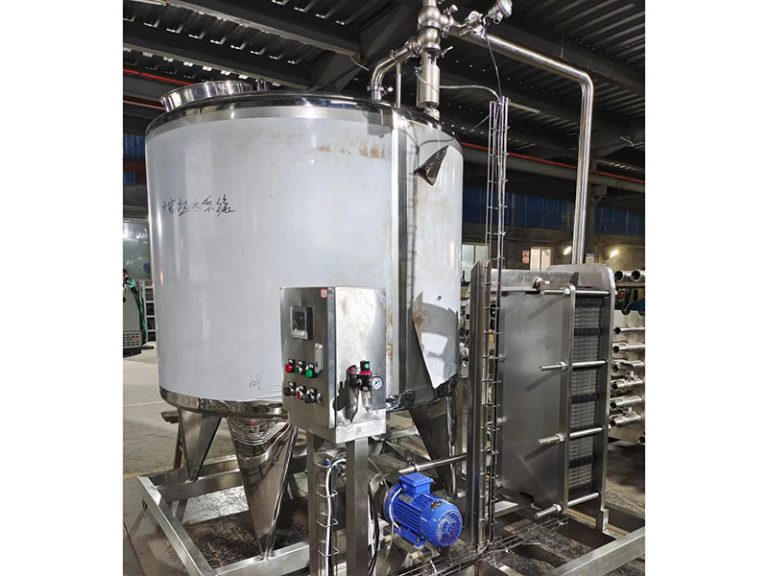
Zhongbo Agitator and High Shear Emulsification Tanks
Zhongbo provides both Agitator Tanks and High Shear Emulsification Tanks for industrial processing applications.
The agitator tank is designed for controlled mixing and blending, making it suitable for processes where bulk circulation and product uniformity are the primary objectives.
The high shear emulsification tank is intended for applications requiring more intensive mixing, dispersion, and emulsification.
When selecting between the two, manufacturers should consider the actual product characteristics and process requirements, including:
- Viscosity
- Density
- Solid content
- Particle size
- Required droplet size
- Emulsion stability
- Mixing time
- Production capacity
- CIP requirements
For more complex production lines, the selected tank can also be integrated with upstream ingredient preparation and downstream processing, buffer storage, CIP, and filling systems.
Conclusion
The choice between an agitator tank and a high shear emulsification tank ultimately depends on what the product needs from the mixing process.
An agitator tank is generally the better choice for bulk blending, ingredient dissolution, temperature uniformity, and maintaining product consistency. A high shear emulsification tank is more suitable when the process requires intensive dispersion, particle-size reduction, or oil-water emulsification.
The key distinction is mixing intensity rather than simply equipment capacity.
Before selecting a tank, manufacturers should evaluate product viscosity, particle size, emulsion requirements, shear sensitivity, production capacity, and CIP integration.
For general liquid mixing, an agitator tank can provide an efficient and versatile solution. When fine emulsification or intensive dispersion is essential, a high shear emulsification tank may be the more appropriate choice.
FAQs
- What is the main difference between an agitator tank and a high shear emulsification tank?
An agitator tank primarily provides bulk circulation and uniform blending, while a high shear emulsification tank generates much stronger localized shear for intensive dispersion and emulsification.
- Is a high shear emulsification tank better than an agitator tank?
Not necessarily. High shear equipment is better for products requiring intensive emulsification or dispersion, while an agitator tank is often more suitable for general mixing and blending.
- Which tank is better for high-viscosity products?
It depends on the product’s rheology and mixing objective. High-viscosity products may require anchor or scraper agitators, while high shear equipment can be used when intensive dispersion or emulsification is also required.
- Can an agitator tank emulsify products?
An agitator can provide some degree of dispersion and mixing, but conventional agitation may not achieve the fine droplet size and emulsion stability required for demanding emulsification processes.
- What products require high shear mixing?
Products requiring fine emulsification or intensive dispersion may benefit from high shear mixing, including certain dairy formulations, sauces, dressings, nutritional products, and oil-water emulsions.
- Can an agitator tank and high shear mixer be used together?
Yes. In some processes, conventional agitation provides bulk circulation while a high shear mixer provides intensive localized processing. This combination can be useful for complex formulations.
- How does CIP affect tank selection?
The tank should have a sanitary design that supports effective CIP coverage, drainage, and cleaning of the vessel and agitator assembly. CIP requirements should be considered during equipment selection rather than after installation.
- How do I choose the right mixing tank for my product?
Start with the product’s viscosity, density, solid content, particle size, emulsion requirements, shear sensitivity, required mixing time, and production capacity. Then select the appropriate agitator or high shear system based on these parameters.