

Introduction
The reception tank is where your raw milk starts its life in the plant, and it is where most of the damage is done quietly. Milk arrives at 30–35 °C, warm enough for bacteria to double every hour. What happens in the next two hours decides how much of your pasteuriser’s capacity you spend catching up. Cooling speed, agitation style and cleaning access are the three design decisions worth arguing about before you buy. Here is how to get them right.
What the Reception Tank Has to Do
Four jobs, in order of difficulty. Receive a tanker load without foaming or aerating the milk. Cool it from arrival temperature to below 4 °C as fast as the refrigeration allows. Hold it cold for hours or overnight without fat separating or bacteria recovering. Feed the pasteuriser at a steady rate without pulling air into the line.
A vessel that does the first and third but not the second is a silo, not a reception tank. Plenty of plants buy a tank with a jacket and a slow agitator, then discover the pull-down time is five hours and the milk has already moved on.
Cooling: How Fast Is Fast Enough
The practical target for a reception tank is to bring milk from arrival temperature to 4 °C within two to three hours, and to hold it there. Faster is better for bacteriology, but the heat load at the start of the pull-down is enormous: cooling 10,000 L of milk by 30 K in two hours means removing roughly 350 kW, which no jacket on a storage tank will deliver on its own.
| Cooling route | Typical pull-down | Best fit |
|---|---|---|
| Direct expansion jacket | 4–8 h for a full batch | Small farms and collection points |
| Chilled water or glycol in a dimple jacket | 3–5 h | Mid-size dairies with a chiller on site |
| Plate cooler on the unloading line, then cold storage | Immediate — milk enters the tank already cold | Plants handling more than one tanker a day |
If you unload more than about 20,000 L a day, cooling on the unloading line through a plate cooler is normally the right answer, with the tank acting as cold storage rather than a heat exchanger. It is a smaller refrigeration load per litre, the milk never sits warm, and the tank can be a simpler insulated vessel.
Watch the first hour: jacket cooling is slowest when the temperature difference is largest and the product is still. Running the agitator intermittently during pull-down, rather than continuously, keeps the boundary layer thin without churning the fat.
Agitation: Gentle Beats Effective
Raw milk separates. Left still for a few hours, the fat rises and the tank develops a cream layer that will not re-mix without damaging something. But agitation is also where reception tanks go wrong, because the obvious fix — a faster impeller — makes cream, butter grains and foam instead of uniform milk.
The design that works is a large, slow-moving paddle or swept-surface agitator at 20–40 rpm, run for five minutes every half hour rather than continuously. Low tip speed is the whole point: you want bulk turnover, not local turbulence. A tank with a high-speed propeller in it will produce a visible foam ring and a fat layer on the wall within a shift.
- Tip speed under about 1 m/s for raw milk; higher speeds shear the fat globule membrane.
- Agitator mounted so it does not create a vortex at low level — a vortex pulls air into the milk.
- Never agitate while the tank is being filled from the top; the falling stream plus the paddle aerates the batch.
- Run the agitator during CIP, at low speed, with the spray ball running.
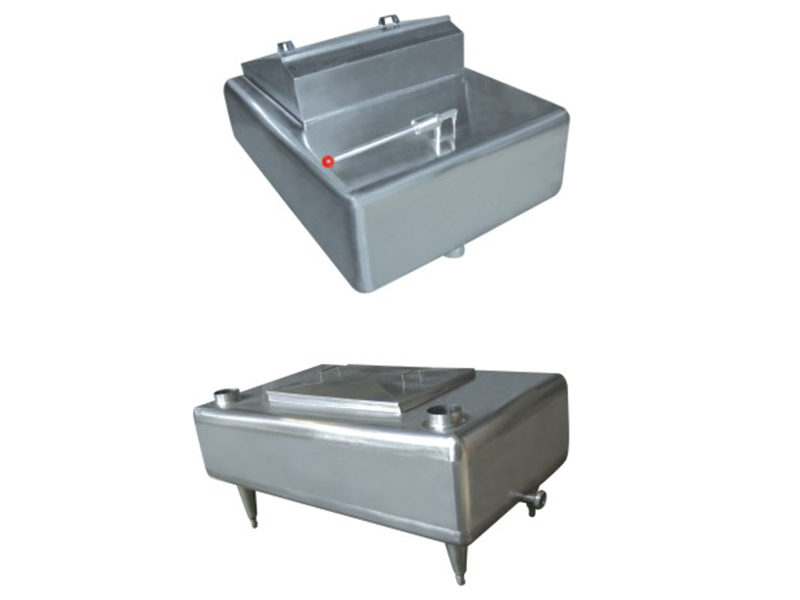
Reception tank with insulated shell and jacket: cooling rate and agitator tip speed decide raw milk quality.
CIP at the Intake
A reception tank is cleaned daily, often twice, and it is a large vessel with a small opening — which makes spray ball coverage the first thing to verify. The ball should be sized so the spray pattern reaches the top of the shell and the underside of the roof; a ball selected for flow rate alone will leave the upper third unwashed and you will find the evidence as a ring of protein film.
Drainage matters just as much. The tank bottom should fall to the outlet with no flat area, and the outlet should be flush or recessed rather than a standpipe. A standpipe leaves a heel of milk that never drains, and that heel is the inoculation point for the next load.
Other details worth specifying: a filtered air vent so the tank does not pull in airborne contamination as it cools, a sample valve with a short, drainable spigot, and a manway sized for a person with a hose. If you are connecting the tank to a shared CIP system, confirm the return line is sized for the tank’s flow, not the line’s.
Sizing and Layout
Size on the intake pattern, not on the daily total. If three tankers arrive between 06:00 and 10:00, your tank must hold all three loads plus what is already in process, or you need a second tank. A useful rule is to provide 1.2 to 1.5 times the largest daily intake as reception capacity, so a late tanker does not force a production change.
Two smaller tanks usually beat one large one. They let you receive while a tank is being cleaned, they let you segregate a load that fails a platform test, and they give the pasteuriser a buffer that can be switched without stopping. The cost is more pipework, more valves and more spray balls to verify.
The feed pump matters more than people expect. A sanitary centrifugal pump sized close to the pasteuriser flow rate, with a VFD rather than a throttle valve, will keep the line full and avoid the air slugs that trip flow switches downstream.
Raw Milk Intake
Designing the intake end of a new dairy?
Zhongbo builds reception tanks, refrigeration tanks and the pumps between them. Send your daily intake, tanker size and available chilled water temperature for a sized proposal.
Insulation, Materials and the Details
For a tank holding milk at 4 °C in a 30 °C room, 50 mm of polyurethane is a minimum and 75–100 mm is normal on larger vessels. The insulation has to be fully sealed, because a damp jacket loses most of its value and you will see condensation on the outer shell long before you see a temperature problem in the product.
316L on product contact and 304 on the jacket is the usual split; 304 throughout is acceptable for milk but gives you less tolerance for cleaning chemicals. Interior finish around Ra 0.8 µm, welded joints ground and polished, and no threaded fittings anywhere in the product path.
If you also store finished product cold, a dedicated refrigeration tank is a better fit than reusing the reception vessel, and our article on direct cooling milk storage tanks covers compressor sizing and jacket design in more depth.
Frequently Asked Questions
What temperature should milk be on arrival at the plant?
Well-run collection keeps milk below 6 °C on the farm and during transport, and most authorities accept it at that level. Anything arriving above 10 °C has spent time outside the cold chain and should be segued to a separate tank and tested before it joins a batch.
Can I cool milk in the tank overnight instead of installing a plate cooler?
You can if the volume is small and the milk can be held below 4 °C before it is processed the next morning. Above about 5,000 L per batch the pull-down gets long enough that bacterial growth in the first hours outweighs the equipment saving. A plate cooler is the cheaper answer over a few years.
Why does the milk temperature rise during storage?
Usually heat leaking in through an uninsulated manway, a failed gasket, or a jacket that has been allowed to warm because the glycol loop is not circulating. Check the shell for warm patches and the manway seal first; both are cheap to fix and both are common.
Is air agitation acceptable for raw milk?
No. Air agitation oxidises milk fat, strips flavour, creates foam and introduces a contamination route through the air supply. It is used in water and some waste applications; for milk it is the wrong tool and no reputable dairy uses it.
How often should the spray ball be inspected?
Every month for pattern and blockage, and after any CIP failure. Spray balls block with scale and with debris from the line, and a partly blocked ball still looks fine from outside. The usual evidence is a clean tank with a dirty roof or a streak down one wall.
Does the tank need a vent?
Yes, and it should be filtered. As the tank cools, the headspace contracts and pulls air in; as you fill, it pushes air out. An unfiltered vent is an open door for airborne microorganisms and for insects, and a blocked vent will collapse a thin-walled tank under vacuum.
What slope does the tank bottom need?
A dished or conical bottom draining to a flush outlet is what you want; on a flat-bottomed tank, 1–2% fall to the outlet is the minimum. The test is simple: after CIP, open the outlet and see whether anything other than water comes out. If it does, the tank does not drain.
Can the reception tank be used for cream or whey?
Physically yes, but cream needs a different agitator (higher viscosity, more tendency to churn) and whey needs faster turnover to stop protein settling. Using one tank for all three usually means compromising on agitation for at least two of them.
How is the tank level measured?
Radar or guided-wave sensors are the usual choice because they do not contact the product; load cells suit smaller tanks and give you mass as well as level. Avoid sight glasses on a raw milk tank — they are a cleaning problem and a breakage risk. Whatever you fit, calibrate it against a dip tape at commissioning.
What is the minimum practical tank size for a small dairy?
About 2,000 L for a farm-scale operation processing a single tanker collection, with a second identical tank as soon as you add a day of production. Below that the surface-to-volume ratio makes cooling inefficient and the agitator has little to work with.
Final Thoughts
The reception tank is the cheapest place in the plant to protect milk quality and the easiest place to lose it. Cool fast, agitate gently, drain completely, and make sure the spray ball reaches the roof. None of that is exotic; it is simply easy to leave out of a quotation. Before you sign, ask for the pull-down time, the agitator tip speed and a spray ball pattern test. Those three answers will tell you more about the supplier than the price will.
Related Resources
Equipment on this site
- Milk Reception Tank — insulated intake vessel with gentle agitation and CIP coverage.
- Refrigeration Tank — cold storage for raw or finished product.
Further reading