

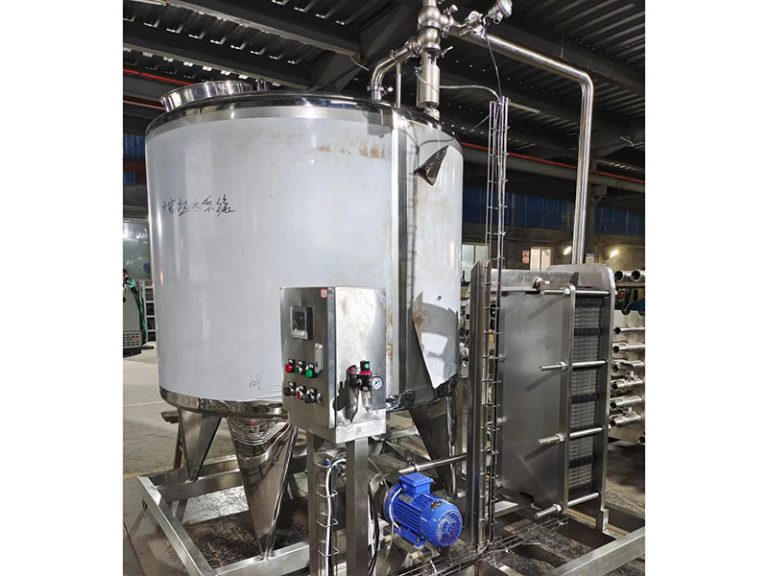

Introduction
Raw milk is perishable the moment it leaves the cow. Bacterial counts double roughly every 20 minutes above 10 °C, and once psychrotrophs establish themselves they produce heat-stable enzymes that survive pasteurization and spoil the finished product weeks later. The single most important piece of equipment between the milking parlour and the processor is the farm or collection-centre direct cooling milk storage tank: it must pull fresh milk from ~35 °C down to 4 °C fast, hold it there, and do so without freezing the milk against the wall or contaminating it during cleaning.
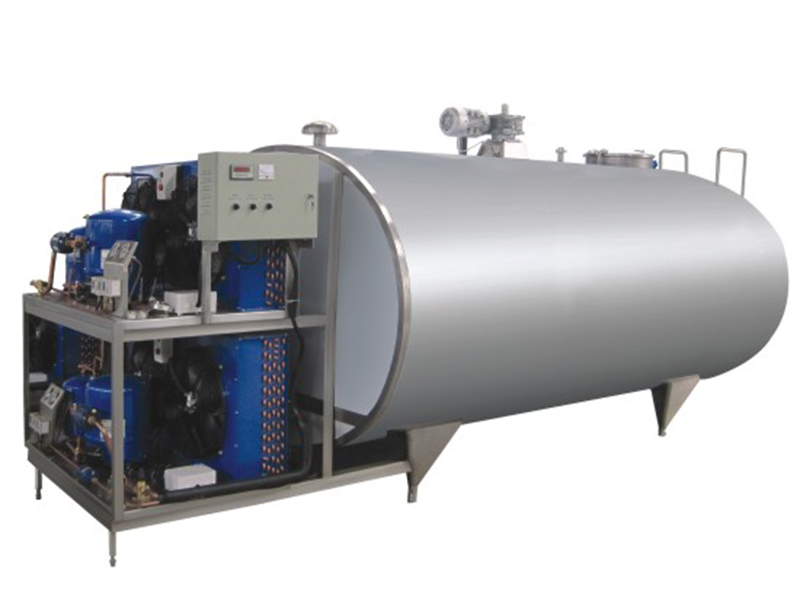
This article walks through the three things that decide whether a tank does that job: compressor sizing, dimple jacket design, and temperature control. We build direct cooling refrigeration tanks with Maneurop/Copeland compressors and full dimple jackets, and the details below are the exact points we check before a tank leaves the factory.
Why Direct Cooling Matters for Raw Milk
“Direct cooling” means the refrigerant evaporates directly in a jacket welded to the tank wall—there is no intermediate glycol loop. That removes a heat-transfer step, so cooling is faster and more efficient than an indirect glycol chiller for the same compressor. The trade-off is that the wall temperature is the refrigerant evaporation temperature, which can sit well below 0 °C; control has to be tight or the milk next to the wall freezes. Done right, direct cooling is the most economical way to hold milk on a farm or collection point.
The quality stakes are concrete: milk held at 4 °C instead of 8 °C can gain a full day of shelf life before processing, and it protects the butterfat and protein that the dairy downstream will standardize and pasteurize.
Compressor Sizing
The Cooling Load
The load has three parts: (1) pulling a fresh fill from 35 °C to 4 °C (the dominant, transient load); (2) removing the heat of agitation and any incoming warm milk; (3) the standing loss through insulation. A practical sizing formula for the pull-down:
Q ≈ m × c × ΔT ÷ t, where m = milk mass (kg), c ≈ 3.93 kJ/kg·K for milk, ΔT ≈ 31 K, t = acceptable pull-down time (s). Add ~15 % for wall and standing losses.
Example: 3,000 L (≈ 3,080 kg) pulled from 35 to 4 °C in 2 hours needs roughly 3,080 × 3.93 × 31 ÷ 7,200 ≈ 52 kW of cooling at the coil—but because the compressor cycles and the load is transient, a unit rated around 8–10 kW of refrigeration (at the tank’s evaporation temperature) sized with adequate pull-down capacity handles a once- or twice-daily fill. Size for the worst single fill, not the daily average.
Compressor Choice
We use Maneurop (Copeland) hermetic reciprocating compressors because they are robust, serviceable in the field, and rated for the low evaporation temperatures direct cooling demands. The key number is not the nameplate horsepower but the cooling capacity at your actual evaporation temperature (often −5 to −10 °C for direct cooling). A compressor that looks ample at 0 °C can lose 30–40 % of its capacity at −8 °C, so always size at the operating point, not the catalogue peak.
Dimple Jacket Design
Why Dimples
A dimple jacket is a thin stainless sheet spot-welded to the tank wall with dimples stamped in it. The dimples create a turbulent, thin refrigerant path that maximizes heat transfer per metre of wall while keeping the jacket pressure low. Against a plain jacket, dimples give far more cooling area in the same footprint and avoid the dead zones where milk would sit warm.
Coverage & Agitation
The jacket should cover the lower cylindrical wall where milk actually sits, and an agitator must keep the milk moving so cold wall meets fresh milk, not a frozen layer. Without agitation, a still tank forms a frozen crust on the wall and a warm core—exactly the failure mode that ruins a batch. We size the agitator for gentle, continuous turning, not violent mixing that whips in air.
Jacket Zones & Refrigerant Circuit
Larger tanks split the jacket into two or three independently fed zones so the compressor can cool a partial fill without flooding an empty upper zone with refrigerant. Zoning also lets the control system pulse refrigerant only where milk is present, which saves energy and prevents over-cooling an empty section.
Temperature Control
Sensors & Setpoints
At least one wall sensor and one immersed sensor, with the control logic driven by the milk temperature, not the wall. The setpoint is typically 4 °C with a 1–2 °C deadband so the compressor does not short-cycle. Alarm at 6 °C and a high-temperature lockout protect against a stuck sensor.
Avoiding Wall Freezing
This is the whole game in direct cooling. The control must cut refrigerant flow before the wall drops below 0 °C at the milk contact surface. We do this with a milk-temperature-led setpoint plus a wall-temperature limit switch: if the wall approaches freezing, the solenoid closes regardless of the milk reading. A tank that freezes milk to the wall is worse than one that cools slowly.
CIP & Hygiene
The tank must be cleanable-in-place with a fixed or rotating spray ball reaching every surface. 316L contact surfaces, full-penetration welds, and a sloped bottom to the outlet prevent milkstone and biofilm. A tank you cannot CIP properly becomes a contamination source no compressor can fix.
Sizing the Tank: Volume & Throughput
Size the tank for the largest single day’s collection plus one fill of headroom, not the annual average. A 500-cow herd producing ~12,000 L/day typically needs two 6,000–8,000 L tanks (one cooling while the other fills) or a single 10,000–12,000 L unit with zoned cooling. Collection centres scale accordingly—50,000 L/day calls for 15,000–20,000 L units in parallel. Oversize slightly; an empty tank costs little, a too-small tank costs a rejected load.
Energy & Operating Cost
Direct cooling beats a glycol chiller on energy because there is no secondary fluid to pump and re-cool. Typical farm-tank energy is 0.05–0.10 kWh per litre of milk cooled and held per day, dominated by pull-down. The biggest avoidable cost is short-cycling from a poor setpoint—fix the control and the power bill drops.
Specifying Your Tank
Give your supplier: daily volume and peak single fill, incoming milk temperature, available power (single vs three phase), and whether it feeds a dairy directly or sits at a collection point. From those we set tank volume, compressor capacity at the real evaporation temperature, jacket zoning, and agitator power. Skipping the peak-fill number is the most common reason a new tank cannot keep up on a hot afternoon.
Common Mistakes
- Sizing on average volume. The tank must handle the worst day, not the mean.
- Reading compressor hp instead of capacity at −8 °C. The operating-point capacity is what cools your milk.
- No agitation. A still tank freezes to the wall and leaves a warm core.
- Ignoring CIP reach. A dead corner becomes a biofilm corner within a week.
- Wall freeze with no limit switch. One frozen batch can write off a load.
FAQ
How fast should a tank cool milk?
From 35 to 4 °C within about 2 hours for a full fill is the common target; faster is better but costs compressor capacity. The key is reaching 4 °C before bacteria multiply.
Direct cooling or a glycol chiller?
Direct cooling is more efficient and simpler for farms and collection points. Glycol makes sense only where you need a single chiller serving several tanks or very tight wall-temperature control.
Why Maneurop/Copeland compressors?
They are field-serviceable, robust, and rated for the low evaporation temperatures direct cooling uses, with readily available spare parts worldwide.
Can the milk freeze to the wall?
Only if control fails. Proper direct-cooling tanks use a milk-led setpoint plus a wall-temperature limit switch that closes the refrigerant solenoid before freezing.
What power supply do I need?
Small farm tanks run on single-phase; larger and collection-centre units need three-phase. State your supply when ordering.
Conclusion
A direct cooling milk storage tank earns its place by pulling milk to 4 °C fast and holding it there without freezing the wall or compromising hygiene. That comes down to three things done right: a compressor sized at its real low-temperature capacity (we use Maneurop/Copeland), a full dimple jacket with zoning and agitation, and temperature control led by the milk with a hard wall-freeze limit. Size for your worst single fill, demand CIP reach, and the tank will protect shelf life and butterfat batch after batch. For any raw-milk operation, the cooling tank is not support equipment—it is the first line of quality control.