Introduction
In dairy and beverage processing, thermal treatment is essential for microbial safety, product stability, and shelf-life extension. However, heating is not the only factor that determines the final quality of a product. Dissolved oxygen and entrained air can also have a significant impact on processing performance and product quality.
Oxygen may enter milk, juice, tea, plant-based beverages, and other liquid products during raw material handling, mixing, pumping, blending, and storage. If this oxygen remains in the product before high-temperature treatment, it can contribute to oxidation, color degradation, flavor changes, nutrient loss, and other quality problems.
More importantly for industrial UHT processing, dissolved air can contribute to bubble formation on hot heat-transfer surfaces. Research on UHT milk has shown that deaeration can reduce bubble-related fouling, while high dissolved oxygen combined with low pressure can increase fouling rates.
This is why a deaeration system is often considered an important part of an integrated dairy or beverage processing line. By removing dissolved oxygen and entrained gases before thermal treatment, manufacturers can improve oxygen control while supporting more stable heat treatment.
In this guide, we explain how deaeration systems work, why dissolved oxygen removal matters before UHT treatment, how deaeration can help address heat exchanger fouling, and what to consider when selecting deaerator equipment for food processing.
What Is a Deaeration System and How Does It Work?
A deaeration system is equipment designed to remove non-condensable gases from liquid products. In food and beverage processing, the primary targets are usually dissolved oxygen, entrained air, and other micro-gases.
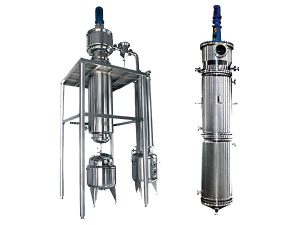
A vacuum deaerator uses reduced pressure to encourage gases to separate from the liquid. Zhongbo describes its deaeration equipment as using vacuum suction to remove non-condensable gases contained in liquid materials. Its vacuum degasser is designed for applications including fruit juice, puree, milk, yogurt, soy beverages, and tea drinks.
The basic operating principle can be summarized as:
Liquid Feed → Vacuum Environment → Liquid Dispersion/Atomization → Gas Release → Gas Removal → Deaerated Product
Inside a vacuum deaeration system, the liquid is exposed to controlled negative pressure. Increasing the liquid’s exposed surface area helps dissolved gases escape more efficiently. Zhongbo’s vacuum degasser uses material atomization under vacuum and temperature control as part of its operating principle.
The objective is not simply to remove visible air bubbles. A properly designed system aims to reduce both entrained air and dissolved oxygen to a level appropriate for the downstream process.
This distinction is important because liquid can appear bubble-free while still containing a considerable amount of dissolved oxygen. For oxygen-sensitive products and high-temperature processing, controlling dissolved oxygen can therefore be more important than simply removing visible foam.

Why Is Dissolved Oxygen Removal Important Before Thermal Treatment?
Oxidation and Product Quality
Dissolved oxygen can participate in oxidation reactions that affect different components of dairy and beverage products.
Depending on the formulation, oxygen exposure may contribute to:
- Flavor and aroma degradation
- Pigment oxidation and color changes
- Vitamin degradation
- Oxidized or stale flavor development
- Changes in nutritional quality
- Reduced overall product stability
These effects can be particularly important for fruit juices, tea beverages, milk, and products containing oxygen-sensitive ingredients.
For UHT milk, research has shown that reducing dissolved oxygen before thermal treatment can reduce oxidation-related changes and undesirable flavor compounds. One study found that flash deoxygenation reduced oxidation indicators and certain compounds associated with oxidized taste in UHT milk.
Therefore, deaeration should not be viewed only as an air-removal operation. It can also function as an oxygen-control step within a broader product-quality strategy.
Deaeration Before UHT Treatment: Reducing Heat Exchanger Fouling
One of the most important industrial reasons for placing deaeration before thermal treatment is its potential role in reducing bubble-related fouling in UHT heat exchangers.
During indirect UHT processing, the product passes through heat-transfer surfaces at very high temperatures. Milk fouling is a major operational challenge because deposits can progressively reduce heat-transfer efficiency, increase pressure drop, and shorten the production run between CIP cycles.
Dissolved gases become less soluble as liquid temperature increases. If the product contains sufficient dissolved air and enters a high-temperature, lower-pressure environment, bubbles can form on or near hot heat-transfer surfaces. These bubbles can contribute to localized drying and deposition, creating conditions that promote fouling. Research has identified dissolved air and bubble formation as important contributors to UHT fouling.
This creates an important process relationship:
Dissolved Air → Bubble Formation During Heating → Bubble-Related Fouling → Reduced Heat-Transfer Performance
Pre-treatment with a deaeration system can help break this chain by reducing the amount of dissolved gas entering the high-temperature section.
Research specifically examining UHT milk has reported that deaeration can reduce fouling, while higher dissolved oxygen levels and lower pressure can increase fouling rates.
However, it is important to understand that deaeration is not a universal solution for all heat exchanger fouling. Fouling in dairy UHT systems also depends on protein denaturation, mineral deposition, temperature history, product composition, flow conditions, pressure, and heat-transfer surface characteristics.
Therefore, the most accurate engineering approach is to regard deaeration as one of several strategies for managing UHT fouling and maintaining stable heat-transfer performance.
Beverage Shelf Life and Flavor Stability
Oxygen control is also closely related to beverage shelf life.
Once oxygen is present in a beverage, oxidation can continue during processing and storage. This can gradually affect flavor, aroma, color, and sensitive components.
For products such as tea and fruit beverages, even relatively small changes in oxidation can affect the sensory profile. Tea beverages, for example, may be particularly sensitive to oxygen because oxidation can influence flavor and color.
A deaeration system can reduce the initial oxygen load before thermal processing, giving manufacturers better control over one of the factors affecting long-term product stability.
The relationship can be summarized as:
Oxygen Control → Lower Oxidation Potential → Better Flavor and Color Stability → Support for Shelf-Life Performance
It is important, however, not to treat deaeration as a guaranteed shelf-life extension by itself. Final shelf life depends on the complete processing and packaging system, including thermal treatment, formulation, filling conditions, package oxygen barrier, storage temperature, and oxygen pickup after deaeration.
Deaeration Applications in Dairy and Beverage Processing
Milk and Dairy Products
Milk is one of the most important applications for industrial deaeration.
During collection, transportation, pumping, storage, and processing, milk can absorb oxygen from the surrounding environment. When the product subsequently enters a high-temperature UHT process, dissolved air can become relevant to both product quality and heat-transfer performance.
A vacuum deaerator can therefore be positioned as part of an integrated dairy processing line to reduce dissolved oxygen before downstream thermal treatment.
Typical dairy applications include:
- Fresh milk
- UHT milk
- Flavored milk
- Yogurt drinks
- Soy beverages
- Other formulated dairy and dairy-alternative products
The exact process configuration should depend on the product formulation, thermal process, production capacity, and required oxygen-removal performance.
For UHT applications, deaeration can be particularly useful because oxygen removal before heating can support product-quality control while also helping address bubble-related fouling in the high-temperature section.
Juice, Tea, and Other Beverages
Beverage processing represents another major application area.
Fruit juices and tea beverages can contain oxygen-sensitive components, including natural pigments, flavors, aromas, and vitamins. Oxygen can also be introduced during blending and liquid transfer.
Vacuum deaeration can therefore be incorporated into beverage processing lines for products such as:
- Fruit juice
- Juice drinks
- Tea beverages
- Soy beverages
- Milk beverages
- Plant-based beverages
- Purees
- Other liquid food products
Zhongbo lists fruit juices, purees, milk, yogurt, soy beverages, and tea drinks among the typical applications of its vacuum degasser.
The appropriate process location depends on the product. For example, a beverage manufacturer may place deaeration before pasteurization or UHT treatment when oxygen control is an important part of the thermal-processing strategy. In other systems, the process engineer may need to evaluate oxygen pickup during blending, pumping, and filling as well.
How to Choose the Right Deaerator Equipment for Food Processing?
Selecting a deaeration system requires more than comparing equipment dimensions or nominal capacity. The equipment needs to match the product, production rate, oxygen-removal target, thermal process, and overall line configuration.
Processing Capacity
The first consideration is production capacity.
The deaerator should be sized according to the actual process flow rather than simply the theoretical maximum output of the entire plant.
Factors to consider include:
- Required hourly production
- Product flow rate
- Batch versus continuous processing
- Peak production demand
- Residence time
- Upstream and downstream equipment capacity
Zhongbo’s current vacuum degasser specification lists a capacity range of 1,000–5,000 L/h.
The ideal capacity should also be coordinated with pumps, heat exchangers, UHT systems, tanks, and filling equipment. An oversized or undersized deaerator can create unnecessary process constraints.
Vacuum and Oxygen Removal Performance
Vacuum performance is another critical factor.
A deaeration system should provide stable and controllable vacuum conditions appropriate to the product and process. However, maximum vacuum level alone does not determine the actual oxygen-removal performance.
The system should also be evaluated according to:
- Product temperature
- Liquid viscosity
- Gas content
- Product flow rate
- Liquid dispersion method
- Residence time
- Required dissolved oxygen level
For sensitive products, manufacturers should establish a target oxygen level based on actual process requirements and verify the result through measurement and commissioning tests.
A good deaerator should therefore be evaluated as a complete process system rather than by looking at one vacuum specification in isolation.
Hygienic Design and CIP
Because deaerators directly handle food and beverage products, sanitary design is essential.
The equipment should be designed to support:
- Hygienic product contact surfaces
- Effective cleaning
- Minimal product retention
- Drainability
- Reliable sealing
- CIP integration
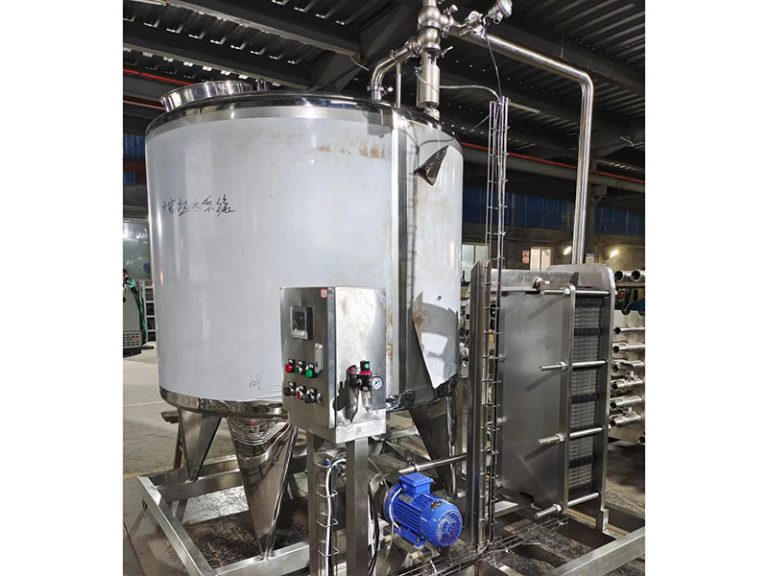
Zhongbo’s vacuum degasser is designed as a sanitary processing unit, and its product information describes a skid-mounted configuration with internal piping, pneumatic valves, vacuum pumps, and CIP spray balls.
CIP compatibility is especially important in dairy and beverage plants because the deaerator is normally part of a larger closed processing circuit. The cleaning system should be able to circulate cleaning solutions through the product-contact areas without requiring frequent manual disassembly.
When evaluating equipment, manufacturers should therefore ask not only “Can this system remove oxygen?”, but also “Can it be cleaned effectively as part of our existing CIP process?”
Integration with UHT Systems (Mixing Tank & Buffer Tank Interconnectivity)
A deaerator should not be treated as an isolated machine.
In a modern dairy or beverage processing plant, the deaerator needs to work together with upstream and downstream equipment to maintain stable flow, pressure, temperature, and product quality.
A typical integrated process may look like:
Mixing/Preparation Tank → Feed Pump → Deaerator → UHT/Heat Treatment → Cooling → Buffer Tank → Filling
The upstream mixing tank prepares and homogenizes the product formulation before deaeration. Stable feed conditions are important because sudden changes in flow, temperature, or product composition can affect deaeration performance.
After deaeration and thermal treatment, a buffer tank can provide controlled product holding and flow management before the filling stage, depending on the aseptic or non-aseptic line configuration.
This interconnectivity is particularly important when designing a complete processing line. Zhongbo’s portfolio includes mixing tanks, stainless steel buffer tanks, pumps, heat exchangers, deaeration equipment, and HTST/UHT treatment systems, allowing these individual process units to be considered as components of a broader production line.
For example, Zhongbo’s tubular pasteurizer configuration includes a balance tank, feed pump, flow-control system, tubular heat exchanger, regeneration/heating/cooling sections, and flow-diversion valves.
This type of integration matters because deaeration performance can be undermined if oxygen is immediately reintroduced by downstream pumps, open tanks, turbulent transfer, or poorly designed piping.
The objective should therefore be:
Stable Mixing → Effective Deaeration → Controlled UHT → Stable Buffering → Hygienic Filling
A well-designed line treats these steps as one connected process rather than a collection of independent machines.
Zhongbo Deaeration Equipment
Zhongbo provides industrial deaeration equipment for dairy, beverage, and liquid food processing. Its Deaeration Equipment portfolio currently includes a vacuum degasser designed to remove air and oxygen from liquid products.
The listed capacity is 1,000–5,000 L/h, making the system suitable for a range of small- to medium-scale industrial processing requirements. The equipment is designed around vacuum gas removal and is intended to address oxygen-related oxidation, gas-related processing problems, and foaming.
The vacuum degasser uses a combination of vacuum negative pressure, material atomization, and temperature control. According to Zhongbo’s product information, liquid is introduced into the vacuum chamber and dispersed through a specialized nozzle to increase the liquid-gas interface and facilitate gas release.
Typical applications include:
- Milk and dairy beverages
- Fruit juice
- Purees
- Tea beverages
- Soy beverages
- Other liquid food products
The equipment can also be considered as part of a broader processing solution. Zhongbo states that it provides integrated food-processing equipment and customized production-line planning, with consideration given to production capacity, energy consumption, cleaning requirements, and investment.
For manufacturers planning a new dairy or beverage line, this approach can be useful because deaeration performance depends heavily on how the unit interacts with upstream mixing, pumping, downstream UHT treatment, heat exchange, buffer storage, and filling.

FAQs
What is a deaeration system?
A deaeration system is processing equipment used to remove dissolved gases and entrained air from liquid products. In dairy and beverage processing, vacuum deaeration is commonly used to reduce dissolved oxygen and other non-condensable gases before downstream processing.
Why remove dissolved oxygen from milk before UHT?
Dissolved oxygen can contribute to oxidation and undesirable flavor changes during UHT processing and storage. It can also contribute to bubble formation under high-temperature processing conditions, which is associated with fouling in UHT heat exchangers. Deaeration before heating can therefore support both product-quality control and process stability. (科学直接)
Does deaeration reduce UHT heat exchanger fouling?
It can help reduce bubble-related fouling, particularly when dissolved air contributes to bubble formation on hot heat-transfer surfaces. However, UHT fouling is a complex phenomenon also influenced by proteins, minerals, temperature, pressure, flow conditions, and product formulation. Deaeration should therefore be considered one part of an overall fouling-control strategy.
Can deaeration improve beverage shelf life?
Deaeration can reduce the initial oxygen load and therefore help limit oxidation of oxygen-sensitive components. This can support flavor, color, and quality stability. However, final shelf life also depends on thermal treatment, formulation, packaging, filling, storage conditions, and oxygen pickup after deaeration.
What products can be processed with a vacuum deaerator?
Vacuum deaeration can be applied to a range of liquid food and beverage products, including milk, yogurt beverages, fruit juice, purees, tea drinks, and soy beverages. The appropriate configuration depends on viscosity, solids content, temperature, flow rate, and oxygen-removal requirements.
Where should a deaerator be installed in a dairy or beverage line?
There is no universal position for every product. In many applications, deaeration is positioned before thermal treatment so that dissolved oxygen is reduced before the product enters the high-temperature section. The final configuration should be determined by the product, thermal process, pumping conditions, and the complete line layout.
How do I choose the capacity of a deaeration system?
Start with the required product flow rate and then consider the capacities of upstream and downstream equipment. For example, Zhongbo’s current vacuum degasser range is listed at 1,000–5,000 L/h. A process engineer should also evaluate product characteristics and the required residence time and oxygen-removal performance.
Conclusion
Dissolved oxygen control is an important consideration in modern dairy and beverage processing. While oxygen may seem like a relatively small process variable, it can influence oxidation, flavor, color, nutrient stability, foaming, and high-temperature processing performance.
For UHT applications, the role of deaeration goes beyond product quality. Dissolved air can contribute to bubble formation at hot heat-transfer surfaces, and research indicates that reducing dissolved air can help mitigate this type of fouling.
A properly selected deaeration system for dairy and beverage processing can therefore support three key objectives:
Oxygen control → Product quality → Thermal-process stability
The best system, however, is not necessarily the one with the highest vacuum or largest capacity. Equipment selection should consider processing capacity, product characteristics, vacuum and oxygen-removal performance, sanitary design, CIP requirements, and integration with the complete processing line.
For plants using mixing tanks, UHT systems, heat exchangers, pumps, buffer tanks, and filling equipment, the deaerator should be designed as part of the overall process architecture.
To explore Zhongbo’s deaeration solutions and discuss a configuration for your dairy or beverage line, visit the official Zhongbo Deaeration Equipment page.