



Introduction
Cavitation is the single most common reason a sanitary centrifugal pump underperforms in a hot UHT line. It happens when the pressure at the pump inlet drops below the vapour pressure of the liquid, and the resulting bubbles collapse against the impeller. The damage is noisy, expensive, and usually avoidable—if the available net positive suction head (NPSHa) stays above the required NPSH (NPSHr) by a healthy margin. This guide walks through how to calculate both numbers for hot milk, juice, and plant-based beverage lines.
What NPSH Means
NPSH is the total suction head above the liquid’s vapour pressure, expressed in metres of fluid column. Two values matter:
- NPSHa — the head available from the installation (tank, pipe, static lift, pressure).
- NPSHr — the minimum head the pump needs at a given flow rate to avoid cavitation.
For a pump to run quietly and durably, NPSHa must exceed NPSHr by a margin, typically 0.5–1.5 m for sanitary pumps, more for hot or viscous products.
The NPSHa Formula
NPSHa = (Ps / ρg) + Hs − Hf − (Pv / ρg)
Where:
- Ps = absolute pressure at the liquid surface in the supply tank (Pa).
- ρg = specific weight of the liquid (N/m³).
- Hs = static head from liquid surface to pump centreline (m); positive if the liquid is above the pump.
- Hf = friction and fitting losses in the suction line (m).
- Pv = vapour pressure of the liquid at pumping temperature (Pa).
NPSHr from the Pump Curve
Every centrifugal pump publishes an NPSHr curve that rises with flow. At the best efficiency point (BEP) the NPSHr is lowest; at higher or lower flows it increases. The critical point is not the design flow but the expected maximum flow—if the pump runs at a higher rate during CIP or peak production, NPSHr climbs and cavitation can start at the worst possible moment.
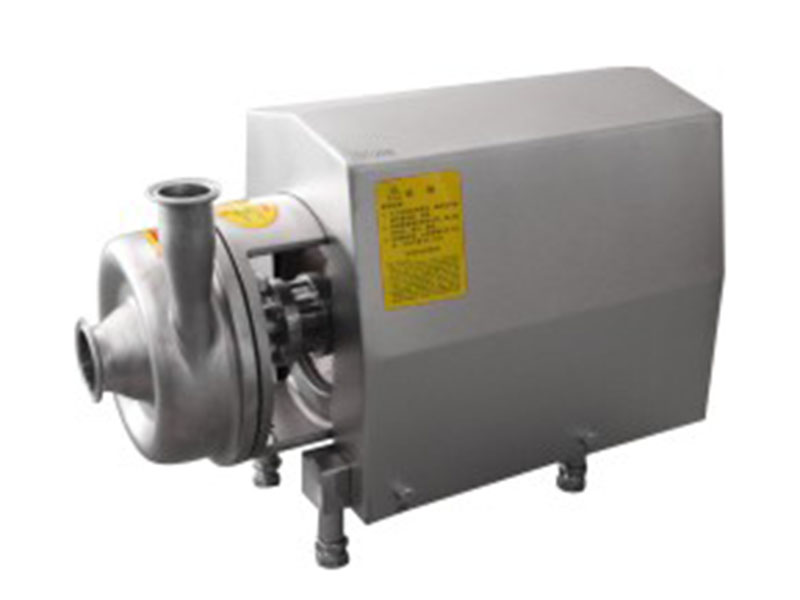
Why Hot UHT Lines Are Especially Risky
Hot products shrink NPSHa in two ways. First, vapour pressure rises sharply with temperature. Milk at 85 °C has a vapour pressure of roughly 60 kPa absolute, while at 60 °C it is only 20 kPa. That 40 kPa difference alone cuts NPSHa by about 4 m. Second, hot liquids are more prone to flashing in the pump eye because any local pressure drop brings the fluid closer to boiling. The result: a pump that is perfectly happy with cold water cavitates immediately when fed from a hot balance tank.
Worked Example: NPSHa in a Hot Milk Line
Scenario: a balance tank at 3 m above pump centreline supplies 85 °C milk to a centrifugal pump. Tank is open to atmosphere. Suction line losses are 0.8 m. Vapour pressure of milk at 85 °C ≈ 58 kPa absolute. Milk density ≈ 1,020 kg/m³.
NPSHa = (101.3 kPa / (9.81 × 1.02)) + 3.0 − 0.8 − (58 kPa / (9.81 × 1.02))
NPSHa ≈ 10.1 + 3.0 − 0.8 − 5.8 = 6.5 m
If the pump’s NPSHr at operating flow is 4.5 m, the margin is only 2.0 m. That is acceptable for clean water-like milk but tight for viscous or aerated product. Add entrained air or a partially clogged strainer and cavitation starts.
Margin and Safety Factor
| Product condition | Recommended NPSHa − NPSHr margin |
|---|---|
| Cold water-like fluid | ≥ 0.5 m |
| Hot milk or juice | ≥ 1.0 m |
| Viscous or particulate | ≥ 1.5 m |
| High suction lift or long suction | ≥ 2.0 m |
Design Choices That Protect NPSHa
- Keep the pump low. Even 1 m of extra static head buys significant margin.
- Short, straight suction. Every elbow, reducer, and valve adds loss; keep the suction line one size larger than the pump inlet if possible.
- Limit temperature. If you can feed the pump from a slightly cooler balance tank, vapour pressure drops dramatically.
- Use a low-NPSHr impeller. Some sanitary centrifugal pumps offer inducers or larger eye diameters for low NPSH applications.
- Avoid suction throttling. Control flow on the discharge side, never the suction.
Signs of Cavitation
Cavitation sounds like gravel passing through the pump. Other signs: fluctuating discharge pressure, reduced flow, pitting on the impeller suction side, increased vibration, and unexplained seal failure. If you hear it, stop the pump and recalculate NPSHa before the impeller is destroyed.
Common Mistakes
- Using cold-water vapour pressure. This overstates NPSHa by several metres on hot lines.
- Ignoring CIP flow. The highest flow rate, not the normal rate, sets the NPSHr demand.
- Undersized suction pipe. A reducer right at the pump inlet creates a sharp pressure drop.
- Running near closed discharge. Low flow can recirculate hot fluid and raise vapour pressure.
FAQ
What is a safe NPSH margin for hot milk?
At least 1.0 m above the pump’s NPSHr at the maximum expected flow, 1.5 m if the product is viscous or aerated.
Can I reduce NPSHr?
Yes—by selecting a pump with a lower NPSHr curve, adding an inducer, or increasing impeller eye diameter. You can also raise NPSHa by lowering the pump or pressurizing the feed tank.
Does a self-priming pump help?
A self-priming pump solves air-purge problems but does not eliminate the NPSH requirement; it still needs adequate NPSHa once primed.
Should I put the control valve on suction or discharge?
Always on the discharge. A suction valve creates variable losses and can push the pump into cavitation.
How does altitude affect NPSHa?
Atmospheric pressure falls with altitude, so the Ps term decreases. At 1,000 m elevation, atmospheric pressure is roughly 10 % lower, cutting NPSHa by about 1 m.
Conclusion
Cavitation in a hot UHT line is almost always a suction-side problem. Calculate NPSHa with the real vapour pressure at product temperature, add a margin suited to the fluid, and choose a centrifugal pump whose NPSHr curve stays comfortably below it at maximum flow. Get the suction line right—short, straight, and slightly oversized—and the pump will run quietly for years. Get it wrong and you will chase seal failures and impeller damage that no discharge valve can fix.