Introduction
Water is more than a utility in a food and beverage plant. It can be a direct ingredient, a cleaning medium, a boiler feed source, or an essential part of heating and cooling processes. Because of this, inconsistent water quality can affect product consistency, equipment performance, energy consumption, and sanitation.
A properly designed process water treatment system for food and beverage plants typically combines several treatment stages rather than relying on a single technology. Depending on the raw-water characteristics and end use, the process may include multimedia filtration, activated carbon treatment, precision filtration, softening, and reverse osmosis (RO).
Zhongbo’s current water-treatment process is structured around raw-water storage, pumping, multi-media filtration, activated carbon filtration, precision filtration, high-pressure pumping, and RO, followed by purified-water storage and distribution.
The key to selecting the right system is understanding what quality of water is required at each point of use. Water used as a beverage ingredient may require a different treatment strategy from boiler feed water or CIP rinse water.
This guide explains the main water treatment methods for food and beverage production, how filtration, softening, and RO work together, and how to select a suitable system for your plant.
Why Is Process Water Treatment Important in Food and Beverage Plants?
Raw water can contain suspended solids, organic compounds, chlorine, hardness minerals, dissolved salts, microorganisms, and other contaminants. If these components are not adequately controlled, they can affect both the product and the processing equipment.
For example, hardness can contribute to scale formation on heat-transfer surfaces and inside pipelines. Scale can reduce heat-transfer efficiency, increase cleaning requirements, and interfere with equipment operation.
Zhongbo specifically identifies equipment protection as one benefit of water treatment, noting that controlling scale can help maintain heat-transfer efficiency in UHT and sterilization equipment. Its product information also links RO-treated water with reduced acid-cleaning requirements.
Water quality can also directly influence beverage formulation. When water is used to reconstitute milk or formulate beverages, excessive minerals in the source water can affect the consistency of the final product. Zhongbo notes that RO water can reduce mineral interference and help maintain consistent beverage flavor.
A suitable beverage plant water filtration system therefore helps address several objectives:
- Reduce suspended particles and turbidity
- Control organic matter and residual chlorine
- Reduce hardness and dissolved salts
- Protect downstream RO membranes
- Protect heat exchangers and pipelines from scaling
- Improve consistency of process water
- Provide suitable water for specific plant utilities
The treatment system should always be designed around the actual raw-water analysis and intended application.
Key Process Water Treatment Methods
Water Filtration
Filtration is generally one of the first stages in an industrial water-treatment system.
Its purpose is to remove suspended particles and other contaminants before the water reaches more sensitive treatment equipment.
A typical pre-treatment sequence may include:
Raw Water → Multi-Media Filter → Activated Carbon Filter → Precision Filter → RO
Zhongbo’s published process follows this general configuration.
Multi-Media Filtration
Multi-media filtration commonly uses materials such as quartz sand to physically capture suspended solids.
It can help reduce:
- Sand and silt
- Rust
- Suspended particles
- Colloids
- Turbidity
- Some particulate organic matter
Zhongbo’s quartz sand filtration system is designed as a mechanical barrier for suspended impurities and is positioned as a pre-treatment stage for downstream systems such as RO.
Activated Carbon Filtration
Activated carbon provides a different treatment mechanism. Instead of primarily relying on mechanical filtration, it uses adsorption to remove or reduce certain dissolved organic compounds and residual chlorine.
This is particularly important before RO because excessive free chlorine can damage many RO membranes.
Zhongbo states that its activated carbon system is designed to reduce residual chlorine to ≤0.1 ppm and to address odors, organic matter, and chemical color.
Precision Filtration
Precision filtration is normally used as a downstream polishing or protection stage.
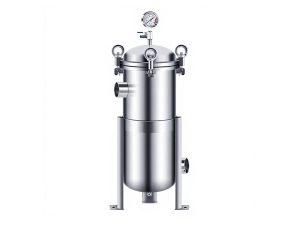
Zhongbo’s precision filters use stainless-steel housings with different cartridge-filter options, allowing the filter element to be selected according to the required effluent quality and process design.
The role of precision filtration is particularly important before high-pressure pumps and RO membranes, where remaining particles could contribute to fouling or operational problems.

Water Softening
Water softening focuses primarily on reducing hardness ions, particularly calcium and magnesium.
Hard water can create scale when heated, making hardness control especially important for food and beverage plants using:
- Boilers
- Heat exchangers
- Hot-water systems
- Pasteurizers
- UHT equipment
- Cleaning systems
However, softening and RO are not interchangeable.
A conventional softener primarily addresses hardness, while RO provides much broader dissolved-solids reduction.
Therefore, the correct choice depends on the required water quality.
For a utility application where hardness control is the primary objective, softening may be sufficient. For beverage formulation or applications requiring low conductivity and low dissolved solids, RO may be more appropriate.
Reverse Osmosis (RO)
Reverse osmosis is a membrane-based purification process that uses pressure to force water through a semi-permeable membrane while rejecting a large proportion of dissolved contaminants.
An RO system for food processing can be used when the plant requires substantially lower dissolved-solids content than conventional filtration or softening can provide.
Zhongbo describes its Reverse Osmosis Purification System as using multi-stage filtration and RO technology to remove suspended solids, organic matter, residual chlorine, bacteria, and most dissolved salts. The treated water is then stored in a purified-water tank before being distributed to points of use.
RO can therefore provide several functions:
- Desalination
- Reduction of dissolved salts
- Reduction of hardness
- Reduction of certain organic contaminants
- Production of purified process water
- Protection of downstream equipment from mineral-related scaling
A typical system can be represented as:
Raw Water → Pre-Treatment → Precision Filtration → High-Pressure Pump → RO Membrane → Pure Water Tank → Water Points
Pre-treatment is critical because RO membranes should not be expected to handle the entire raw-water contaminant load by themselves.
Zhongbo’s system specifically places multi-media filtration, activated carbon, and precision filtration before the RO unit.
Boiler Feed Water Treatment
Boiler systems require controlled feed-water quality because hardness and dissolved minerals can cause scale and reduce thermal efficiency.
For a food or beverage plant, boiler feed water treatment may involve combinations of:
- Filtration
- Softening
- RO
- Additional polishing, depending on boiler requirements
The exact configuration should be based on boiler pressure, feed-water chemistry, condensate return, steam-use requirements, and the applicable boiler-water specification.
RO can be particularly useful where a low-mineral feed-water source is required. Zhongbo lists boiler make-up water among potential applications for its RO-treated water.
The objective is not simply to produce “pure water,” but to provide feed water that minimizes scaling, corrosion, and other boiler operating problems.
Water Treatment Requirements for Food and Beverage Production
Water Quality for Beverage Production
When water becomes part of the finished beverage, its quality can directly affect product composition and sensory characteristics.
For example, water used for:
- Reconstituted milk
- Juice beverages
- Tea drinks
- Syrups
- Plant-based beverages
- Ingredient preparation
may require tighter control of minerals, suspended solids, chlorine, and other contaminants than general utility water.
RO-treated water can provide a more consistent mineral profile and help reduce variability caused by changes in the source-water composition.
However, RO is not automatically required for every beverage. The correct treatment level depends on the formulation, source-water quality, product specifications, and local regulatory requirements.
The important principle is:
Treat the water to the quality required by the application—not simply to the maximum possible purity.
CIP Water Quality
CIP, or Cleaning-in-Place, uses water together with cleaning chemicals and controlled temperature and flow to clean processing equipment without dismantling the system.
Water quality can affect CIP efficiency.
Hardness minerals can contribute to scale and deposits, while poor-quality rinse water can leave unwanted residues or introduce contaminants into cleaned equipment.
Zhongbo specifically notes that RO water can reduce the frequency and consumption of acid cleaning by helping control scale formation.
However, the required quality of CIP water depends on its specific use.
For example:
- Initial rinse water
- Caustic preparation water
- Acid solution preparation
- Final rinse water
may have different quality requirements.
The water-treatment system should therefore be designed together with the plant’s CIP strategy rather than treating CIP water as a single generic category.
Boiler and Utility Water
Not all water in a beverage plant becomes part of the product.
Utility water may be used for:
- Boiler feed
- Hot-water generation
- Cooling
- Equipment cleaning
- General plant services
These applications can have very different water-quality requirements.
For example, boiler feed water needs careful control of hardness and dissolved minerals, while cooling-water requirements may depend on the cooling system design.
Separating water quality by point of use can prevent unnecessary treatment. A plant does not necessarily need to send every litre of utility water through the same high-purity RO system.
A well-designed plant may therefore use different treatment streams for:
Ingredient Water | CIP Water | Boiler Feed Water | General Utility Water
This approach can reduce operating costs while maintaining the required quality at each point of use.
How to Choose a Water Treatment System for a Beverage Plant?
Water Source and Quality
The first step is always to analyze the raw-water source.
Possible sources include:
- Municipal water
- Well water
- Surface water
- Process-recovered water
A proper water analysis should identify parameters such as:
- Turbidity
- pH
- Hardness
- Conductivity
- TDS
- Chlorine
- Iron and manganese
- Organic matter
- Microbiological indicators
The treatment system should then be designed around these actual values.
Without a raw-water analysis, selecting filtration media, softening capacity, or RO membrane configuration becomes largely speculative.
Required Capacity
Capacity is another fundamental selection parameter.
The water-treatment system should be sized according to:
- Daily water consumption
- Peak hourly demand
- Beverage production capacity
- CIP requirements
- Boiler demand
- Cleaning and backwash requirements
- Water storage capacity
For example, a plant may have a moderate average water demand but significantly higher short-term demand during CIP or simultaneous production and utility operation.
The system therefore needs enough capacity to maintain stable supply during peak demand rather than simply matching average consumption.
Multi-Media Filtration and RO System Configuration
For many food and beverage applications, the most effective approach is a multi-stage water-treatment system.
A typical configuration is:
Raw Water Tank
↓
Raw Water Pump
↓
Multi-Media / Quartz Sand Filter
↓
Activated Carbon Filter
↓
Precision Filter
↓
High-Pressure Pump
↓
RO System
↓
Purified Water Tank
↓
Distribution Points
This configuration follows Zhongbo’s published industrial water-treatment process.
Each stage has a different role.
| Treatment Stage | Main Function |
| Multi-media filter | Suspended solids and turbidity reduction |
| Activated carbon filter | Chlorine, odor, and organic-compound reduction |
| Precision filter | Fine-particle removal and RO protection |
| RO system | Dissolved-salt and contaminant reduction |
| Purified-water tank | Treated-water storage and supply stabilization |
This staged approach is generally more reliable than asking one treatment technology to solve every water-quality problem.
It also helps protect the RO membrane, which is one of the more sensitive and expensive components in the treatment train.
CIP and Maintenance Requirements
A water-treatment system should be designed for continuous operation and practical maintenance.
Important considerations include:
- Filter replacement intervals
- Backwashing requirements
- Activated-carbon replacement
- RO membrane cleaning
- Pressure monitoring
- Flow monitoring
- Conductivity monitoring
- Chemical dosing
- Spare-parts availability
Automation can significantly simplify system operation.
Zhongbo states that its broader processing systems can incorporate PLC control, Siemens touch screens, Schneider electrical components, and process measurement/control equipment.
For a commercial food and beverage plant, automated monitoring can help operators identify pressure increases, flow reductions, or changes in treated-water quality before they become major production problems.
Zhongbo Water Treatment Equipment
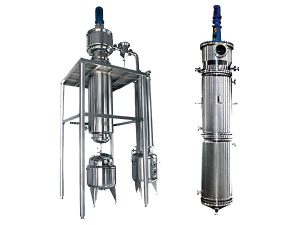
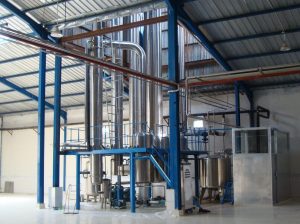
Zhongbo provides Water Treatment Equipment for industrial water purification and food and beverage processing applications.
Its current product range includes:
- Precision Filters
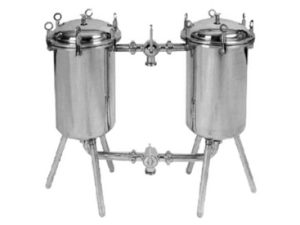
- Duplex Filters
- Reverse Osmosis Purification Systems
- Sand & Activated Carbon Filtration Systems
The published water-treatment process combines these technologies into a multi-stage system, beginning with raw-water filtration and continuing through activated carbon treatment, precision filtration, high-pressure pumping, and RO purification.
The Reverse Osmosis Purification System is designed to reduce dissolved salts and other contaminants, while the sand and activated-carbon filtration systems provide upstream protection for RO membranes.
Zhongbo also identifies several relevant applications for RO-treated water, including:
- Dairy plant boiler make-up water
- CIP final rinse water
- Beverage formulation
- Process water
- Water reuse applications
The company states that its water-treatment equipment can be configured according to water quality, processing capacity, filtration requirements, and application standards.
This customization is important because there is no universal food and beverage water treatment system suitable for every plant. Raw-water chemistry, production capacity, end-use requirements, and utility configuration all influence the final design.
Conclusion
A reliable water-treatment system is an important part of modern food and beverage plant infrastructure. The objective is not simply to produce purified water, but to provide the right water quality for each application while protecting equipment and maintaining stable production.
Filtration removes suspended contaminants and protects downstream equipment. Softening controls hardness where scale prevention is the primary concern. RO provides deeper reduction of dissolved salts and other contaminants when higher-purity water is required.
For many beverage plants, a multi-stage configuration such as:
Multi-Media Filtration → Activated Carbon → Precision Filtration → RO
provides a practical foundation for producing consistent process water. Zhongbo’s published system follows this general configuration. The best system should ultimately be selected according to raw-water quality, required capacity, application-specific water standards, CIP requirements, boiler requirements, and maintenance strategy.
For manufacturers looking to build or upgrade a process water treatment system for food and beverage production, Zhongbo’s Water Treatment Equipment portfolio provides filtration, precision filtration, and RO-based solutions that can be configured around different industrial water-treatment requirements.
FAQs
- What is process water treatment in a food and beverage plant?
Process water treatment is the controlled treatment of raw water to achieve the quality required for beverage formulation, equipment operation, CIP, boiler feed, and other plant applications.
- What is the difference between filtration, softening, and RO?
Filtration primarily removes suspended particles and certain contaminants. Softening mainly reduces hardness ions such as calcium and magnesium. RO uses a semi-permeable membrane to reduce dissolved salts and a broad range of other contaminants.
- Is RO water necessary for beverage production?
Not necessarily. The required treatment level depends on the raw-water quality, beverage formulation, product specifications, and applicable regulations. RO is appropriate when lower dissolved-solids content or tighter control of mineral composition is required.
- What is a multi-media filter used for?
A multi-media filter, such as a quartz sand filter, is primarily used to reduce suspended solids, turbidity, and particulate contaminants before downstream treatment. Zhongbo positions its quartz sand system as a pre-treatment stage for sensitive equipment such as RO systems.
- Why is activated carbon used before RO?
Activated carbon can reduce residual chlorine and certain organic compounds. This is important because free chlorine can damage many types of RO membranes. Zhongbo’s published activated-carbon system is designed to reduce residual chlorine to ≤0.1 ppm.
- Can RO water be used for CIP?
RO water can be used for selected CIP applications, particularly where lower mineral content is beneficial. Zhongbo lists CIP final rinse water among potential applications for its RO-treated water.
- Why does water treatment matter for UHT equipment?
Poorly controlled hardness and dissolved minerals can contribute to scale formation on heat-transfer surfaces. This can reduce heat-transfer efficiency and increase cleaning requirements. Proper water treatment can help protect UHT and sterilization equipment from mineral-related scaling.
- How do I choose the capacity of a beverage plant water-treatment system?
Consider average and peak water demand, beverage production capacity, CIP consumption, boiler requirements, backwashing, and storage capacity. The system should be sized for peak operating conditions rather than average consumption alone.
- What information is needed to design a water-treatment system?
A raw-water analysis is the starting point. Important information includes water source, flow rate, turbidity, hardness, TDS, conductivity, chlorine, pH, organic matter, microbiological quality, and the required quality at each point of use.
- Can a water-treatment system be customized for a food and beverage plant?
Yes. Treatment stages, filtration media, RO configuration, capacity, storage, instrumentation, and control systems can be configured according to the plant’s raw-water characteristics and application requirements. Zhongbo states that its water-treatment equipment can be selected according to water quality, processing capacity, filtration requirements, and application standards.