

Introduxtion
Every year, global dairy brands face intensifying regulatory and consumer pressure to embrace the “Clean Label” movement. Modern B2B milk processors are aggressively phasing out synthetic antimicrobials, sorbates, and artificial shelf-life extenders. Yet, the core commercial challenge remains: How do you maintain structural milk stability and guarantee biological food safety across global distribution chains without chemical preservatives?
The solution lies deep within processing thermodynamics. By deploying highly engineered High-Temperature Short-Time (HTST) pasteurization and Ultra-High Temperature (UHT) sterilization loops, dairy plants can achieve commercial sterility and eliminate pathogens mechanically. Here is an engineering-focused breakdown of how precise thermal fluid processing by Zhongbo Machinery renders chemical preservatives obsolete.
The Bio-Chemical Challenge: Why Does Milk Spoil?
Raw milk is a highly complex, nutrient-dense fluid emulsion consisting of lipids, proteins (caseins and whey), lactose, and water. Because of its neutral pH ($6.5 – 6.7$) and high water activity, it is a perfect substrate for microbial proliferation.
Milk spoilage is driven by two main vectors:
- Pathogenic Colonization: Organisms like Salmonella enterica, Listeria monocytogenes, Escherichia coli, and the highly heat-resistant Coxiella burnetii pose severe food safety risks.
- Enzymatic and Spore Degradation: Bacterial endospores (e.g., Bacillus cereus and Geobacillus stearothermophilus) synthesize heat-stable lipases and proteases that hydrolyze dairy fats and proteins, causing bitter off-flavors, gelation, and structural destabilization even under refrigeration.
To deactivate these vectors without adding chemical inhibitors like sodium benzoate or potassium sorbate, food engineers must deploy precise heat load regimes that target the thermal death kinetics ($D$-value and $z$-value) of specific target pathogens.
HTST Pasteurization: Extending Refrigerated Shelf Life via Continuous Flow
For fresh, liquid fluid milk operations where maintaining the native sensory profile, natural color, and fragile vitamin matrices is paramount, HTST Pasteurization is the industry standard. The process relies on continuous-flow dairy processing equipment layouts.
The Thermal Profile of HTST
HTST continuous pasteurization heats every single milk particle to a minimum of 72°C (161°F) and holds it for exactly 15 seconds before driving a rapid, sub-second chilling phase down to ≤4°C.
How It Eliminates Preservatives:
This rapid heat spike is statistically lethal to all non-spore-forming vegetative pathogens. It disrupts cell membrane permeability and denatures microbial structural proteins. Because the residence time in the holding tube is restricted to 15 seconds, the chemical Maillard reaction (sugar-protein browning) is arrested, and vital nutrients are preserved. This engineering loop extends fresh milk shelf life to 14–21 days under strict cold-chain infrastructure—requiring zero chemical additives.

UHT Sterilization: The Foundation of Ambient, Preservative-Free Long-Life Milk
When dairy distribution networks span long distances or operate in tropical zones with broken or non-existent cold chains, HTST is insufficient. The process must eliminate not just vegetative cells, but highly resilient, dormant bacterial endospores. This is accomplished via UHT Treatment.
The Thermal Profile of UHT
An industrial UHT sterilization system subjects the fluid stream to ultra-high temperatures ranging from 135°C to 140°C (275°F to 284°F) for an ultra-short holding window of 2 to 5 seconds.
How It Eliminates Preservatives:
Bacterial spores possess a dense, protective cortex that shrugs off low-temperature processing. However, the extreme kinetic energy of 140°C steam heat cracks open the spore coat, denaturing its internal core DNA and core enzymes almost instantaneously.
Because the exposure is limited to less than 5 seconds, the heat load achieves what food scientists call Commercial Sterility. When paired with downstream aseptic packaging machines, this milk can be stored at ambient room temperatures for 3 to 6 months without a single drop of chemical preservatives.
| Parameter / Attribute | HTST Pasteurization | UHT Sterilization |
|---|---|---|
| Operating Temperature | 72°C – 75°C | 135°C – 140°C |
| Holding Tube Time | 15 seconds | 2 – 5 seconds |
| Microbial Target | Vegetative Pathogens (Salmonella, E. coli) | Vegetative Cells + Bacterial Endospores |
| Preservative Requirement | 0% (Requires Cold Chain) | 0% (Ambient Temperature Stable) |
| Typical Shelf Life | 14 – 21 Days (Refrigerated) | 3 – 6 Months (Shelf-Stable) |
The Engineering Safeguards: Why Precision Systems Matter
You cannot achieve preservative-free commercial stability with subpar hardware. If the temperature fluctuates by even 0.5°C below the set point, or if the fluid flow accelerates inside the holding loop, under-processed milk will pass through, resulting in catastrophic batch spoilage.
Zhongbo Machinery ensures absolute process security through three mechanical barriers:
- Automated Flow Diversion Devices (FDD): Our systems utilize high-precision PID monitoring loops. If sensors detect a temperature drop at the exit of the holding tube, the pneumatic FDD automatically reroutes the sub-standard milk back to the balance tank instantly, preventing downstream contamination.
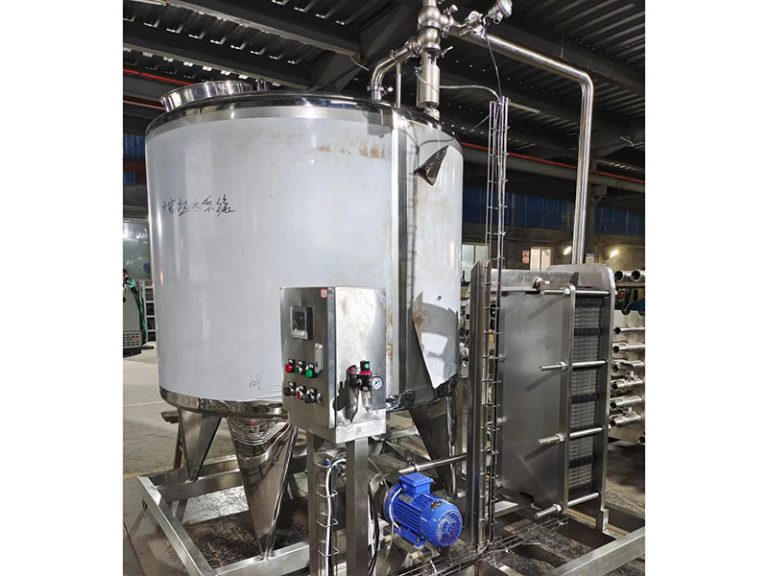
- 95% High-Efficiency Thermal Regeneration: In our advanced plate heat exchanger matrix, outgoing hot pasteurized milk runs counter-current to incoming cold raw milk. This recovers up to 94-95% of thermal energy, significantly lowering steam production utility costs while stabilizing the plant’s heat signature.
- Sanitary Anti-Fouling Design: Milk proteins denature at high temperatures, creating a sticky, insulating layer known as Type A fouling. Zhongbo plates are engineered with deep-etched, high-turbulence herringbone corrugations that maintain high Reynolds numbers, delaying protein scaling and extending uninterrupted processing run-times.
FAQ
Q1: How do HTST and UHT systems eliminate the need for chemical preservatives in milk?
A: They use thermodynamic heat load instead of chemicals. HTST destroys all harmful vegetative pathogens, while UHT delivers extreme thermal energy that destroys even dormant bacterial spores, achieving absolute commercial sterility mechanically.
Q2: Does UHT milk require refrigeration before opening if it has no preservatives?
A: No. Because UHT processing destroys all living microorganisms and spores, and the system fills the product into hermetically sealed aseptic containers, the milk remains completely shelf-stable at room temperature for 3 to 6 months.
Q3: What happens if the pasteurizing temperature drops below the legal threshold during continuous flow?
A: An automated Flow Diversion Device (FDD) configured by Zhongbo instantly triggers. It diverts the under-heated milk back to the start balance tank, ensuring that sub-sterilized product never advances to the packaging line.
Q4: How does Zhongbo handle milk protein fouling during high-temperature UHT processing?
A: We utilize high-turbulence plate heat exchangers or specialized corrugated tubular matrices. The calculated fluid velocity creates intense turbulence, minimizing thermal boundaries and reducing protein-rich (Type A) scaling on the stainless steel walls.
Q5: Can the same thermal processing line be used for both plant-based milks and dairy milk?
A: Yes, provided the system is paired with a fully optimized, multi-phase Clean-in-Place (CIP) cleaning cycle. Plant-based milks (oat, almond) have different viscosity metrics, requiring customizable VFD speed controls on the feed pump.
Q6: What is the purpose of regenerative heating sections in modern pasteurizers?
A: Regenerative sections allow outgoing hot, sterile milk to preheat incoming cold, raw milk. This counter-current heat transfer loop recovers up to 95% of thermal energy, drastically cutting boiler steam and water costs.
Q7: Does UHT treatment destroy the nutritional value of milk?
A: Because the holding window is incredibly short (2–5 seconds), the thermal shock selectively targets microbial structures while minimizing chemical browning and vitamin degradation, preserving the core macronutrients.
Q8: What is commercial sterility versus absolute sterility?
A: Commercial sterility means that all pathogenic and spoilage microorganisms capable of growing under normal ambient storage conditions have been totally deactivated, ensuring absolute market safety without over-cooking the product.
Q9: Why are positive displacement pumps used instead of standard centrifugal pumps in holding loops?
A: Positive displacement pumps (like rotary lobe pumps) deliver a precise, constant volumetric flow rate. This prevents fluid slippage, ensuring that every drop of milk spends the exact required legal time inside the holding tube.
Q10: Are Zhongbo pasteurization systems compatible with existing automated CIP skids?
A: Yes. All of our engineering skids are built with mirror-polished sanitary stainless steel ($Ra \le 0.4\,\mu\text{m}$) and are fully pre-programmed to interface seamlessly with automated centralized CIP systems for comprehensive chemical washing.
Related Resources & Engineering Guides
- HTST vs. UHT Pasteurization for Dairy Lines: Process Selection & CIP Design
- Engineering Guide: Continuous Tunnel Spray Sterilizers for Post-Packaging Pasteurization
- Upcoming Technical Guide: Evaluating Thermal Efficiency: Plate vs. Tubular Heat Exchangers in Low-Acid Beverage Processing
Upgrade to a Preservative-Free, Premium Dairy Process Line
Are you planning to transition your processing line to clean-label, preservative-free production? Or do you need accurate thermal calculation models for an upcoming facility scale-up?