Introduction
In the industrial processing sectors—spanning food, beverage, pharmaceuticals, chemicals, and environmental wastewater management—thermal concentration is an essential operational stage. However, procurement managers and chemical plant engineers frequently face a critical dilemma: selecting the exact thermal separation architecture that aligns with their specific fluid dynamics.
Choosing the wrong evaporator design can be an incredibly costly mistake. An incorrect setup can lead to catastrophic pipe scaling, burned or ruined product quality, low energy efficiency, and frequent emergency shutdowns for maintenance.
The core engineering rule of thumb is simple: the physical characteristics of your feed fluid—specifically its dynamic viscosity, heat sensitivity, and scaling potential—must dictate your hardware configuration. As a global engineering pioneer, Zhejiang Zhongbo (Zhongbo) designs and builds the entire spectrum of heavy-duty, high-performance Evaporation and Concentration plants. Our specialized systems are tailored to handle diverse and challenging industrial processing workloads smoothly and efficiently.

The Golden Matrix: Falling Film vs. Forced Circulation vs. Scrape Film
To help engineering teams map out their processing options, the selection matrix below outlines the precise operating parameters and ideal application boundaries for each major evaporator type:
| Operational Metric | Falling Film Evaporator | Scrape Film (Wiped Film) Evaporator | Forced Circulation Evaporator |
| Optimal Viscosity Range | Low to Medium ($\le 100 \text{ cP}$) | Extremely High ($\le 100,000+ \text{ cP}$) | Medium to High ($\le 2,000 \text{ cP}$) |
| Fouling & Scaling Resistance | Low (Prone to crusting) | Medium to High (Mechanically cleared) | Exceptional (High-velocity suppression) |
| Thermal Retention Time | Ultra-Short (A few seconds) | Short (Controlled thin film) | Long (Continuous loop recirculation) |
| Primary Industrial Application | Food, juices, dairy, and high-volume solvent recovery. | Highly concentrated tars, botanical extracts, polymers, and food pastes. | Wastewater crystallization, salts recovery, and highly fouling slurries. |
Deep-Dive 1: The Falling Film Evaporator – Champion of Low Viscosity & Heat Sensitivity
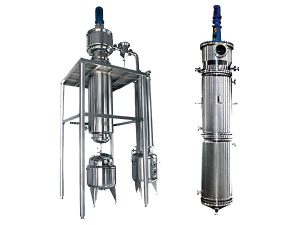
For operations dealing with large fluid volumes that require gentle, low-temperature handling, a high-efficiency falling film evaporator is the ideal solution.
                    FALLING FILM EXTRACT FLOW

                     [ Low-Viscosity Feed Input ]
                                │
                                ▼
                     ┌──────────────────────┐
                     │ Top Distribution Box │
                     └──────────────────────┘
                        │                │
                        ▼ (Gravity Film) ▼
                     │ ║                  ║ │  <── [ Controlled Steam /
                     │ ║  Heating Tubes   ║ │       Vacuum Jacket ]
                        │                │
                        ▼                ▼
             [ Concentrated Product ]   [ Vaporized Evaporated Solvent ]
How it Operates
In a falling film unit, the process liquid is pumped up to the top head of a vertical tube-and-shell heat exchanger. A specialized distribution plate divides the liquid evenly, forcing it to flow downward along the inner walls of the heating tubes as a micro-thin, gravity-driven film. Because the chamber operates under a deep vacuum, the solvent vaporizes rapidly at lower temperatures as the film glides down.
When to Choose It
This design excels at processing heat-sensitive fluids. The micro-thin layer ensures a massive heat transfer coefficient with an ultra-short residence time—meaning your product is exposed to thermal energy for only a few seconds. This prevents any burning, browning, or flavor degradation. It is widely used for concentrating milk, clear fruit juices, and performing high-speed chemical recovery.
Explore our engineering specifications on our dedicated Falling Film Evaporator product page.
The Boundaries
Falling film units depend heavily on a perfectly uniform liquid film. If your fluid is too viscous or contains heavy suspended solids, the film will break apart on the tube walls. This creates dry spots, which cause immediate product scorching and tube fouling.
Deep-Dive 2: The Scrape Film Evaporator – The Ultimate Answer for High Viscosity and Tars
When a processing line requires concentrating fluids into heavy, thick pastes or treating viscous botanical extracts, standard tube bundles are highly prone to clogging. This is where a specialized scrape film evaporator becomes necessary.
How it Operates
Also referred to as a wiped film evaporator, this system features a single jacketed cylindrical body containing a high-speed internal rotor equipped with mechanical wiper blades. As the thick liquid enters the chamber, these blades actively wipe and spread the fluid across the internal heated walls, maintaining a highly turbulent, uniform thin film regardless of fluid thickness.
When to Choose It
If your fluid handles heavy concentration end-points, sticky polymers, or delicate botanical extracts, a scrape film system is ideal. The mechanical wiping action prevents any product from sticking to the hot walls, completely eliminating baking or fouling. It is the gold standard for final-stage solvent stripping, lecithin processing, and concentration finishing.
The Boundaries
Because of its complex internal moving parts and specialized rotor assembly, a scrape film unit has a smaller overall heat transfer surface area compared to massive tube-bundle systems. Therefore, it is typically utilized for lower volumetric flow rates or as a highly effective finishing stage following a bulk evaporator.
Deep-Dive 3: The Forced Circulation Evaporator – The Powerhouse for High Fouling & Crystallization
When dealing with heavy industrial applications where solids will inevitably precipitate out, or when managing Zero-Liquid Discharge (ZLD) environmental workflows, standard thin-film principles are no longer sufficient. These aggressive scenarios require a robust forced circulation evaporator.
How it Operates
This system does not rely on gravity or thin films. Instead, it utilizes high-capacity, high-head recirculation pumps to drive the fluid through the inner heat exchanger tubes at extreme velocities. The system is pressurized so that the liquid is suppressed from boiling inside the tubes. Vaporization only occurs when the superheated fluid flashes into the separate vapor-liquid separator tank, leaving the heat exchange tubes clean.
When to Choose It
This configuration is essential if your fluid contains salts that crystallize during concentration, or if it is prone to extreme scaling and crusting. The high-velocity turbulent flow continuously scours the inner tube surfaces, preventing solids from sticking. It is widely used in chemical processing plants, mineral concentration lines, and industrial wastewater treatment systems.
The Boundaries
The primary trade-off with a forced circulation design is utility consumption. Running a massive, high-power circulation pump continuously demands higher electrical consumption compared to gravity-driven setups.
FAQs
Before submitting an equipment inquiry for your processing facility, ensure your technical team has verified these four critical fluid parameters:
-
What is the dynamic viscosity curve? How does your product’s viscosity change from its raw feed state to its final concentrated target?
-
Are there precipitating solids or salts? Will crystals form during the evaporation process, or are there aggressive scaling elements present?
-
What is the thermal sensitivity threshold? What is the exact maximum temperature and duration your product can tolerate before experiencing quality degradation?
-
Can your plant support an energy-saving loop? Can your facility layout integrate a multi-effect configuration or a Mechanical Vapor Recompression (MVR) loop to recover and reuse latent heat?
Conclusion
Navigating industrial thermal processing requires a clear technology strategy: low-viscosity, clean fluids belong in a high-speed falling film evaporator; high-viscosity, sticky concentrates demand a mechanical scrape film unit; and heavily scaling, crystal-forming solutions require a forced circulation design.
In many advanced industrial configurations, engineers often choose to layer these distinct technologies in series. For example, a large-capacity falling film evaporator is utilized first to strip away 90% of bulk water or solvents at a very low operational cost. The concentrated concentrate is then sent into a final scrape film unit or forced circulation loop to finish the job safely.
Are you preparing to build a new processing line, scale up your current plant capacity, or upgrade your facility to modern export standards?
Contact Zhongbo’s Technical Application Engineers for a Customized Plant Quote