
Reading time: ~9 min | Categories: Industrial News, HTST & UHT Treatment
Introduction
When a dairy plant engineer or production manager specifies a new thermal processing line, the choice between HTST pasteurization and UHT pasteurization is not simply a question of temperature. It determines shelf life, cold chain requirements, packaging format, capital expenditure, CIP cleaning frequency, and — critically — product quality at the consumer’s table.
Make the wrong call and the consequences compound: a plant built around HTST that needs to serve export markets without refrigeration has to rebuild its processing core. A plant that installs a full UHT aseptic line for a local fresh-milk brand wastes capital and over-processes its product.
This guide gives dairy plant managers, process engineers, and equipment procurement teams a clear decision framework — covering the physics of each process, equipment differences, a side-by-side selection matrix, and a detailed CIP programme matched to each system type. All equipment references link to Zhongbo’s HTST & UHT treatment equipment, built to CE and ISO 9001 standards for dairy and beverage processing lines worldwide.
What HTST and UHT Actually Do — The Physics Behind the Labels
Both processes use heat to inactivate microorganisms, but they target different microbial populations at different intensity levels — and that single distinction drives every other difference between the two systems.
HTST Pasteurization
High Temperature Short Time (HTST) pasteurization heats milk to a minimum of 72°C for 15 seconds, then rapidly cools it to below 4°C. According to the Canadian Food Inspection Agency (CFIA) and the International Dairy Foods Association (IDFA), this time-temperature combination is the global regulatory standard for continuous pasteurization of fluid milk.
HTST destroys all vegetative pathogenic bacteria — including Listeria monocytogenes, Salmonella, and E. coli O157:H7 — but does not eliminate heat-resistant spores or all spoilage organisms. The result is a pasteurized product: safe, but still perishable, requiring continuous refrigeration and offering a typical shelf life of 14–21 days.
UHT Pasteurization
Ultra High Temperature (UHT) processing heats milk to 135–150°C for 2–5 seconds, then cools and fills it into hermetically sealed aseptic packaging. This intensity eliminates not only vegetative pathogens but also heat-resistant spores, achieving commercial sterility. The result is a shelf-stable product requiring no refrigeration for 6–12 months when unopened.
The key regulatory distinction: HTST pasteurizes; UHT sterilizes. This single word difference cascades into fundamentally different equipment, packaging, distribution infrastructure, and CIP requirements.
Side-by-Side Comparison
| Parameter | HTST Pasteurization | UHT Pasteurization |
|---|---|---|
| Temperature | 72–85°C | 135–150°C |
| Holding time | 15–30 seconds | 2–5 seconds |
| Microbial target | Vegetative pathogens | Vegetative pathogens + spores |
| Result | Pasteurized (not sterile) | Commercially sterile |
| Shelf life | 14–21 days (refrigerated) | 6–12 months (ambient) |
| Cold chain required | Yes — continuous refrigeration | No — until opened |
| Flavour impact | Minimal — closest to fresh | Slight cooked note possible |
| Nutritional retention | Higher — less heat damage | Slightly lower — higher temperatures |
| Packaging format | Standard refrigerated carton / bottle | Aseptic carton (Tetra Pak style) |
| Capital cost | Lower | Higher (includes aseptic filler) |
Equipment Differences — Plate Heat Exchanger vs. Tubular UHT System

The thermal process you choose dictates the core equipment on your line. Understanding the hardware differences helps prevent misspecification and supports more accurate capital budgeting.
HTST Equipment: The Plate Heat Exchanger System
A standard HTST line consists of four integrated components:
- Plate heat exchanger (PHE): Thin corrugated stainless steel plates create narrow flow channels that transfer heat rapidly and efficiently. The PHE handles three zones — regeneration (preheating incoming cold milk with warm outgoing milk, typically recovering 85–95% of heat energy), heating (raising milk to target temperature using hot water or steam), and cooling (chilling the pasteurized product).
- Holding tube: A precisely sized stainless steel tube that ensures every particle of milk is held at the target temperature for the required minimum time. Tube length and diameter are calculated from the flow rate to guarantee regulatory compliance.
- Flow Diversion Valve (FDV): A critical safety device that automatically diverts under-temperature product back to the balance tank rather than allowing it to pass to packaging. The FDV is the primary food-safety control point in any HTST system.
- Temperature and pressure instrumentation: Continuous monitoring is a regulatory requirement. HTST systems must record time-temperature data for every production run.
UHT Equipment: Direct vs. Indirect Heating
UHT systems are available in two fundamentally different heating configurations, each with distinct implications for product quality, operating cost, and CIP complexity.
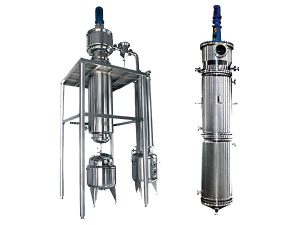
Indirect UHT uses a tubular heat exchanger — concentric tubes or a shell-and-tube arrangement — where product and heating medium are separated by a metal wall. This is the more common configuration for dairy milk. It produces minimal flavour change compared to direct heating and is compatible with standard CIP procedures.
Direct UHT (steam infusion or steam injection) mixes steam directly with the product for almost instantaneous heating, followed by flash cooling under vacuum. This preserves flavour and nutrients exceptionally well — the product exposure to high temperature is measured in milliseconds — but requires more complex equipment and higher capital investment.
Both UHT configurations require aseptic filling: the sterile product must be packaged in a pre-sterilised container under sterile air conditions, or commercial sterility is immediately compromised.
Zhongbo’s HTST and UHT treatment systems include coil, plate, and tubular pasteuriser configurations with PLC control panels and full instrumentation, engineered for precise temperature control across dairy, beverage, and food processing applications.
How to Choose — A Decision Framework for Dairy Plant Managers
The right thermal process is determined by your market, your product, and your infrastructure — not by which technology is theoretically superior. Use this decision matrix as the starting point for your specification:
| Decision Factor | Choose HTST | Choose UHT |
|---|---|---|
| Target market | Local or regional — cold chain available | National or export — no reliable cold chain |
| Product type | Fresh milk, yogurt base, cheese milk, cultured products | Ambient milk, cream, plant-based drinks, infant formula |
| Flavour priority | High — consumer expects fresh taste | Medium — ambient convenience accepted |
| Capital budget | Lower — PHE + standard filler | Higher — tubular system + aseptic filler |
| Production scale | Small to mid-size operations | Large-scale or export-oriented production |
| Distribution model | Refrigerated logistics required | Ambient distribution — lower logistics cost |
| Regulatory context | Cold chain compliance monitoring | Aseptic process validation required |
| Energy profile | Lower processing energy; higher cold chain energy | Higher steam demand; eliminates refrigeration cost |
A practical rule of thumb used in the industry: if your product will travel more than 500 km from production to consumer, or if reliable cold chain cannot be guaranteed at every distribution point, UHT becomes the safer commercial choice regardless of flavour preference.
CIP Cleaning Cycles — Why HTST and UHT Lines Have Different Requirements
Clean-in-Place (CIP) is not a single standardised procedure — it must be matched to the thermal process and the soiling characteristics it produces. This is one of the most frequently underestimated aspects of dairy line specification, and inadequate CIP design is a leading cause of product contamination incidents, premature equipment failure, and regulatory non-compliance.
Why Pasteurizer CIP Is More Demanding Than Standard Tank CIP
Two specific soil types make pasteuriser and UHT system CIP significantly more challenging than cleaning unheated tanks or pipework:
- Heat-denatured whey protein: When whey proteins are heated above approximately 70°C, they unfold and bond tightly to stainless steel surfaces. This denatured protein layer is far more resistant to caustic cleaning than native protein residues, requiring higher NaOH concentrations and temperatures than standard dairy CIP.
- Milkstone (calcium phosphate-protein complex): As milk is heated repeatedly, inorganic calcium and phosphate minerals co-precipitate with protein onto heat exchanger surfaces, forming a hard, grey-white scale that is completely insoluble in caustic solution. Milkstone can only be removed by periodic acid wash cycles — alkaline cleaning alone will not address it, and progressive accumulation leads to significantly reduced heat transfer efficiency and harbours bacteria.
Standard CIP Programme for HTST Pasteurizer Lines (5 Steps)
The following programme is based on Tetra Pak Dairy Processing Handbook recommendations and industry-standard practice for plate heat exchanger circuits:
| Step | Stage | Parameters | Purpose |
|---|---|---|---|
| 1 | Pre-rinse | Water 38–45°C, 8–10 min | Flush residual milk, melt butterfat, prevent protein adhesion. Avoid thermal shock to PHE gaskets. |
| 2 | Caustic wash | NaOH 1–2%, 55–66°C, 15–30 min, flow velocity ≥1.5 m/s | Hydrolyse heat-denatured protein, saponify fats. Higher concentration and temperature than cold-circuit CIP due to denatured residues. |
| 3 | Intermediate rinse | Potable water, ambient, 5–10 min | Remove caustic residues. Essential before acid phase — alkaline residue neutralises acid and reduces milkstone removal effectiveness. |
| 4 | Acid wash | Nitric or phosphoric acid 0.5–1%, 50–60°C, 15–20 min | Dissolve milkstone and mineral deposits. Mandatory for heated-surface circuits. Note: acid must always follow caustic, never precede it — acid-first causes protein precipitation and worsens fouling. |
| 5 | Final rinse + sanitisation | Hot water 90–95°C, 10–15 min (return temp ≥85°C) OR peracetic acid 0.1–0.2% | Eliminate residual microorganisms before production start. Tetra Pak handbook specifies hot water sanitisation as the standard approach for pasteuriser circuits. |
CIP frequency for dairy HTST lines: After every production batch, or at minimum every 24 hours. This is a regulatory requirement in most markets and a food safety best practice regardless of regulatory obligation.
Additional CIP Requirements for UHT Lines
UHT tubular heat exchanger circuits demand more intensive CIP than HTST plate systems for three reasons: higher operating temperatures produce more heavily denatured protein deposits; longer continuous run times between CIP cycles accumulate greater soil loads; and the commercial sterility claim of UHT products means any CIP failure has more serious consequences.
- Acid wash is mandatory (not optional as it may be for some HTST circuits) due to accelerated milkstone formation at 135–150°C operating temperatures.
- Higher caustic concentration is typically required: 1.5–2.5% NaOH at 70–75°C to address the more resistant denatured protein layer from UHT temperatures.
- Steam-In-Place (SIP) is required before every production start on UHT aseptic lines — steam at 130–140°C circulated through the entire product-contact circuit to achieve sterility before the first product passes through.
- CIP validation must be formally documented, including microbiological swab testing and conductivity monitoring to verify complete chemical removal.
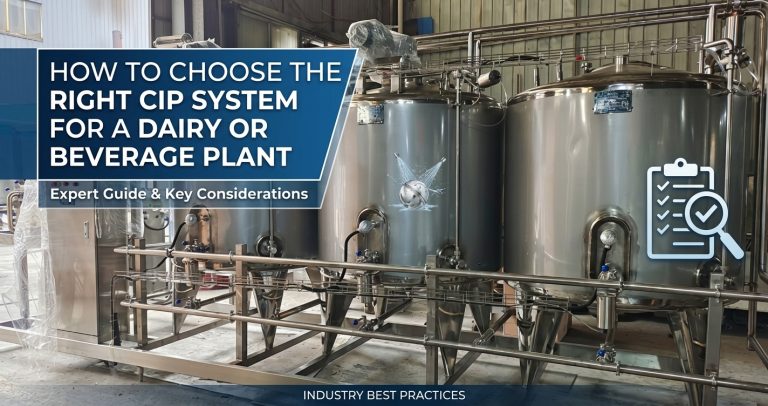
Zhongbo’s Cleaning In Place (CIP) systems are available in manual, semi-automatic, and fully automated configurations, designed to integrate with both HTST and UHT processing lines in dairy, beverage, and food manufacturing environments.
Common CIP Mistakes That Compromise Pasteuriser Performance
Based on industry experience, these are the most frequent CIP errors on dairy thermal processing lines — each of which creates measurable food safety risk or equipment damage:
- Running acid wash before caustic wash. This is the single most damaging CIP sequence error. Acid causes protein to precipitate and bond even more tightly to surfaces, making subsequent caustic cleaning significantly less effective. The correct sequence is always: caustic first, then intermediate rinse, then acid.
- Insufficient CIP flow velocity. Turbulent flow (Reynolds number Re >10,000, typically achieved at ≥1.5 m/s in standard dairy pipework) is required to mechanically shear soil from surfaces. Low-flow CIP looks like it’s running but leaves a biological film behind. Always verify flow rate against pipe diameter — do not assume the CIP pump is sized correctly for every circuit in the plant.
- Neglecting the flow diversion valve and holding tube in HTST CIP. These components have complex geometries and flow dead zones that are not adequately cleaned by simple through-flow. They require specific flow direction protocols and should be included in periodic physical inspection and swab testing programmes.
- Skipping acid wash cycles on UHT lines to save time. Milkstone accumulation reduces heat transfer efficiency progressively — a fouled UHT system must compensate by raising steam temperature, increasing energy consumption and accelerating gasket degradation. A consistent acid wash cycle costs far less than an unplanned heat exchanger strip-down.
- No CIP validation programme. Running CIP without periodic microbiological verification — ATP bioluminescence testing, contact plates, or rinse water cultures — is analogous to running a pasteuriser without temperature recording. Regulatory auditors increasingly require documented CIP validation records, and third-party retailer audits (BRC, IFS, SQF) typically include CIP records as a scored item.
FAQs
Q1. What is the main difference between HTST and UHT pasteurization?
HTST pasteurizes — it destroys pathogenic bacteria at 72°C for 15 seconds, producing a product that is safe but perishable and requires continuous refrigeration with a shelf life of 14–21 days. UHT sterilizes — it eliminates all microorganisms including spores at 135–150°C for 2–5 seconds, producing a commercially sterile product that is shelf-stable at ambient temperature for 6–12 months. The process you choose determines your entire distribution and packaging model.
Q2. Which pasteurization method is better for fresh milk?
HTST is universally preferred for fresh milk products. The lower processing temperature preserves more heat-sensitive vitamins, retains native flavour compounds, and avoids the slight “cooked” note that some consumers detect in UHT milk. For any product where fresh taste and maximum nutritional retention are the commercial priority, HTST is the right choice — provided a reliable cold chain exists from plant to consumer.
Q3. Can the same equipment run both HTST and UHT?
No. HTST and UHT require fundamentally different equipment. HTST uses a plate heat exchanger operating at relatively low temperatures and pressures; UHT uses a tubular heat exchanger (or direct steam injection system) capable of reaching 150°C and requires downstream aseptic filling equipment. A plant cannot convert an HTST line to UHT without replacing the core processing equipment and aseptic packaging infrastructure.
Q4. How often does a dairy pasteurizer need CIP cleaning?
Dairy HTST and UHT lines should be CIP-cleaned after every production batch or at a minimum every 24 hours. This frequency is required because heat-denatured protein deposits accumulate rapidly on heated heat exchanger surfaces and provide a substrate for microbial growth if left overnight. Some high-throughput lines running multiple products per day may require mid-production CIP cycles between product changeovers.
Q5. Why is acid wash necessary in dairy CIP, and when should it be done?
Acid wash removes milkstone — a hard calcium phosphate-protein mineral scale that builds up on heated dairy equipment surfaces and cannot be dissolved by caustic (alkaline) cleaning alone. On HTST lines, an acid wash is recommended at least weekly; on UHT lines, it should be included in every CIP cycle. Acid wash must always follow the caustic wash and intermediate rinse — running acid before caustic causes protein precipitation that worsens fouling.
Q6. What CIP chemicals are used for dairy pasteurizer cleaning?
The standard CIP chemical programme for dairy pasteurizers uses three agents: sodium hydroxide (NaOH) at 1–2% concentration for alkaline cleaning of protein and fat deposits; nitric acid or phosphoric acid at 0.5–1% for milkstone and mineral scale removal; and a sanitiser — either hot water at ≥90°C, peracetic acid at 0.1–0.2%, or chlorine-based compounds — applied as the final step before production restart. Chemical concentrations and temperatures must be higher for UHT circuits than for HTST due to more heavily denatured deposits.
Q7. What is the flow diversion valve (FDV) in an HTST system?
The flow diversion valve (FDV) is the primary food safety control device in an HTST pasteurizer. It continuously monitors the temperature of milk leaving the holding tube. If the temperature drops below the regulatory minimum (typically 72°C), the FDV automatically diverts the under-pasteurized product back to the balance tank for reprocessing rather than allowing it to reach packaging. The FDV must be included in CIP cleaning protocols and in regular physical inspection and maintenance programmes.
Q8. What is SIP (Steam-In-Place) and is it required for HTST lines?
Steam-In-Place (SIP) is a sterilisation procedure in which steam at 130–140°C is circulated through the product-contact circuit to achieve sterility before production. SIP is a mandatory requirement for UHT aseptic lines — commercial sterility claims cannot be made without it. For HTST lines producing pasteurized (non-sterile) products, SIP is not required; hot water sanitisation at ≥90°C is the standard start-up procedure.
Q9. How does product type affect the choice between HTST and UHT?
Product type is one of the most decisive factors. Yogurt base milk must be HTST-treated — UHT temperatures denature whey proteins in ways that interfere with starter culture fermentation and yogurt texture. Cheese milk is similarly HTST-processed. Infant formula, on the other hand, is typically UHT-treated because the sterility requirement and long shelf life for global distribution outweigh the marginal flavour difference. Plant-based beverages — oat, soy, almond milk — are increasingly UHT-treated to enable ambient distribution and longer shelf life in retail.
Q10. How do I get HTST or UHT equipment sized for my dairy line?
Accurate equipment sizing requires: daily production volume (litres/hour), product type and composition (fat content, solids), target shelf life and distribution model, available utilities (steam pressure, cooling water temperature, electrical supply), and site-specific regulatory requirements. Zhongbo’s engineering team has over 30 years of experience designing HTST and UHT systems for dairy and beverage producers worldwide. Contact our engineering team with your process data for a detailed technical and commercial proposal.
Conclusion: Matching Thermal Process to Business Strategy
The choice between HTST and UHT pasteurization is ultimately a business decision as much as a technical one. HTST delivers the freshest-tasting product at the lowest capital cost — but requires cold chain investment and limits distribution range. UHT opens national and international markets with ambient shelf life — but demands higher upfront equipment spend and rigorous aseptic process validation.
Neither system performs to specification without a correctly designed CIP cleaning programme. Heat-denatured protein and milkstone deposits are unavoidable in any dairy thermal processing operation, and the caustic-then-acid CIP sequence is not optional — it is the engineering baseline for food safety compliance and equipment longevity on both HTST and UHT lines.
Zhongbo designs and supplies HTST and UHT treatment systems and integrated CIP systems as a matched processing solution — ensuring that your thermal process and your cleaning programme are engineered together, not specified independently. With CE and ISO 9001 certification, 30 years of industry experience, and over 100 international clients, Zhongbo provides the technical depth and manufacturing reliability that dairy and beverage producers demand.
Need Help Choosing Between HTST and UHT for Your Dairy Line?
Share your production volume, product type, and distribution model with Zhongbo’s engineering team. We’ll recommend the right thermal process, equipment configuration, and CIP programme — at no obligation.
Get a Free Technical Consultation →
📧 Response within 24 hours | 🏭 30 years of dairy processing expertise | 🌍 100+ international clients
Related Resources
📖 Existing Zhongbo Blogs (Internal Links)
- Understanding UHT and HTST Pasteurization: A Complete Guide
- What Is the Difference Between UHT and HTST?
- The Ultimate Guide to Indirect UHT Sterilizers: Maximizing Efficiency in Dairy and Beverage Production
- Industrial Evaporator Selection Guide: Falling Film vs. Forced Circulation vs. Scrape Film Evaporator