Reading time: ~8 min | Categories: Industrial News, Evaporation & Concentration
Introduction
When a dairy plant concentrates whole milk, or a pharmaceutical manufacturer reduces an herbal extract, temperature is the enemy. Prolonged exposure to high heat destroys vitamins, denatures proteins, alters colour and flavour, and deactivates active pharmaceutical ingredients (APIs). Traditional evaporation methods — open-pan boiling or short-tube calandrias — rely on bulk liquid pools and long residence times that make this thermal damage almost unavoidable.
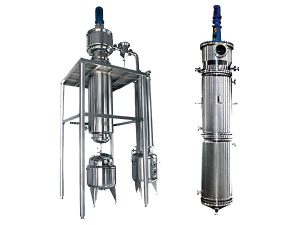
The falling film evaporator (FFE) solves this by combining gravity-driven thin-film flow, vacuum operation, and continuous vapour-liquid separation into a system where liquid contacts the heated surface for only 5–30 seconds and at temperatures as low as 40–60 °C. That combination is why FFEs account for the majority of industrial evaporation installations worldwide in food, beverage, dairy, and pharmaceutical processing.
This guide explains exactly how FFEs work, what parameters engineers must size correctly, how they compare to alternatives, and how Zhongbo’s evaporation and concentration equipment is engineered to meet these demands.
What Makes a Liquid “Heat-Sensitive”?
A liquid is classified as heat-sensitive when its valuable components — nutritional, functional, or chemical — degrade faster than the evaporation process can complete. Three categories of damage drive this classification:
- Nutritional degradation: Vitamins C and B-group in fruit juices begin breaking down above 60 °C. Milk proteins denature and aggregate above 70 °C, impairing texture and digestibility.
- Sensory deterioration: The Maillard reaction between sugars and amino acids accelerates sharply with temperature, causing browning and off-flavours in dairy concentrates, coffee extracts, and glucose syrups.
- Active-ingredient deactivation: Enzymes, probiotics, and pharmaceutical APIs have narrow thermal stability windows. Even brief excursions above their threshold cause irreversible activity loss.
The two process parameters that control thermal damage are residence time (how long the liquid is hot) and operating temperature (how hot it gets). A well-designed FFE minimises both simultaneously — something no other mainstream evaporator type does as efficiently.
How a Falling Film Evaporator Works: Step by Step
Understanding the operating principle is essential before specifying sizing parameters.
Step 1 — Liquid Distribution
Feed liquid is introduced at the top of the tube bundle (calandria) through a precision distributor — either a perforated plate or a spray-nozzle tray. Even distribution across every tube is critical: under-wetted tubes create dry spots that cause fouling and product burn-on; over-wetted tubes reduce heat transfer efficiency.
Step 2 — Thin-Film Formation and Heat Transfer
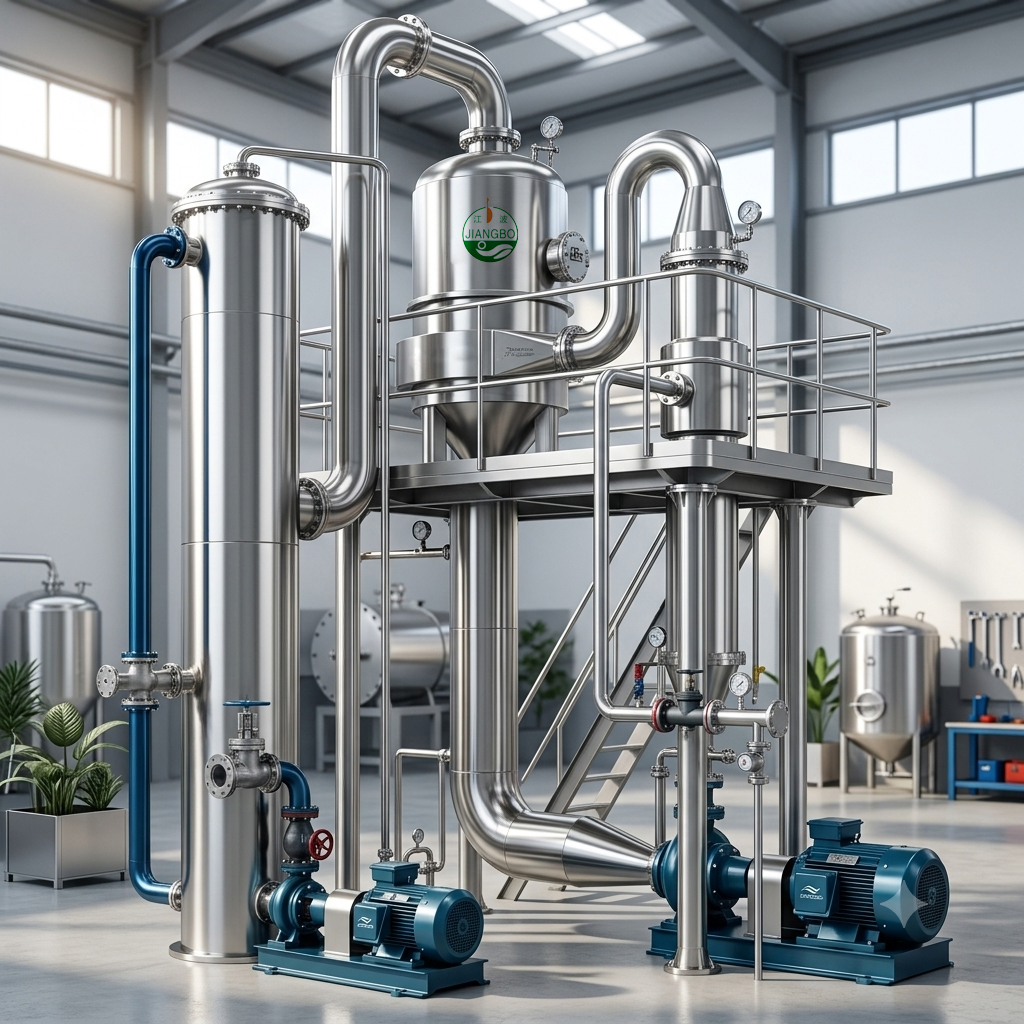
Gravity pulls the liquid down the inside of vertical stainless steel tubes as a continuous thin film. Steam or hot water on the shell side transfers heat through the tube wall into the film. Because the film is only a few millimetres thick, heat penetrates it almost instantaneously, reaching boiling point with a very small temperature difference (ΔT) between the heating medium and the product — typically 3–5 °C, compared to 15–25 °C in forced circulation systems.
Step 3 — Evaporation and Vapour Acceleration
As the solvent (usually water) evaporates, the resulting vapour flows downward inside the tube parallel to — and faster than — the liquid film. This co-current shear force accelerates the film, further shortening the residence time while maintaining turbulence that sustains high heat transfer rates.
Step 4 — Vapour-Liquid Separation
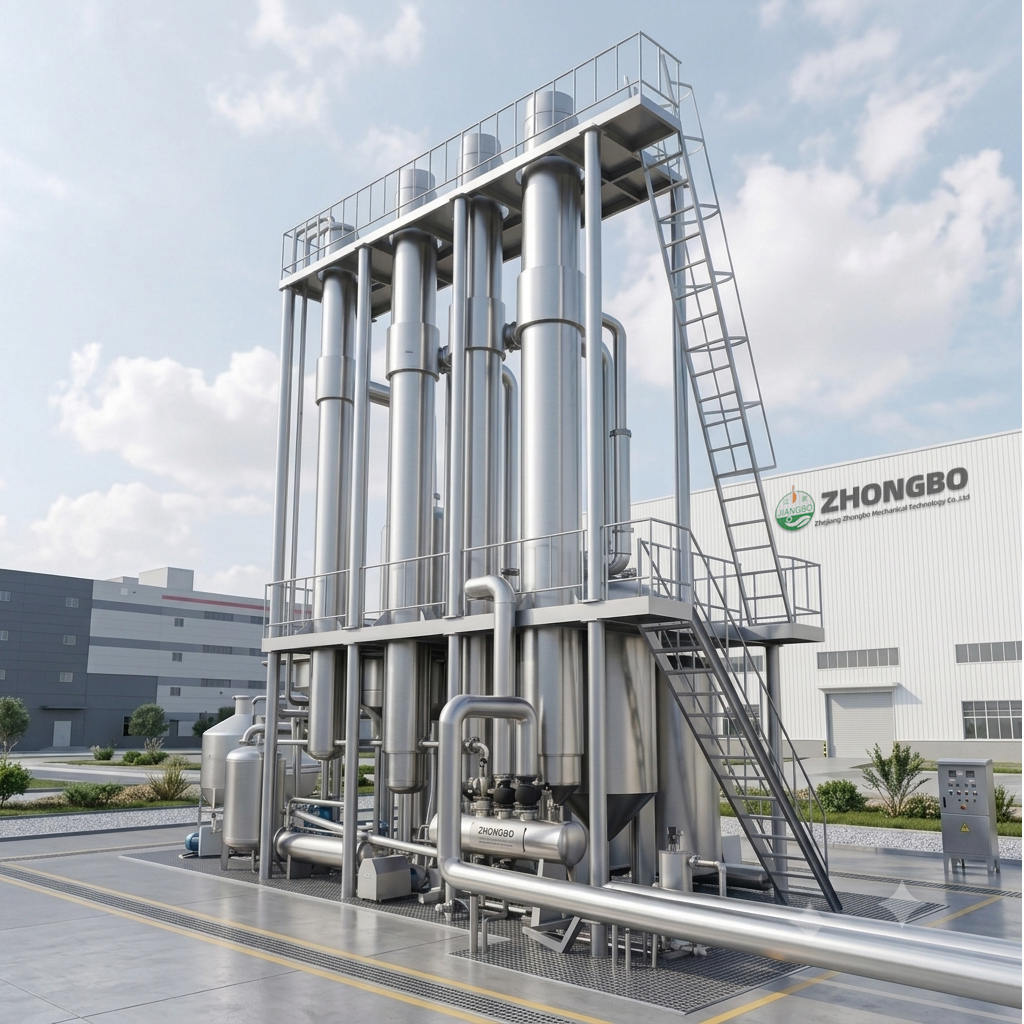
At the base of the calandria, the concentrated liquid and vapour enter a centrifugal separator. The vapour exits at the top — either to a condenser for solvent recovery, or onwards to the next effect in a multi-effect evaporator arrangement. The concentrated product is discharged at the bottom. In a Mechanical Vapour Recompression (MVR evaporator) configuration, the vapour is recompressed and recycled as the heating medium, dramatically reducing steam consumption.
Critical Sizing Parameters Every Engineer Must Know
This section differentiates a properly engineered FFE from an undersized or oversized one. Most published guides skip or oversimplify these parameters — which is precisely where costly commissioning problems originate.
Wetting Rate (Γ) — The Foundation of Stable Operation
The falling film evaporator wetting rate (Γ, kg/m·s) is the mass flow rate of liquid per unit of tube circumference. It is the single most important sizing parameter because it determines whether a continuous, unbroken film forms on the tube wall.
- Recommended range: 0.25–1.0 kg/m·s for water-like, low-viscosity liquids
- Below minimum wetting rate: Film breaks down, creating dry patches that cause fouling and product degradation
- Above maximum: Film becomes too thick, reducing heat transfer efficiency and increasing residence time
When scaling up an FFE, tube length and wetting rate must be held constant — simply increasing tube diameter or number of tubes without re-checking Γ is one of the most common engineering errors.
Overall Heat Transfer Coefficient (U-Value)
The FFE heat transfer coefficient for a thin falling film of low-viscosity liquid on a clean stainless steel surface typically ranges from 2,000 to 4,000 W/(m²·K) — two to four times higher than forced circulation evaporators handling the same fluid. This superior U-value means less installed heat transfer area is needed for the same evaporation duty, reducing capital cost.
Critical note: as concentration increases toward the product end of the tube, viscosity rises and U-values drop. Sizing must account for the full concentration range, not just inlet conditions.
Vacuum Level and Operating Temperature
Operating under vacuum (5–20 kPa absolute) reduces the boiling point of water to 40–60 °C, providing a gentle evaporation environment for heat-sensitive products. The vacuum system — whether a water ring pump, steam ejector, or dry pump — must be sized for the non-condensable gas load, not just the vapour load. Under-sized vacuum systems are a frequent cause of instability in heat-sensitive liquid concentration.
Tube Geometry: Diameter and Length
Tube inner diameter typically ranges from 25–65 mm. Longer tubes increase wetting surface area and allow higher evaporation ratios per pass, but require greater building height. A common rule of thumb: tube length-to-diameter ratio of 200:1 to 400:1 optimises wetting while maintaining manageable installation height. For high-viscosity products (above ~100 cP), larger diameters and recirculation loops are necessary to maintain adequate wetting.
Evaporation Load Calculation
The basic heat duty equation:
Q = F · Cp · (Tboiling − Tfeed) + E · λ
Where F = feed rate, Cp = specific heat, E = evaporation rate, and λ = latent heat of vaporisation. The required heat transfer area then follows from Q = U · A · LMTD. This calculation, combined with the wetting rate check, defines the tube bundle specification.
FFE vs. Forced Circulation vs. Scrape Film: Choosing the Right Evaporator
No single evaporator type suits every application. The table below summarises when to select each type:
| Criteria | Falling Film (FFE) | Forced Circulation (FCE) | Scrape Film (SFE) |
|---|---|---|---|
| Heat-sensitive products | ✅ Best choice — lowest ΔT, shortest residence time | ⚠️ Higher ΔT required; longer residence time | ✅ Good — mechanically agitated film |
| High-viscosity liquids (>500 cP) | ⚠️ Requires recirculation; risk of film instability | ✅ Pump maintains flow regardless of viscosity | ✅ Best choice — scrapers maintain film |
| Liquids with suspended solids | ❌ Solids block distributor and cause fouling | ✅ Handles moderate solids loads | ✅ Scrapers remove deposits |
| Energy efficiency | ✅ Lowest — ideal for MVR and multi-effect | ⚠️ Moderate | ❌ Highest energy consumption |
| Capital cost | ✅ Low-to-medium | Medium | ❌ High |
| Typical applications | Milk, whey, juice, pharma extracts, glucose | Salt solutions, crystallising liquors, high-solids | Tomato paste, gelatin, high-viscosity APIs |
For the vast majority of dairy, beverage, and pharmaceutical concentration duties — where the liquid is clean, low-to-medium viscosity, and heat-sensitive — the falling film evaporator vs forced circulation evaporator comparison almost always favours the FFE on product quality, energy consumption, and long-term operating cost

Industry Applications: Where FFEs Deliver the Most Value
Dairy Processing
The falling film evaporator for dairy processing is the global standard for concentrating whole milk, skim milk, whey, and lactose solutions. Milk concentration to 45–55% total solids before spray drying is almost universally performed in multi-effect FFE systems. The short residence time prevents Maillard browning and protein denaturation, preserving the nutritional profile and powder reconstitution properties that premium dairy buyers demand.
Beverage and Food Processing
Fruit juice concentration (apple, orange, pineapple), coffee and tea extract concentration, glucose syrup production, and starch hydrolysate processing all rely on FFEs. The thin film evaporation mechanism preserves volatile aroma compounds that define product quality — a property no other evaporator type matches at comparable throughput.
Pharmaceutical and Biotechnology
The sanitary evaporator pharmaceutical sector uses FFEs to concentrate fermentation broths, herbal extracts, API solutions, and enzyme preparations. Sanitary design standards — electropolished tube internals, CIP-compatible gaskets, full drainability — are non-negotiable. Zhongbo’s FFEs are manufactured to CE and ISO 9001 standards with SMS/DIN/3A-compliant wetted parts, meeting GMP facility requirements.
Chemical Processing and Solvent Recovery
FFEs are widely used for ethanol and solvent concentration in extraction processes. The low operating temperature under vacuum makes them particularly suitable for recovering flammable solvents safely. Combined with an ethanol distillation column, the FFE pre-concentrates the dilute extract before final purification.
Common Sizing Mistakes to Avoid
Based on industry experience, these are the most frequent causes of FFE underperformance:
- Sizing only for inlet conditions. As liquid concentrates, viscosity increases and U-values drop. A system sized only for inlet feed properties will be under-surfaced at the product end, causing incomplete concentration or unstable operation.
- Inadequate liquid distributor design. An uneven distributor creates dry zones in some tubes and flooded conditions in others. This is the leading cause of fouling in industrial FFE installations. Distributor hole sizing, number of holes per tube, and vapour venting must all be engineered — not assumed.
- Ignoring non-condensable gas load in vacuum sizing. Air ingress through seals and dissolved gases released during evaporation increase the non-condensable load. Under-sized vacuum systems cause boiling point elevation and unstable operation, particularly in multi-effect arrangements.
- Neglecting the MVR or multi-effect energy opportunity. A single-effect FFE with a dedicated steam supply is rarely the optimal configuration for throughputs above 500 kg/h evaporation. Properly specified multi-effect evaporator or MVR systems typically reduce steam consumption by 60–80%, with payback periods under two years at current energy prices.
- Specifying standard tube diameters for viscous products. Products that approach 100 cP at concentration require either larger tube diameters, forced recirculation, or a switch to a scrape film design. Forcing a viscous product through standard FFE geometry produces film instability and dramatically reduced throughput.
FAQs
Q1. What is a falling film evaporator used for?
A falling film evaporator is used to concentrate liquids by removing water (or another solvent) under vacuum at low temperatures. It is the preferred choice for heat-sensitive products such as milk, fruit juice, pharmaceutical extracts, and glucose syrups, where conventional evaporation would cause thermal degradation.
Q2. What is the residence time in a falling film evaporator?
Residence time in a typical falling film evaporator is 5 to 30 seconds inside the heating zone. This extremely short contact time with the heated surface is the primary reason FFEs are chosen for heat-sensitive liquid concentration, as it minimises thermal damage to nutrients, flavours, and active compounds.
Q3. What is the wetting rate in a falling film evaporator, and why does it matter?
The wetting rate (Γ) is the liquid mass flow per unit of tube circumference, measured in kg/m·s. For water-like liquids, it should be maintained between 0.25 and 1.0 kg/m·s. If the wetting rate falls below the minimum threshold, the liquid film breaks down, creating dry patches on the tube wall. These dry patches cause fouling, product burn-on, and reduced heat transfer — making the wetting rate the single most critical parameter in FFE design and operation.
Q4. What temperature does a falling film evaporator operate at?
Under vacuum operation at 5–20 kPa absolute pressure, the boiling point of water is reduced to approximately 40–60 °C. This low operating temperature is ideal for heat-sensitive products. The exact temperature depends on the vacuum level applied and the boiling point elevation caused by dissolved solids.
Q5. What is the difference between a falling film evaporator and a forced circulation evaporator?
The key differences are: (1) residence time — FFEs expose liquid to heat for seconds, forced circulation evaporators for minutes; (2) temperature difference (ΔT) — FFEs operate at ΔT of 3–5 °C, forced circulation requires 15–25 °C; (3) suitability — FFEs excel for clean, low-viscosity, heat-sensitive liquids; forced circulation is better for viscous, scaling, or high-solids liquids. For most dairy and beverage applications, the FFE is the superior choice on both product quality and energy efficiency.
Q6. How many effects should my falling film evaporator have?
The optimal number of effects depends on evaporation load, available steam cost, and capital budget. As a general rule: single-effect for loads below ~500 kg/h evaporation; double-effect for 500–2,000 kg/h; triple or quad-effect above 2,000 kg/h. Each additional effect roughly halves steam consumption but adds capital cost. MVR systems become attractive above ~1,000 kg/h evaporation where electricity is cheaper than steam.
Q7. Can a falling film evaporator handle viscous liquids?
FFEs work well for liquids up to approximately 100–150 cP. Above this threshold, the falling film becomes unstable — the liquid no longer flows uniformly down the tube wall, leading to channelling and dry spots. For high-viscosity products (tomato paste, gelatin, thick syrups), a scrape film evaporator is more appropriate. Products that are low-viscosity at feed but become viscous at concentration may require recirculation or a hybrid system.
Q8. What sanitary standards apply to falling film evaporators for food and pharma use?
For food and dairy applications, FFEs should comply with 3-A Sanitary Standards (USA) or EHEDG guidelines (Europe), which govern surface finish (typically Ra ≤ 0.8 µm electropolished), dead-leg elimination, full drainability, and CIP compatibility. For pharmaceutical use, GMP compliance requires documented material traceability, surface roughness certification, and validated CIP/SIP procedures. Zhongbo’s sanitary evaporators are manufactured to CE, ISO 9001, SMS/DIN/3A standards.
Q9. What is MVR (Mechanical Vapour Recompression) and should I use it?
MVR evaporator energy saving works by compressing the vapour generated during evaporation to a higher pressure and temperature, then recycling it as the heating medium for the same evaporator — eliminating the need for fresh steam. A well-designed MVR system can reduce energy consumption by up to 90% compared to a single-effect FFE. MVR becomes economically attractive for evaporation duties above approximately 1,000 kg/h water removal, or wherever electricity is significantly cheaper than steam on a per-kWh basis.
Q10. How do I get a falling film evaporator sized for my specific application?
Proper FFE sizing requires: feed flow rate and composition, target output concentration, feed temperature, available utilities (steam pressure, cooling water temperature, vacuum source), and product thermal sensitivity data. Zhongbo’s engineering team has over 30 years of experience designing custom evaporation systems for dairy, beverage, food, and biopharmaceutical industries. Contact us with your process data for a tailored technical proposal.
Conclusion
The falling film evaporator’s dominance in heat-sensitive liquid concentration is not accidental — it results from a unique combination of short residence time, low operating temperature, high heat transfer efficiency, and compatibility with energy-saving MVR and multi-effect configurations that no other mainstream evaporator type delivers simultaneously.
For engineers and procurement managers evaluating evaporation equipment, the sizing decisions that matter most are wetting rate, U-value accounting for the full concentration range, vacuum system capacity, and whether a multi-effect or MVR configuration is justified by the evaporation load. Getting these parameters right at the specification stage prevents costly retrofits later.
Zhongbo has designed and delivered falling film evaporators for over 100 international clients across dairy, beverage, food processing, and biopharmaceutical industries, with full OEM capability, CE/ISO 9001 certification, and compliance with SMS/DIN/3A/EHEDG sanitary standards. All systems are engineered to specification — not off-the-shelf.
Ready to Size Your Falling Film Evaporator?
Share your process data with Zhongbo’s engineering team. We’ll provide a detailed technical proposal — including evaporation load calculation, effect configuration, and energy analysis — at no obligation.
Get a Free Technical Proposal →
📧 Response within 24 hours | 🏭 30 years of evaporation engineering | 🌍 100+ international clients
Related Resources
📖 Existing Zhongbo Blogs (Internal Links)
- Industrial Evaporator Selection Guide: Falling Film vs. Forced Circulation vs. Scrape Film Evaporator
- The Ultimate Guide to Falling Film Evaporators in Solvent Extraction and Ethanol Recovery
- The Ultimate Guide to Indirect UHT Sterilizers: Maximizing Efficiency in Dairy and Beverage Production
- The Ultimate Guide to Scrape Film Evaporators: Mastering High-Viscosity and Heat-Sensitive Concentration