

Introduction
A high level tank looks like an afterthought: a small stainless box on a frame above the pasteuriser. In practice it is what lets a pasteuriser run at a steady rate while tankers, CIP cycles and production schedules do whatever they like. Size it wrongly and you either starve the feed pump or hold product long enough to matter. This guide defines what the tank is, how to calculate its volume, and which details decide whether it works.
What a High Level Tank Is
It is a balance tank mounted at elevation, feeding the pasteuriser inlet by gravity through a short, large-bore line. Two things come out of that arrangement. First, the feed pump always has positive suction head, which removes cavitation risk on hot or volatile products. Second, the pasteuriser sees a stable inlet pressure regardless of what the upstream tanks are doing.
It is not the same as a buffer tank. A buffer tank stores product between process stages and is usually at floor level with its own pump. A high level tank is small, elevated, and exists to control flow and suction head rather than to hold inventory. Confusing the two is why some plants end up with a 10,000 L vessel where a 1,500 L one would do.
| Vessel | Main purpose | Typical hold time |
|---|---|---|
| High level tank | Constant head and steady feed to the pasteuriser | 10–30 minutes of line flow |
| Balance tank | Receives diverted product and stabilises the circuit | Minutes — often just a sump |
| Buffer tank | Decouples two process stages running at different rates | 30 minutes to several hours |
Sizing It: The Calculation
Start with the pasteuriser flow rate. The working volume you need is the flow rate multiplied by the hold time you want between upstream events and the pasteuriser inlet, plus a margin for the level band the control system needs to operate in.
Worked example. A line runs at 5,000 L/h and you want 20 minutes of decoupling, so that a tank changeover upstream does not reach the pasteuriser:
- Flow × time = 5,000 × (20 ÷ 60) = 1,667 L of usable volume.
- Level band. If the tank runs between 60% and 85%, only a quarter of the geometric volume is usable, so divide by 0.25: about 6,700 L.
- That number is large, which is the point. Most plants accept a narrower band, or a smaller hold time, rather than a tank that size.
Now run it with realistic values: 10 minutes of hold time and a 70–85% level band (0.15 usable fraction). 5,000 × (10 ÷ 60) ÷ 0.15 = 5,500 L. Still substantial. This is why high level tanks on real dairies are usually sized for 8 to 15 minutes and rely on the control loop rather than on storage.
Better rule: size for 10 minutes at design flow with a 70–85% control band, then check that the resulting tank still fits above the pasteuriser with enough static head. If it does not, reduce the hold time and add a level-controlled feed pump instead of relying on gravity.
Height and Static Head
Gravity feed only works if the liquid level sits high enough above the pump or the pasteuriser inlet. As a starting point, allow 1.5 to 2 m from the minimum operating level to the pump centreline. That gives roughly 0.15 to 0.2 bar of suction pressure, which is enough to keep a centrifugal pump out of cavitation on cool milk but not on hot product near its boiling point.
If the product is hot, or the run from tank to pump is long, calculate the available NPSH rather than guessing. Our article on NPSHa vs NPSHr in hot UHT lines walks through the method with worked numbers.
The outlet line should be short, generously sized and free of unnecessary bends. Every metre of pipe and every elbow costs you head that the elevation was supposed to provide. A 2 m rise feeding a 6 m horizontal run with four elbows is not a gravity feed; it is a restriction.
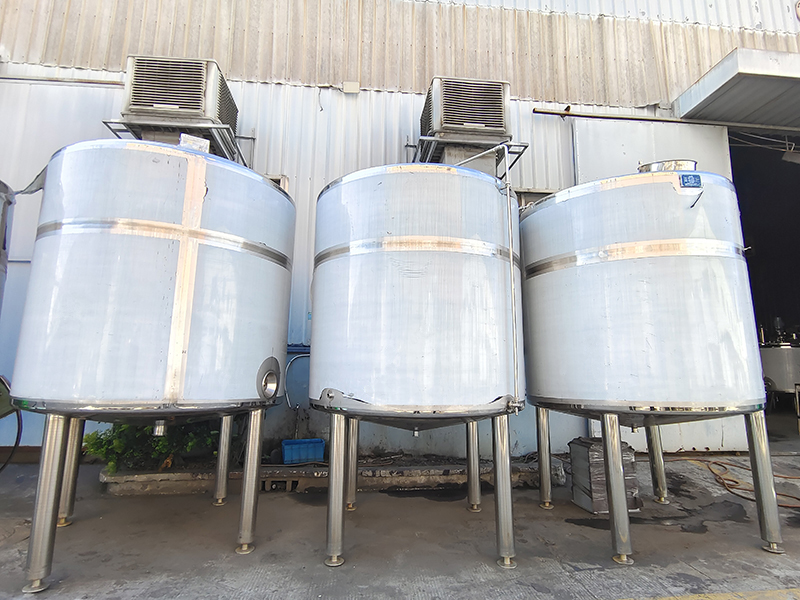
Elevated feed tank: elevation provides suction head, the level band provides the control margin.
Level Control and the Feed Pump
You have two ways to keep the level steady: modulate the incoming flow, or modulate the outgoing flow. Modulating the inlet with a valve on the feed from the raw tank is the common arrangement, because it keeps the pasteuriser rate fixed and that rate is what your holding time and flow diversion are calibrated against.
A proportional or PID loop on level, driving a modulating valve or a VFD on the transfer pump, works well if the loop is tuned and the tank has enough volume to absorb the dead time. On a tank sized for two minutes of flow, no controller will save you — the loop will hunt and the pasteuriser flow will oscillate.
- Level transmitter with a 4–20 mA output, calibrated at commissioning against a dip tape.
- Low-level switch that stops the feed pump before the pump runs dry, not after.
- High-level overflow piped back to the raw tank, sized for the maximum inlet flow.
- Local indication so an operator can see the level without opening the HMI.
Line Design
Starving your pasteuriser at peak rate?
Send your line flow, product and available headroom. Zhongbo will size the elevated tank, the control band and the feed pump together, so the loop has something to work with.
Details That Cause Trouble Later
Foam space. The tank needs freeboard above the maximum level, because milk foams when it is pumped in from above the liquid line. Inlet piping should discharge below the surface, ideally through a dip tube, or you will be fighting level alarms caused by foam rather than by liquid.
CIP coverage. An elevated tank is harder to clean than it looks: the spray ball has to reach a small vessel with a sloped bottom, and the outlet has to drain completely. Specify a spray ball sized for the tank diameter, a bottom outlet flush with the dish, and a vent that is filtered so the tank does not pull in contaminated air as it drains.
Access. Someone will need to inspect the interior and change a gasket. A manway on a tank 3 m in the air needs a platform, not a ladder, and the platform needs to be designed with the tank rather than added afterwards.
Insulation. If the tank holds product for 10 minutes, insulation is optional. If it holds overnight during a shutdown, it is not, and neither is a cooling jacket. Decide which duty you actually have before the fabrication drawing is issued.
Where It Sits in the Line
The tank feeds the plate pasteurizer inlet, usually through a feed pump with a VFD. Between the tank and the pasteuriser you normally find the flow meter, the pressure gauge that the differential protection depends on, and a sample point. Keeping that run short makes all three easier to trust.
A high level tank is a good place to inject minor ingredients that must be dosed at a steady rate into the flowing stream, because the flow rate at that point is controlled. It is a poor place to dump powder, which will float, foam and block the outlet strainer.
For the wider question of how much inventory a dairy line needs between stages, our guide to buffer tanks in dairy processing covers the sizing logic stage by stage, and aseptic vs atmospheric vs pressure buffer tanks explains when a simple atmospheric vessel stops being acceptable.
The physical unit is a straightforward stainless vessel — see the high level tank specification for capacities and outlet arrangements — but the design conversation is about control, not about litres.
Frequently Asked Questions
Can a high level tank double as a balance tank?
Sometimes, if the diverted product can return to it and the level control can absorb the extra volume without overflowing. Many designs keep them separate because the balance tank receives hot diverted product and the high level tank feeds cold raw product, and mixing the two makes the inlet temperature control harder.
What happens if the tank runs empty?
The feed pump loses suction, the pasteuriser flow drops, and the flow diversion device may trip on low flow or the differential may sag. Both are nuisance stops that cost product. A low-level switch that stops the pump cleanly, plus a hold time above five minutes, prevents most of them.
Does the tank need a cooling jacket?
Only if it holds product for long periods, for example overnight between shifts. For a 10 to 20 minute hold on a running line, insulation is enough and a jacket adds cost and cleaning surface for no benefit. If you do fit one, it needs its own drain and a glycol circuit.
Why is my level reading unstable?
Usually foam or a vortex at the inlet, not the instrument. Radar can read foam as product; a stilling well or a guided-wave probe fixes it. Also check that the transmitter is not mounted directly above the inlet stream, which gives you a permanently noisy signal.
Can the tank be at floor level with a pump instead?
Yes, and this is common on skid-mounted lines. You lose the positive suction head, so the pump has to be selected for the lower NPSH available, and the control loop has to hold the pasteuriser inlet pressure rather than rely on gravity. It works, but the pump selection becomes more critical.
How much static head do I need for a centrifugal pump?
1.5 m above the pump inlet is a safe general figure for cool milk, giving about 0.15 bar. For hot product, work out NPSHa from the vapour pressure at the pumping temperature; at 80 °C the margin you need roughly quadruples.
Is stainless 304 acceptable?
For milk and most beverages yes, with a good interior finish. If the tank will see acidified products, high-chloride water or aggressive CIP chemistry, 316L is the safer specification and the price difference is small relative to the fabrication cost.
How is the tank cleaned?
As part of the line CIP, with the spray ball running and the outlet open to the return. Because it is small, cleaning is quick, but the spray ball must be sized for the diameter — an oversized ball in a small tank floods the vent, and an undersized one leaves the shoulder unwashed.
Can it be used with a homogeniser upstream?
Yes, but the homogeniser changes the flow characteristic, and a piston homogeniser delivers pulsating flow. Put the tank upstream of the homogeniser where possible, or fit a pulsation dampener between them, otherwise the level will oscillate at the homogeniser frequency.
What size tank do most 5,000 L/h lines use?
Somewhere between 800 and 1,500 L working volume, which is 10 to 18 minutes at design flow. Larger tanks appear on lines with frequent upstream interruptions, but at that point you are really buying a buffer tank and should size it as one.
Final Thoughts
A high level tank is a control device that happens to be made of stainless steel. Size it on flow and hold time, not on the volume of a tanker, and check that the elevation still gives you suction head after the pipe run is counted. Keep the run to the pasteuriser short, put the level loop on the inlet, and give the tank enough freeboard for foam. Get those four things right and the pasteuriser will run at a steady rate all day, whatever happens upstream.