

What Is a Pasteurizer and How Does It Work in Milk Processing?
A pasteurizer is the piece of equipment that makes raw milk safe and shelf-stable without sterilizing away its nutrition and flavor. It heats milk to a precise temperature, holds it just long enough to inactivate pathogens and spoilage organisms, then cools it rapidly. In modern dairies this happens continuously, automatically, and under tight temperature control — and the same principle extends to juice, plant-based drinks, and many liquid foods.
Zhongbo builds pasteurizers as part of its HTST & UHT treatment range. This article explains what a pasteurizer is, the steps inside it, and why the design details matter for milk quality.
Why Pasteurize Milk at All?
- Food safety: destroys pathogens such as Salmonella, Listeria, and E. coli.
- Shelf life: slows spoilage organisms so chilled milk lasts days to weeks instead of hours.
- Consistency: standardized thermal treatment gives predictable, repeatable product.
Pasteurization is not sterilization — it targets harmful and spoilage organisms while keeping most nutrients, enzymes, and flavor intact. That is why “minimal effective heat” is the design goal.
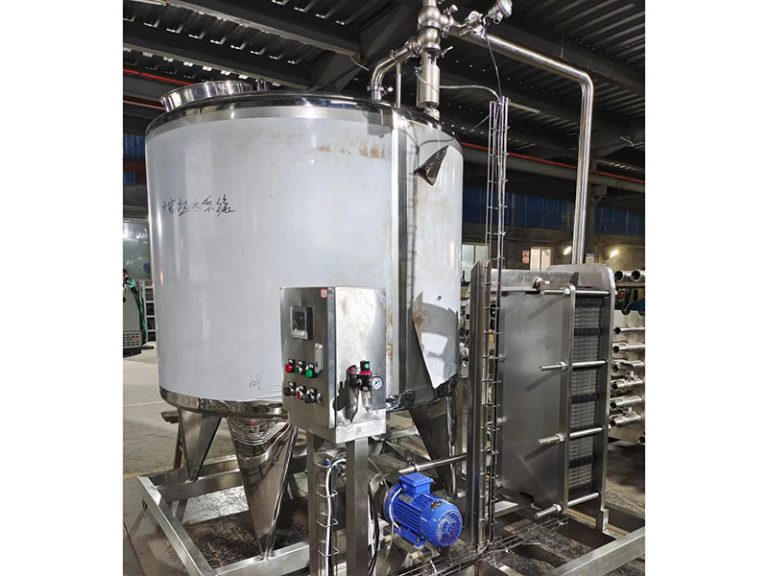
The Core Components of a Milk Pasteurizer
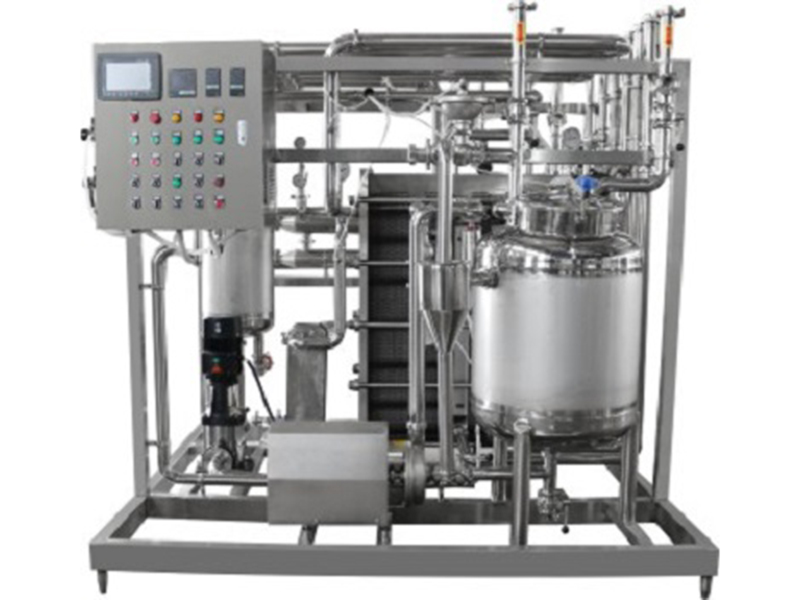
A continuous (HTST) milk pasteurizer is a loop of linked modules:
- Balance / buffer tank — steadies feed pressure (see Zhongbo buffer tanks).
- Regeneration section — hot pasteurized milk pre-heats incoming cold milk, recovering most of the energy.
- Final heater — lifts milk to pasteurization temperature (often via hot water or steam through a heat exchanger).
- Holding tube — holds milk at temperature for the required time (the legal “hold”).
- Flow diversion valve — sends any under-temperature milk back, never to the filler.
- Cooler — brings milk down to filling temperature.
- CIP loop — cleans the whole path without dismantling (Zhongbo CIP systems).
How the Process Works, Step by Step
1. Cold milk in
Raw, chilled milk enters from the balance tank and is pumped through the regeneration section.
2. Regeneration
Incoming cold milk picks up heat from outgoing hot milk. Up to ~95% of the heating energy is recovered here, so only a small final boost is needed.
3. Final heating to temperature
The heater raises milk to the pasteurization setpoint (for milk, commonly 72°C for 15 seconds in HTST).
4. Holding
Milk flows through the holding tube at controlled velocity so every particle spends the full required time at temperature.
5. Diversion check
If temperature drops below setpoint, the flow diversion valve returns the milk to the tank. Only in-spec milk proceeds.
6. Cooling and filling
Milk is cooled and sent to the filler or downstream process. The path is then cleaned in place.
Plate vs Tubular in Milk Processing
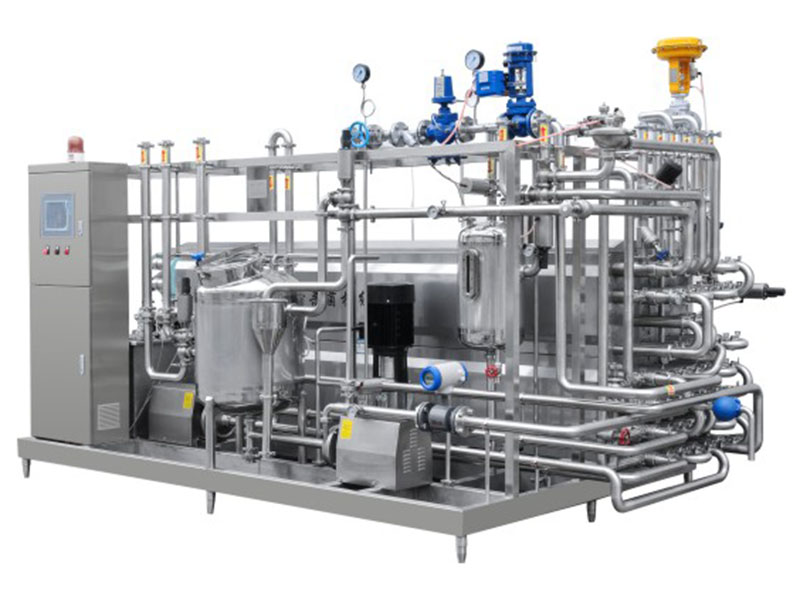
For standard, particle-free milk, a plate pasteurizer gives the best regeneration and lowest footprint. When the recipe includes cultured, viscous, or particulate dairy (yogurt base, cheese curd streams), a tubular pasteurizer avoids fouling and is easier to keep clean.
HTST vs UHT: A Quick Note
HTST pasteurization (e.g., 72°C / 15 s) keeps milk refrigerated. UHT (≈135–140°C for 2–5 s) gives ambient shelf stability. Both are thermal treatments; the difference is temperature, hold time, and the filling environment. The choice between them — and how they compare with package sterilization — is covered in our guide to UHT treatment vs package sterilization.
Key Parameters to Get Right
| Parameter | Why it matters |
|---|---|
| Temperature | Sets the log reduction of pathogens |
| Hold time | Must match temperature for a valid process |
| Flow rate | Controls residence time in the holding tube |
| Regeneration | Drives energy cost down |
| CIP validity | Keeps the path hygienic between runs |
Frequently Asked Questions
Does pasteurization kill all bacteria?
It inactivates pathogenic and most spoilage bacteria to a safe level. UHT approaches commercial sterility; HTST targets pathogens and extends refrigerated shelf life.
Is pasteurized milk less nutritious?
Proper pasteurization causes only minor losses of heat-sensitive vitamins; the safety and shelf-life gain far outweighs them.
Why is the holding tube important?
It guarantees every particle reaches the required time at temperature — the legal basis of a valid pasteurization process.
Can one pasteurizer handle milk and juice?
Yes, with validated CIP between products and the right exchanger type for each (plate for clean, tubular for pulp).
Build Your Milk Pasteurization Line With Zhongbo
From the balance tank to the flow diversion valve and CIP, Zhongbo designs pasteurizers matched to your milk profile, throughput, and filling setup. Tell us your target shelf life (refrigerated or ambient) and we will specify the HTST or UHT configuration that fits.