How to size the compressed-air cushion that protects glass, cans, HDPE, and pouches during 115–135 °C continuous thermal sterilization.
Zhongbo Engineering Team | Beverage Thermal Processing Group
Zhongbo Machinery designs turnkey beverage and dairy processing lines — including continuous tunnel spray sterilizers, falling-film evaporators, and UHT systems — engineered to international sanitary standards (ISO 9001:2015, FDA 21 CFR 113, EU 852/2004).
Why Overpressure Matters in Continuous Beverage Retorts
When a beverage container enters a continuous retort or spray tunnel, the heating medium (saturated steam at 115–135 °C) creates an internal chamber pressure of roughly 1.7 to 3.2 bar absolute. The product inside the sealed container simultaneously builds its own internal pressure as water and dissolved gases expand — but at a much lower rate than the surrounding steam.
This pressure mismatch creates two failure modes:
- If the external pressure rises faster than the internal pressure (the typical case at the start of the heating ramp), the container is crushed inward. Glass bottles crack. Tin cans buckle. Pouches collapse.
- If the internal pressure rises faster than the external pressure (the typical case during sudden cooling), the container bursts outward. Lids pop off glass jars. Pouch seals delaminate.
Overpressure — supplied as compressed air on top of the saturated steam — solves both failure modes by elevating the external chamber pressure to match, or slightly exceed, the rate at which internal product pressure is building. Without it, no modern continuous retort system can commercially process glass, HDPE, or flexible packaging at temperatures above 100 °C.

What Exactly Is Overpressure?
Overpressure (OP) is the additional compressed-air pressure layered on top of the saturated steam pressure inside the retort or spray tunnel chamber, expressed in bar (gauge). It is calculated relative to atmospheric pressure:
Overpressure (bar, gauge) = P_chamber (absolute) − P_atmospheric (absolute)
The chamber pressure itself is the sum of two contributors:
- Saturated steam pressure (P_steam): A thermodynamic property of water at the sterilization temperature (e.g., 1.98 bar absolute at 121 °C, 3.17 bar absolute at 135 °C).
- Compressed-air cushion (P_air): The overpressure we are intentionally adding to protect container integrity.
Total chamber pressure: P_chamber = P_steam + P_air. The compressed-air component is what engineers call “overpressure” in day-to-day retort terminology.
The Core Calculation Formula
The design target for overpressure is the pressure differential (ΔP) between the chamber and the container interior:
ΔP = P_steam(T_sterilization) − P_internal(product, T)
Where:
- P_steam(T_sterilization) is the saturated steam pressure at the target sterilization temperature, read from a steam table (e.g., 2.0 bar at 121 °C, 2.7 bar at 128 °C, 3.2 bar at 135 °C).
- P_internal(product, T) is the pressure developed inside the container at the same temperature, which is the sum of the headspace gas pressure at fill (typically 0.2–0.5 bar gauge for hot-fill beverages, near zero for vacuum-sealed cans) plus the vapour pressure contribution of the product at temperature.
The compressed-air overpressure to apply is then:
P_air = ΔP + P_safety_margin
A typical safety margin is 0.2 to 0.4 bar above ΔP, depending on container rigidity and the steepness of the heating ramp. Glass and HDPE need the higher end of that margin because they have low deformation tolerance.
Worked example (121 °C sterilization, glass bottle, 0.3 bar gauge headspace):
- P_steam at 121 °C = 1.98 bar absolute (≈ 1.0 bar gauge at sea level)
- P_internal at 121 °C ≈ 0.3 bar (headspace) + 1.0 bar (water vapour) ≈ 1.3 bar absolute
- ΔP = 1.98 − 1.3 = 0.68 bar
- Add 0.3 bar safety margin → set P_air = ~1.0 bar
- Total chamber pressure ≈ 1.98 + 1.0 = 2.98 bar absolute
This 1.0 bar of compressed-air overpressure is exactly the “0.7–1.5 bar glass window” you will find in the quick-reference table below.
Recommended Overpressure Windows by Container Type
The acceptable overpressure window is set by the container’s deformation tolerance and seal strength. Containers that flex easily (pouches) need only a small overpressure cushion. Rigid containers (glass, tinplate) need higher overpressure to keep wall stress within their elastic range.
| Container | Sterilization T | P_steam (bar abs.) | OP Window (bar gauge) | Failure Mode If OP Too Low |
|---|---|---|---|---|
| Glass bottle (lug cap) | 121 °C | ~1.98 | 0.7 – 1.5 | Bottle crush, cap blow-off |
| Tinplate can (3-piece) | 121 °C | ~1.98 | 0.3 – 0.8 | Paneling, double-seam distortion |
| Aluminum can (2-piece) | 121 °C | ~1.98 | 0.4 – 0.9 | Can collapse, score line stress |
| HDPE rigid bottle | 121 °C | ~1.98 | 0.5 – 1.0 | Bottle bulge, wall thinning |
| PP rigid bottle | 121 °C | ~1.98 | 0.4 – 0.8 | Deformation, seal failure |
| Retort pouch (alu laminate) | 121 °C | ~1.98 | 0.1 – 0.3 | Pouch burst, seal delamination |
| PET (hot-fill only) | 95 °C | ~0.85 | 0.2 – 0.5 | Bottle shrinkage, base failure |
Overpressure Quick-Reference Card
Bookmark this section — it condenses the most-asked sizing questions into a single lookup. For a given sterilization temperature and container, find the recommended overpressure window in one glance.
📋 Field Engineer’s Overpressure Card (121 °C baseline)
Engineering Control: How Zhongbo Locks In ΔP
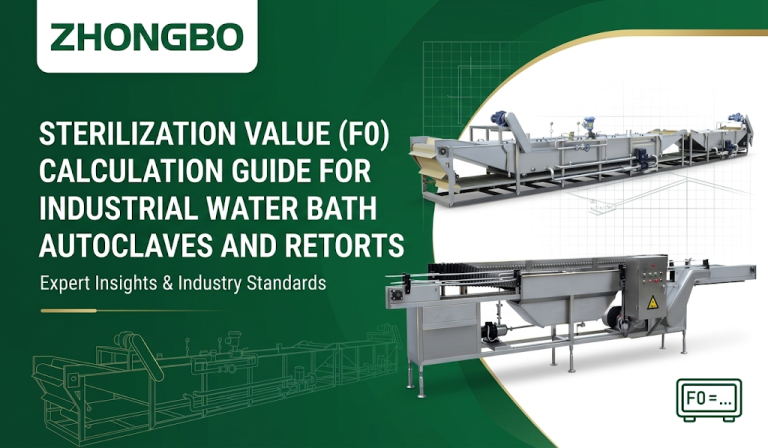
Zhongbo’s Continuous Tunnel Spray Sterilizer divides the heating/cooling curve into four PLC-controlled zones — preheating, sterilizing, warm cooling, and cold cooling — each with its own temperature and pressure set-point. Three control loops maintain overpressure stability:
- Steam pressure loop — a proportional valve modulates saturated steam injection to hold the sterilization-zone temperature at ±0.5 °C of the target (typically 121 °C).
- Compressed-air loop — a pressure transmitter downstream of an air-over-steam mixer maintains the overpressure set-point within ±0.05 bar throughout the entire cycle.
- Vent/relief loop — a safety relief valve set 0.2 bar above the OP set-point protects against PLC faults or steam-supply transients.
For batch-style or smaller-volume operations, the Zhongbo Water Bath Sterilizer provides the same overpressure logic in a smaller footprint, suitable for R&D lines, pilot plants, and small SKUs.
For beverages that can be sterilized upstream before packaging — typically low-viscosity clear drinks, plant-based milks, and UHT-grade products — an indirect UHT loop can replace post-packaging thermal processing entirely. For products requiring concentration before thermal processing, integrate a Falling Film Multi-Effect Evaporator upstream of the sterilization train.
Step-by-Step Sizing Procedure
Use this five-step procedure to size overpressure for any new continuous retort line:
- Step 1 — Define the sterilization temperature. Read P_steam from a saturated steam table at that temperature. Example: 128 °C → 2.67 bar absolute.
- Step 2 — Characterize the container. Note material (glass / tinplate / HDPE / pouch), nominal volume, headspace pressure at fill (typically 0.2–0.5 bar gauge for hot-fill products, near zero for vacuum cans), and the manufacturer’s stated deformation pressure.
- Step 3 — Estimate the internal product pressure at sterilization T. P_internal = P_headspace + P_water_vapor(T). For a 0.3 bar hot-fill headspace at 121 °C, P_internal ≈ 0.3 + 1.0 = 1.3 bar absolute.
- Step 4 — Compute ΔP and add the safety margin. ΔP = P_steam − P_internal. Add 0.2–0.4 bar margin depending on container rigidity. Result is the OP set-point.
- Step 5 — Verify against the container’s deformation pressure. Total chamber pressure (P_steam + OP) must remain below the manufacturer’s published deformation pressure for the specific container SKU. If it exceeds, the OP set-point is wrong and must be re-checked against the actual fill temperature and headspace.
Five Sizing Mistakes That Cause Container Failure
- Using steam table pressure as the chamber pressure. The chamber pressure is steam + compressed air. Sizing for “sterilization at 121 °C = 2 bar” alone ignores the air cushion entirely.
- Ignoring the headspace gas at fill. Carbonated beverages (0.5–1.5 bar CO₂) and hot-fill products (0.3–0.5 bar) develop very different internal pressure curves. A single “OP = 0.7 bar” rule fails across product categories.
- Using the same OP set-point for heating and cooling. Most container failures occur during the cooling ramp. The OP set-point should be re-validated for each thermal phase, not just held constant from come-up to cook.
- Over-pressurizing pouches to “be safe”. Flexible packaging has a tight elastic range. Excess OP will delaminate seals rather than protect them. The 0.1–0.3 bar pouch window is narrow — respect it.
- Skipping the air-supply sizing. A 2 m³/s continuous tunnel can require 200–400 m³/h of compressed air at 4 bar to maintain OP. Under-sized air compressors cause OP droop and container crush. For more context on CIP and utility design, see the related HTST vs. UHT pasteurization guide.
FAQs
Q1: What is overpressure in a continuous beverage retort?
Overpressure is the additional compressed-air pressure added on top of saturated steam inside a retort or spray tunnel chamber, expressed in bar (gauge). It protects containers from crushing during the heating ramp and from bursting during cooling by matching the rate of internal product pressure buildup. Contact our engineers →
Q2: Why is overpressure necessary during thermal sterilization?
Without overpressure, the external chamber pressure (saturated steam at 1.7–3.2 bar absolute) would exceed the internal product pressure early in the heating ramp, crushing glass, HDPE, and pouch containers. Overpressure aligns the two pressure curves and keeps the differential within the container’s elastic deformation range.
Q3: How do you calculate the overpressure value for a glass bottle retort?
Use ΔP = P_steam (at sterilization T) − P_internal (product vapour pressure at T), then add 0.2–0.4 bar safety margin. For 121 °C sterilization of a 0.3 bar hot-fill glass bottle, the result is typically 0.7–1.5 bar of compressed-air overpressure.
Q4: What overpressure range is recommended for tin cans and aluminum containers?
Tinplate (3-piece) cans typically use 0.3–0.8 bar; aluminum (2-piece) cans use 0.4–0.9 bar. Cans are more deformation-tolerant than glass, so the safety margin can be smaller, but the paneling failure mode (can wall buckling inward) is still the primary risk if OP is under-sized.
Q5: Do retort pouches need overpressure control?
Yes, but the window is much smaller: 0.1–0.3 bar at 121 °C. Pouches have very low elastic deformation tolerance — too little OP and they collapse, too much and the seals delaminate. The narrow window is why continuous retort systems for pouches need PLC pressure control within ±0.05 bar.
Q6: What is the relationship between sterilization temperature and saturated steam pressure?
Steam pressure rises exponentially with temperature. Key reference points: 115 °C ≈ 1.70 bar abs., 121 °C ≈ 1.98 bar abs., 128 °C ≈ 2.67 bar abs., 135 °C ≈ 3.17 bar abs. Higher sterilization temperatures demand correspondingly higher overpressure capacity from the compressed-air system.
Q7: How does the ΔP (pressure differential) affect container integrity?
ΔP is the load applied to the container wall during the sterilization hold. If ΔP exceeds the container’s deformation pressure (e.g., 4 bar for typical glass, 6 bar for tinplate), the wall yields permanently. The OP set-point is engineered so that ΔP stays within the elastic range throughout the entire ramp-hold-cool curve.
Q8: What role does compressed air play in maintaining overpressure?
Compressed air is the overpressure medium. It is injected into the chamber via an air-over-steam mixer upstream of the spray nozzles, or via a separate air manifold with its own pressure regulator. Oil-free, food-grade compressed air is required to avoid product contamination in the event of a seal failure.
Q9: How does Zhongbo ensure overpressure stability across multi-zone spray tunnels?
Zhongbo’s continuous tunnel uses independent PLC pressure transmitters in each zone, with PID-controlled proportional valves modulating compressed-air injection. Typical control accuracy is ±0.05 bar, well within the deformation tolerance of glass, HDPE, and pouch packaging. View the Zhongbo Tunnel Spray Sterilizer →
Q10: Which international standards govern overpressure in retort systems?
Key references: FDA 21 CFR 113 (Thermally Processed Low-Acid Foods Packaged in Hermetically Sealed Containers), EU Regulation 852/2004 on food hygiene, GB 31607-2021 (China national standard for sterilized milk), and 3-A Sanitary Standards for processing equipment. Compliance documentation should be requested from the equipment supplier before commissioning. Request a compliance package →
Related Resources
Zhongbo published guides (linked):
- Aseptic UHT vs. In-Container Sterilization: Selecting the Right Thermal Process Line for Low-Acid Beverages — the upstream review article on which this overpressure guide expands.
- HTST vs. UHT Pasteurization for Dairy Lines: Process Selection & CIP Design — for beverage lines that use pasteurization instead of full sterilization.
- The Ultimate Guide to Indirect UHT Sterilizers — for products that can be sterilized upstream before packaging.
- How HTST & UHT Treatment Eliminates Chemical Preservatives in Commercial Milk Processing — the clean-label angle on thermal processing.
Recommended future Zhongbo posts:
- Spray Tunnel CIP Cleaning Cycle Design for Beverage Plants — pairs with this overpressure guide for full line design.
- Container Selection for Continuous Retort Systems: Glass vs. Can vs. Pouch — extends the quick-reference table into a full decision matrix.
- Compressed Air System Design for Retort Overpressure Control — sizing the utility side of OP delivery.
- F₀, D, and Z Value: A Practical Calculation Guide for Sterilization Engineers — the lethality reference that pairs with any overpressure discussion.
- FDA 21 CFR 113 Compliance Checklist for Low-Acid Canned Beverage Manufacturers — the regulatory side of OP documentation.
Plan Your Next Continuous Retort Line with Zhongbo
From overpressure set-point calculation to multi-zone PLC control, Zhongbo engineers tunnel spray sterilizers, water bath sterilizers, and complete retort-ready beverage lines to FDA 21 CFR 113, EU 852/2004, and GB 31607-2021.
View Continuous Tunnel Spray Sterilizer → Request a Retort Sizing Consultation →
Published by Zhongbo Machinery — Beverage Thermal Processing Group. This article is intended for engineering and procurement decision-makers evaluating continuous retort and spray tunnel systems. Specifications and overpressure windows are typical values; final sizing must be validated with the equipment manufacturer and your specific container SKU. Last updated July 2026.