

Introduction
Sand and carbon are often sold as a pair, bolted together on one skid, and described as if they did the same job twice. They do not. One removes things you can see; the other removes things you cannot taste until the product is packed. Getting the order wrong, or sizing the carbon like the sand, is one of the most common reasons a new beverage plant fails its first water test. Here is what each stage does and how to size both.
What Each Stage Removes
| Contaminant | Quartz sand / multimedia | Activated carbon |
|---|---|---|
| Suspended solids, turbidity | Yes — the main duty | Some, but it blinds the bed |
| Free chlorine | No | Yes, fast and complete |
| Chloramine | No | Slowly — needs long contact time |
| Colour, taste and odour | Minimal | Yes, the main duty |
| Dissolved organics, THM precursors | No | Yes, by adsorption |
| Hardness, dissolved salts | No | No — that is softening or RO |
Sand is a mechanical filter: particles are trapped in the voids between grains, and backwashing lifts the bed and flushes them out. Carbon is an adsorber: organics diffuse into the pore structure and stay there until the sites are full, at which point the bed is spent and backwashing will not revive it. One is reversible, the other is consumable. That single difference explains almost every design consequence.
Order Matters: Sand First, Always
Put carbon after sand for two reasons. First, solids in the feed blind the carbon bed and coat the granules, which blocks access to the pores and shortens bed life far more than the adsorption load alone would. Second, carbon is a nutrient-rich environment; if you feed it turbid water and let the bed sit, you grow biofilm on the granules.
The standard train is: raw water, sand or multimedia, activated carbon, softener if hardness matters, a 5 µm guard filter, then RO or the process. If you run a chlorinated municipal supply, the carbon also protects the RO membrane from chlorine attack, which is the fastest way to destroy a polyamide element.
If you only have room for one vessel: choose multimedia sand for surface water and carbon for chlorinated municipal water. Do not put carbon first because it is the stage people associate with “taste”.
Sizing the Sand Filter
Sand is sized on service velocity and bed depth. For a multimedia bed, design on 8 to 12 m/h of empty-bed velocity, with a bed depth of 800 to 1,200 mm over a gravel support layer. Velocity higher than that gives you short runs between backwashes; much lower gives you a vessel so wide it costs more than the media saves.
Worked example for 10 m³/h at 10 m/h: area = 1.0 m², which is a 1,130 mm diameter vessel. Add 40 to 50% freeboard above the bed for expansion during backwash, plus the gravel layer, and you have the straight shell height.
- Backwash at 40–50 m/h, which lifts the bed 30–50% and carries the trapped solids to drain.
- Air scour before the water backwash cuts wash water by a third on heavily loaded beds.
- Run to a turbidity target, not a timer — a timer either wastes water or leaves the bed dirty.
- Differential pressure across the bed tells you when to backwash; a 0.5–0.8 bar rise is a reasonable trigger.
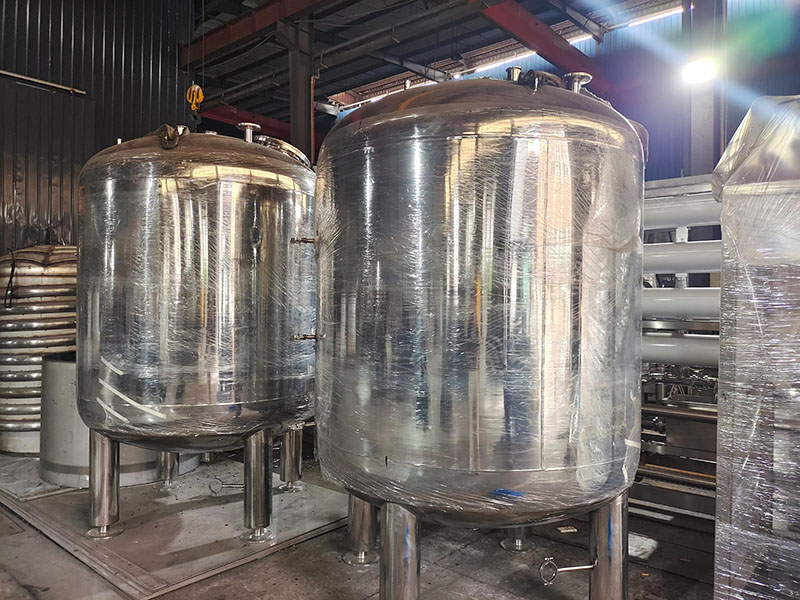
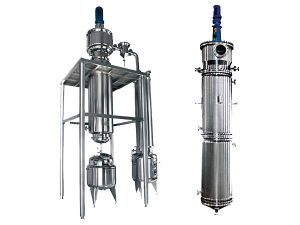
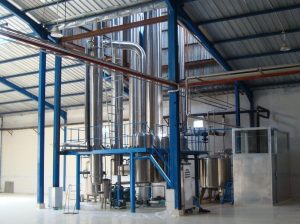
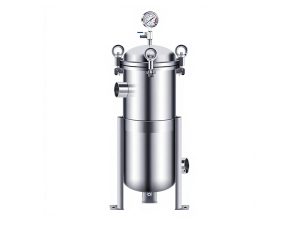
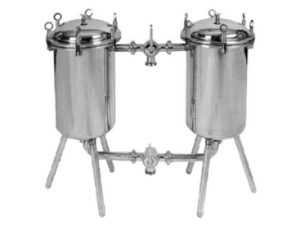
Sand and carbon vessels in series: the sand protects the carbon bed from solids, the carbon protects the membrane from chlorine.
Sizing the Carbon Filter: EBCT Is the Number
You cannot size carbon on velocity alone, because adsorption needs contact time. The design parameter is empty bed contact time — the bed volume divided by the flow rate. For chlorine removal, 5 to 10 minutes is often enough. For taste, odour, colour and organics, 10 to 20 minutes is the working range, and chloramine removal wants the top of that range or more.
Worked example at 10 m³/h with a 10-minute EBCT: bed volume = 10 × (10 ÷ 60) = 1.67 m³. In a 1.13 m diameter vessel (1.0 m² area), that means a bed depth of 1.67 m — noticeably taller than the sand bed. This is why carbon vessels are tall and why replacing a sand vessel with a carbon vessel of the same dimensions never gives you the contact time you need.
Carbon depth also has a practical floor around 700–800 mm. Below that, the mass transfer zone reaches the bottom of the bed before the top is exhausted and you get premature breakthrough.
Water Pretreatment
Two vessels, one skid, and a flow rate that keeps changing
Send us your raw water analysis and peak flow. Zhongbo will size vessel diameter, bed depth and backwash rate for both stages, and tell you honestly if one of them is unnecessary.
When the Carbon Is Finished
Carbon does not fail visibly. It simply stops removing what you bought it for, and the first sign is usually a taste panel result or a chlorine breakthrough at the outlet. Track three things: outlet free chlorine, outlet UV absorbance at 254 nm, and the total organic carbon if you have the instrument. A rising trend on any of them means the bed is approaching exhaustion.
Bed life depends on the organic load, not on the calendar. A surface water source can exhaust a carbon bed in months; a clean municipal supply can last a couple of years. When you replace it, expect fines: fresh carbon is dusty, and the guard filter downstream will load quickly for the first week or two.
Carbon beds also harbour bacteria if they sit idle. If your plant runs five days a week, either keep water moving through the bed or plan a sanitisation step. That is a design decision worth making at the drawing stage, because retrofitting a hot water sanitisation loop into a vessel that was not built for it is expensive.
Common Design Errors
The first is a single combined vessel with sand and carbon in one shell. It looks compact and it ruins both stages: you cannot backwash the sand at the right rate without fluidising the carbon, and you cannot replace the carbon without disturbing the sand.
The second is sizing on average flow. Backwash, CIP and filler peaks all draw more than the average, and a vessel sized for the average will run at double velocity during a peak, which shows up as turbidity breakthrough exactly when demand is highest.
The third is omitting the guard filter. Carbon fines and sand fines both travel, and the first thing downstream is usually a reverse osmosis system whose membranes are expensive to replace. A precision filter at 5 µm costs a fraction of a membrane set.
For the full picture of how these stages interact with softening, RO and UV, see process water treatment for food and beverage plants, and for why the whole train matters in a dairy, water treatment for dairy plants. The sand and activated carbon filtration system page lists the standard vessel configurations.
Frequently Asked Questions
How often should the sand bed be backwashed?
Trigger on differential pressure and outlet turbidity rather than a fixed interval; most plants land between once and three times a day. A bed backwashed only when the differential alarm sounds is already passing solids, so set the trigger at around 0.5 bar rather than at the maximum.
Does carbon remove fluoride or nitrate?
No. Activated carbon adsorbs organics and reduces chlorine; it does not remove dissolved inorganic ions to any useful degree. Fluoride, nitrate and hardness need reverse osmosis, ion exchange or a specific media. If a supplier offers carbon for nitrate removal, ask for the mechanism.
Can I use sand filtration on well water with iron?
Only if the iron is already oxidised. Ferrous iron passes straight through a sand bed and then stains everything downstream. You need oxidation first — aeration, chlorine or an oxidising media — and then filtration. Test for iron species before choosing the media.
What is the difference between GAC and PAC?
Granular activated carbon sits in a bed and is backwashed in place; powdered activated carbon is dosed into the water as a slurry and removed by the sand filter. GAC suits continuous duty and is easier to operate; PAC suits seasonal taste and odour events because you can dose only when needed.
Why does the carbon outlet smell worse than the inlet?
The bed has gone anaerobic or developed biofilm. Carbon consumes dissolved oxygen and, if water sits stagnant for days, sulphate-reducing bacteria produce a sulphidic odour. Backwash, sanitise, and keep the bed flowing rather than letting it stand full.
How much water does backwashing use?
Plan on 2–5% of production for a sand bed and a similar figure for carbon, depending on the load and the rinse discipline. Air scour followed by a shorter water wash is the standard way to cut it. If you are recycling backwash water, send the early dirty portion to drain and recover the later rinse.
Can the two stages share one backwash pump?
Often yes, but the required rates differ: sand wants 40–50 m/h, carbon 25–35 m/h. A single pump with a throttling valve and a flow meter on the backwash line works; sizing the pump for the sand rate and throttling for the carbon is the usual compromise.
Do I need a softener before the RO if I have carbon?
If your water is hard, yes. Carbon does nothing for hardness, and hardness scales the RO concentrate side, which raises cleaning frequency and shortens membrane life. Softening upstream of the RO is cheaper than descaling membranes every quarter.
Is stainless required for the vessels?
For potable and product water, 304 is the norm and 316L is used where chlorides are high. FRP vessels are cheaper and common on RO pretreatment, but they cannot be steam sanitised and they are harder to inspect. Choose based on your sanitisation strategy, not on price alone.
How do I know the carbon needs replacing rather than backwashing?
If a full backwash and rinse does not restore chlorine removal or reduce colour, the adsorption sites are exhausted. Iodine number testing on a sample gives you a direct measure of remaining capacity; a lab result is more reliable than guessing from the calendar.
Final Thoughts
Sand and carbon are not interchangeable stages, and treating them as one is how plants end up with chlorinated feed water reaching a polyamide membrane. Put sand first, size carbon on contact time rather than flow, and keep a guard filter between the beds and anything expensive. Then watch the trend, not the calendar. A carbon bed tells you it is finished through a rising chlorine reading weeks before anyone notices a taste problem in the finished product. That early warning is the whole point.
Related Resources
Equipment on this site
- Quartz Sand & Activated Carbon Filtration Systems — the two pretreatment stages on one skid.
Further reading