


Introduction
Water quality is the hidden foundation of every dairy, beverage, and food plant. If the boiler scales, the pasteurizer fouls, or the final product carries off-tastes, the cause is often the water treatment system. Reverse osmosis (RO) is the standard for reducing dissolved solids, but a single pass may not be enough when the target is boiler feed, UHT makeup, or ingredient water. A double-pass RO system runs the permeate from a first RO stage through a second RO stage, squeezing conductivity, total dissolved solids (TDS), and silica to very low levels. This guide gives the benchmarks that define whether the system is doing its job.
What Double-Pass RO Means
In a single-pass RO unit, feed water is pressurized against a semi-permeable membrane; pure water passes through and the dissolved salts concentrate in the reject stream. A typical single-pass system rejects 97–99 % of dissolved ions. A double-pass system takes that already-purified permeate and runs it through a second RO stage. The result is permeate quality roughly one to two orders of magnitude better than a single pass, with conductivity often below 5 µS/cm and silica reduced to the parts-per-billion range.
Conductivity and TDS Benchmarks
Conductivity is the easiest online measure of RO permeate quality because dissolved ions conduct electricity. TDS is usually estimated from conductivity using a conversion factor, commonly 0.5–0.7 for RO water depending on the ion mix.
| Parameter | Feed water (typical) | Single-pass RO | Double-pass RO |
|---|---|---|---|
| Conductivity | 200–1,000 µS/cm | 5–20 µS/cm | 1–5 µS/cm |
| TDS (estimated) | 100–700 ppm | 3–14 ppm | 0.5–3 ppm |
| Rejection | — | 97–99 % | 99.5 %+ |
For boiler feed water, conductivity below 10 µS/cm is usually acceptable; for ingredient water in premium beverages, below 5 µS/cm is preferred.
Silica Rejection Rates
Silica is one of the hardest contaminants to remove because it is weakly ionized and can exist as dissolved silicic acid or colloidal silica. High silica leads to glassy scale on boiler tubes, UHT plates, and membranes themselves. A single-pass RO may remove 85–95 % of reactive silica; a double-pass system can push that to 98–99.5 %, leaving permeate silica below 0.1 ppm in many applications. For plants with high-silica source water, double-pass is usually the only practical way to meet boiler and process-water specs without chemical softening.
First Pass vs Second Pass
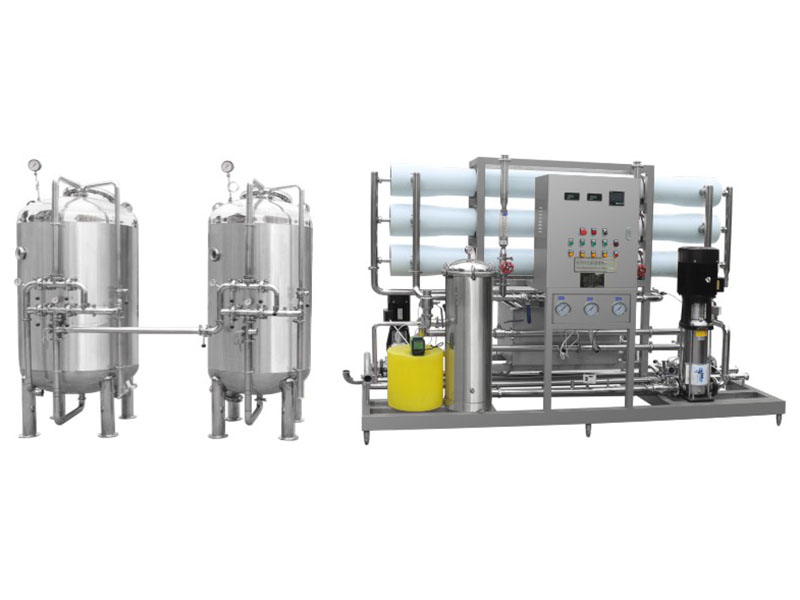
The first pass does the heavy lifting, removing the bulk of salts and organics at a higher recovery rate. The second pass polishes the permeate at lower recovery but much higher rejection. A typical configuration:
- First pass: 75 % recovery, permeate TDS ~10 ppm.
- Second pass: 85 % recovery of the first permeate, final permeate TDS ~1–2 ppm.
- Combined system recovery: roughly 60–65 % of feed.
The second-pass reject is usually cleaner than the raw feed, so it is recycled to the first-pass inlet rather than wasted.
Sizing and Recovery
Double-pass systems are sized on permeate flow and on the worst-case feed water analysis. Recovery is limited by scaling risk: if too much water is recovered, sparingly soluble salts (calcium carbonate, sulfate, silica) precipitate on the membrane. Antiscalant dosing, pH adjustment, and temperature control extend recovery, but practical limits are usually 60–70 % for double-pass systems on typical groundwater. Municipal water with lower hardness may allow slightly higher recovery.
Monitoring Instruments
A well-run double-pass RO should log: feed and permeate conductivity (each pass), pressure drop across each stage, temperature, flow rates, recovery percentage, pH, and oxidant level. The conductivity ratio between feed and permeate gives an instant rejection check. A sudden drop in rejection is often the first sign of membrane oxidation, scaling, or mechanical damage.
Specifying a Double-Pass RO
Provide the supplier with a full water analysis: TDS, conductivity, hardness, silica, chloride, sulfate, iron, manganese, organics, and turbidity. Also state required permeate flow, target conductivity, target silica, available feed pressure, and whether the water is for boiler feed, CIP, pasteurizer makeup, or direct ingredient use. The reverse osmosis purification system must be sized for the worst feed, not the average, because seasonal variation in source water can change TDS by 30 % or more.
Common Mistakes
- Sizing on average feed TDS. Seasonal peaks push the system out of spec.
- Ignoring silica. A single-pass system may meet TDS but fail silica.
- Over-recovery. High recovery looks efficient until scaling shuts the plant down.
- No pre-treatment. SDI and chlorine must be controlled before RO; otherwise membranes foul or oxidize.
FAQ
What conductivity should double-pass RO achieve?
Typically 1–5 µS/cm, depending on feed quality and membrane selection. Premium ingredient water targets the lower end.
Why is silica harder to remove than TDS?
Silica is weakly ionized and can be colloidal, so standard RO rejection is lower than for dissolved salts. Double-pass and proper pH control are usually needed for high-silica feeds.
Can I use double-pass RO water directly as boiler feed?
Yes, the low conductivity and silica make it excellent boiler feed, though additional polishing may be needed for high-pressure boilers.
What recovery is realistic?
60–70 % overall for double-pass on typical groundwater; higher on soft municipal supplies.
How often do membranes need cleaning?
When normalized pressure drop rises 10–15 % or permeate conductivity rises 10 %, clean-in-place. Frequency varies from weekly on challenging feeds to quarterly on clean water.
Conclusion
A double-pass reverse osmosis system is the practical way to reach low-conductivity, low-silica process water for dairy, beverage, and boiler applications. Expect permeate conductivity below 5 µS/cm, TDS below 3 ppm, and silica rejection above 98 % when the system is sized for the worst-case feed and recovery is kept within scaling limits. Specify from a complete water analysis and monitor conductivity, pressure drop, and recovery continuously; those three numbers tell you whether the membranes are healthy long before product quality drifts.