

Introduction
Milk, plant milk, and flavored beverages are all emulsions or suspensions: fat or oil droplets dispersed in water. To keep them stable, the droplets must be small and evenly distributed. Two technologies dominate: the high-shear emulsification tank, which shears the product in a batch vessel, and the high-pressure homogenizer, which forces it through a narrow valve. For many small-to-medium dairy and plant-milk lines, the in-tank shear approach is more flexible and far less capital-intensive, provided it is sized correctly.
What Emulsification Means
An emulsion is two immiscible liquids, one dispersed as fine droplets in the other. In milk the fat is dispersed in the aqueous phase; in plant milk the oil is dispersed similarly. Stability depends on droplet size, surfactant, viscosity, and the energy input used to create the droplets. Smaller droplets stay suspended longer and create the smooth mouthfeel consumers expect. Droplet size is controlled by mechanical shear energy, measured roughly as energy per unit volume.
How a High-Shear Emulsification Tank Works
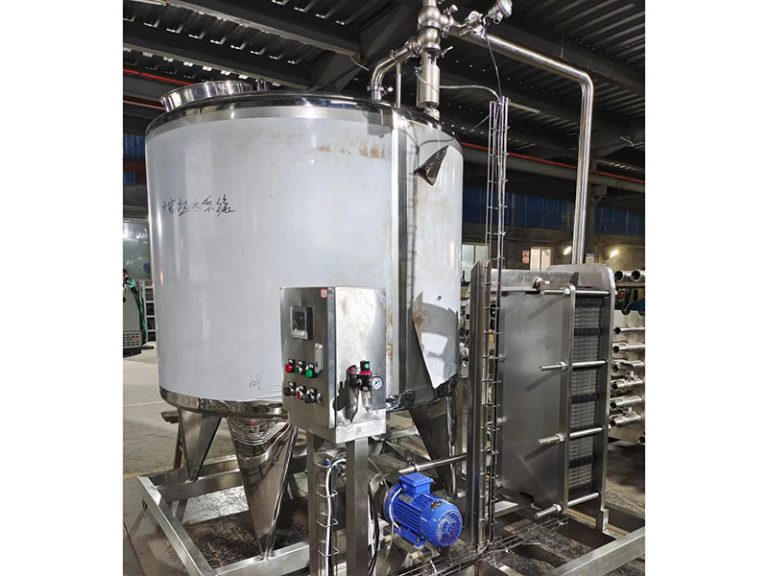
A high-shear emulsification tank has a rotor-stator mixer mounted in the vessel bottom or side. The rotor spins at high speed, drawing liquid through the stator head. The narrow gaps between rotor and stator create intense shear rates that break droplets into the micron range. Batch circulation keeps the entire vessel passing through the shear zone until the target droplet size is reached. Because the process is in-tank, it can also serve as the batching and holding vessel.

How a High-Pressure Homogenizer Works
A homogenizer forces product through a small adjustable valve at 100–250 bar. The pressure drop creates extreme turbulence, cavitation, and shear that reduces droplets to sub-micron size. It is the standard for UHT milk, cream, and long-life products because it delivers very small droplets and long-term stability. The downside is high capital cost, high-pressure pumps, wear on the valve, and continuous-flow operation that requires steady upstream supply.
When to Use an In-Tank Shear Mixer
- Batch sizes from a few hundred to several thousand litres.
- Products with moderate stability requirements, such as fresh milk, drinkable yogurt bases, and plant milks for short shelf life.
- Multi-product plants that switch formulations frequently.
- Lines where capital cost and floor space are limited.
- Applications where the same vessel is used for mixing, heating, cooling, and emulsifying.
When to Use a High-Pressure Homogenizer
- Continuous high-volume lines (>5,000 L/h).
- UHT or ESL products that must stay stable for months.
- Cream, condensed milk, and products needing sub-micron droplets.
- Applications where regulatory or customer specs require a specific homogenization pressure.
Comparison
| Factor | High-Shear Emulsification Tank | High-Pressure Homogenizer |
|---|---|---|
| Typical droplet size | 2–10 µm | 0.5–2 µm |
| Batch/continuous | Batch | Continuous |
| Capital cost | Lower | Higher |
| Floor space | Compact (one vessel) | Separate machine + buffer tanks |
| Maintenance | Rotor-stator wear | Homogenizing valve wear |
| Best for | Short-shelf, multi-product, medium scale | UHT, ESL, high-volume, long stability |
Milk and Plant Milk Applications
For standard pasteurized milk and plant milk sold chilled with a 7–14 day shelf life, a high-shear emulsification tank usually delivers adequate stability and a smoother texture. For UHT milk or products transported long distances without refrigeration, a homogenizer or a two-stage homogenizer is the safer choice. Many plants use both: the shear tank for batch preparation and a homogenizer for final finishing on the UHT line.
Specifying a High-Shear Emulsification Tank
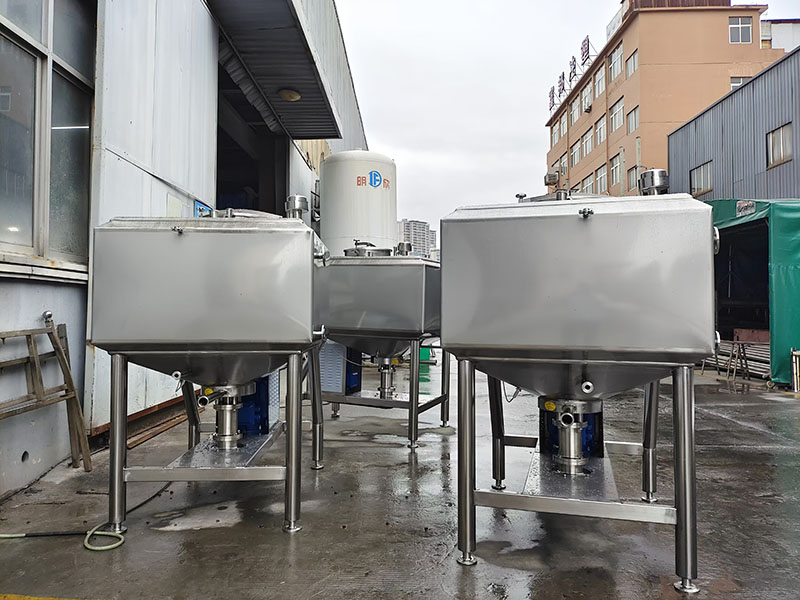
Key inputs: batch volume, target droplet size, product viscosity, temperature, desired batch time, and whether the vessel must also heat or cool. Power is typically 1–3 kW per 1,000 L for light emulsions and 3–6 kW per 1,000 L for viscous or high-oil products. The rotor tip speed, not just motor power, determines shear intensity. A high-speed emulsification tank variant offers even higher rotor speeds for fine emulsions.
Common Mistakes
- Choosing shear for UHT shelf-stable product. Droplets may be too large for long-term stability.
- Ignoring batch time. Short shear time gives coarse emulsion; over-shearing heats the product.
- Wrong vessel geometry. Poor circulation leaves dead zones where droplets remain large.
- Using a homogenizer for tiny batches. The minimum flow and high capital cost make it uneconomical.
FAQ
Can a high-shear tank replace a homogenizer?
For many short-shelf and medium-stability products, yes. For UHT and long-life products, a homogenizer still gives finer droplets.
What droplet size does a shear tank reach?
Typically 2–10 µm, depending on rotor speed, batch time, and product viscosity.
Is a high-shear tank cheaper than a homogenizer?
Yes—capital cost is lower and it combines mixing, heating/cooling, and emulsifying in one vessel.
When do I need two-stage homogenization?
For very high-fat products like cream or condensed milk, where the first stage breaks droplets and the second stage stabilizes them.
Does temperature affect emulsification?
Yes—warmer oils and fats are easier to shear, but excessive heat damages proteins and affects flavor.
Conclusion
High-shear emulsification tanks and high-pressure homogenizers both produce stable emulsions, but they serve different scales and shelf-life targets. For batch-scale dairy and plant-milk production with moderate stability needs, a high-shear emulsification tank is the flexible, compact choice. For high-volume UHT or ESL lines, a homogenizer remains the gold standard. Match the equipment to the droplet size the product actually needs, and avoid over-investing in pressure when shear in a tank will do the job.