


Introduction
When a product is already sealed in its final bottle, can, or pouch, “sterilization” means heating the container itself—not pumping liquid through a heat exchanger. This is in-container sterilization, and it is the backbone of shelf-stable sauces, ready-meals, pet food, dairy-based retorts, and a long list of herbal and beverage packs that cannot go through a tubular pasteurizer because they are too viscous, too particulate, or simply already packed.
The two workhorse machines for this are the tunnel spray sterilizer and the water bath sterilizer. They look similar and both use hot water, but they differ in how heat reaches the container, how uniform that heat is, and which packs they treat gently. This guide compares them so you can specify the right one instead of the cheaper one.
What “In-Container” Sterilization Means
Sterilization inside the container is governed by a lethal-dose calculation, usually expressed as F₀ (the equivalent minutes at 121 °C). To reach a given F₀ you must hold the cold spot of the product at temperature for a calculated time. The challenge is that heat moves slowly through a still pack, so the machine’s job is to deliver uniform temperature to every container’s cold spot without bursting flexible pouches or denting cans. Both tunnel spray and water bath systems do this with pressurized hot water; they differ in how they apply it.
Tunnel Spray Sterilizer
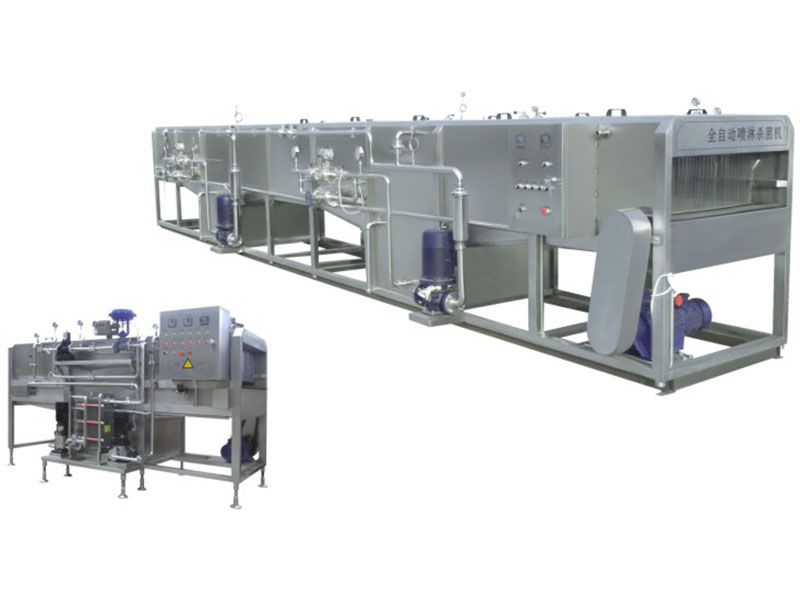
The tunnel spray sterilizer moves containers on a belt through a long tunnel divided into pre-heat, sterilization, and cooling zones. Pressurized hot water is sprayed through nozzles directly onto the moving containers.
How It Works
Containers ride a mesh belt; recirculated water is heated and forced through spray bars above and below the belt. Because water is sprayed, not immersed, the containers stay in a thin, well-mixed water film and heat (and cool) quickly and evenly. Counter-current water flow pre-heats incoming packs with outgoing heat, saving energy.
Best Applications
- High-throughput lines (hundreds to thousands of containers per minute) of bottles and cans.
- Products where fast, uniform heating protects texture and color.
- Lines that need continuous, in-line operation feeding a filler or labeller.
Temperature Uniformity & Spray Zones
Spray nozzles above and below the belt eliminate the top-to-bottom gradient you get in static baths. Well-designed tunnels hold container-to-container temperature spread within a few degrees, which lets you cuthold time (and F₀ margin) without under-processing. Uniformity is the spray tunnel’s headline advantage.
Water Bath Sterilizer
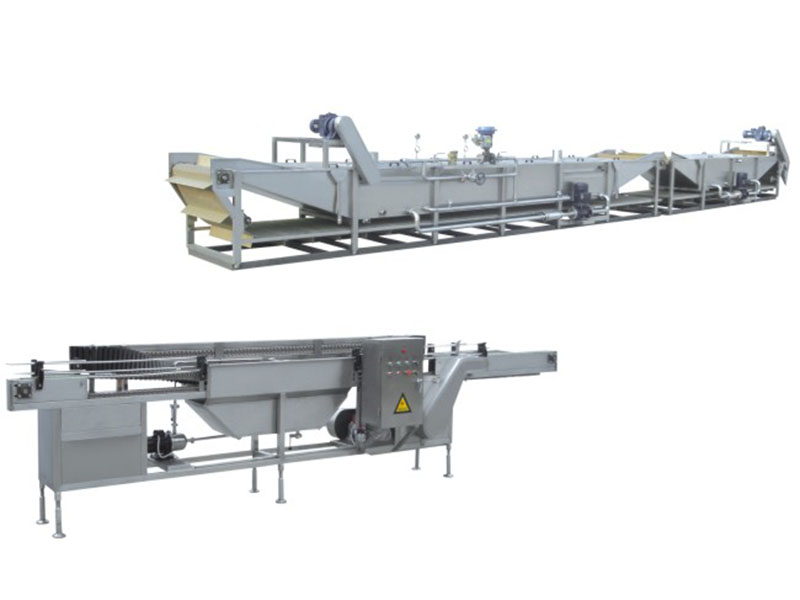
The water bath sterilizer immerses containers—usually in baskets or crates—in a full tank of heated, pressurized water, often with a slow agitator or water circulator.
How It Works
Crates of containers are loaded into a vessel flooded with hot water at the sterilization temperature and held under pressure. The water fully surrounds each pack, so conduction from all sides heats it. Cooling is by exchanging the hot water for cooled, pressurized water to avoid thermal shock.
Best Applications
- Batch or lower-throughput operations and variable pack sizes run in the same vessel.
- Fragile or irregular packs (retort pouches, trays, glass) that benefit from full immersion and support.
- Products where a gentle, fully submerged heat cycle matters more than line speed.
Counter-Pressure for Fragile Packs
Flexible pouches and thin-wall trays would burst when internal pressure exceeds external pressure as they heat. A water bath run with controlled over-pressure (air or water pressure above the vapour pressure at temperature) keeps the pack intact. This counter-pressure control is why pouches and delicate glass are usually batched in a water bath, not sprayed.
Side-by-Side Comparison
| Factor | Tunnel Spray Sterilizer | Water Bath Sterilizer |
|---|---|---|
| Container motion | Continuous belt | Batch (crates immersed) |
| Throughput | Very high, in-line | Moderate, batch |
| Temperature uniformity | Excellent (top/bottom spray) | Good (with circulator) |
| Best packs | Bottles, cans, rigid | Pouches, trays, glass, mixed |
| Counter-pressure control | Limited | Strong, precise |
| Changeover | Slower (belt/recipe) | Fast (swap crates) |
| Footprint | Long tunnel | Compact vessel(s) |
| Energy recovery | Counter-current water reuse | Heat retained in bath |
Throughput, Footprint & Energy
A tunnel spray line is the choice when volume justifies a continuous belt and you can dedicate it to a stable pack format—it uses counter-current water to recover heat and keeps labor low. A water bath needs less floor space per vessel and handles a mix of pack sizes in the same shell, but labor is higher (loading/unloading crates) and throughput is capped by batch size. For a plant running ten pack formats, water baths almost always win on flexibility; for a plant running one format at speed, the tunnel wins on cost per container.
How to Choose
- What is your throughput and is it one pack format or many? High & single → tunnel. Mixed → water bath.
- Are the packs fragile (pouch, tray, thin glass)? Yes → water bath with counter-pressure.
- Do you need in-line continuity feeding filler/labeller? Yes → tunnel.
- Is floor space tight but volume moderate? Water bath vessels fit a smaller hall.
- Is energy cost dominant? Tunnel’s counter-current recovery usually edges it.
Common Mistakes
- Buying on price, not pack. A cheap tunnel that dents your pouches is no bargain.
- Underestimating counter-pressure need. Pouches burst without it; specify it deliberately.
- Ignoring cold-spot validation. F₀ must be proven at the pack cold spot, not assumed from bath temperature.
- Skipping cooling control. Thermal shock cracks glass and bursts pouches if cooling water is not pressurized and staged.
FAQ
Which gives better temperature uniformity?
The tunnel spray sterilizer, because nozzles above and below the belt remove the top-to-bottom gradient. A water bath is close behind with a good circulator but cannot match a well-tuned tunnel.
Can a water bath sterilizer handle pouches?
Yes—this is its strength. Run with controlled counter-pressure, it sterilizes retort pouches and trays that a spray tunnel would damage.
Do I need counter-pressure?
If the pack is flexible or thin-walled glass, yes, to keep internal pressure from bursting it as it heats. Rigid cans in a tunnel usually do not need it.
Which is better for a small, mixed-pack plant?
A water bath sterilizer: one vessel handles many formats with fast changeover and strong counter-pressure.
Can I sterilize both bottles and pouches on one machine?
Not ideally. Bottles and cans suit a tunnel; pouches need a counter-pressure water bath. Run both only if the tunnel has a pouch-rated counter-pressure option, which is uncommon.
Typical Applications by Product
The choice shows up clearly once you map it to real products:
- Sauces, ketchup, and retorted ready-meals in cans or rigid bowls. High volume, rigid pack → tunnel spray sterilizer, often fed straight from the filler.
- Pet food in pouches and trays. Fragile, high-value, frequently format-changed → water bath sterilizer with counter-pressure; the pouch is the deciding factor.
- Dairy-based retort puddings and flavored milks. Sensitive to over-heating and often in glass or flexible cups → water bath with staged cooling to avoid thermal shock.
- Herbal and functional beverages already bottled. If the formula cannot pass a tubular pasteurizer (particulates, sediment, or post-fill requirement), in-container sterilization—spray for bottles, bath for mixed packs—is the route to shelf stability.
- Low-volume specialty lines. A single water bath vessel serving ten SKUs beats a dedicated tunnel on total cost every time.
Conclusion
Tunnel spray and water bath sterilizers solve the same problem—in-container sterilization to a target F₀—with different trade-offs. The tunnel spray sterilizer wins on throughput, uniformity, and in-line continuity for bottles and cans; the water bath sterilizer wins on flexibility and gentle counter-pressure handling of pouches, trays, and mixed packs. Choose on pack format and volume first, validate the cold spot, and control cooling as carefully as heating. For any plant shipping shelf-stable sealed product, the right sterilizer is the one matched to the pack—not the one with the lower quote.