Introduction
Evaporation sits near the top of the energy bill in dairy and beverage processing. Whether the feed is whey, apple juice, mango juice, or another liquid food, the job is the same: remove water efficiently without hurting product quality or the operating budget.
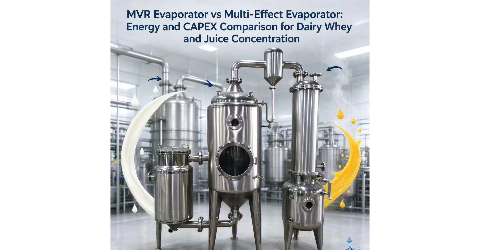
For many plants, the key equipment decision comes down to MVR evaporation versus multi-effect evaporation.
Both technologies recover part of the energy carried in the generated vapor. They just recover it differently. A multi-effect evaporator passes vapor from one effect to heat the next. An MVR evaporator runs the vapor through a mechanical compressor, raises its pressure and temperature, then sends it back around as the heating medium.
This difference matters because the two systems push costs in opposite directions. Multi-effect evaporation generally needs more steam but keeps the utility arrangement fairly straightforward. MVR can cut fresh steam demand dramatically, and in exchange it brings a compressor, a motor, electrical infrastructure, and controls onto the project.
So for dairy whey and juice concentration, “Which evaporator consumes less energy?” is the wrong starting question. The better one is:
Which system provides the best total cost of ownership for the actual evaporation load, product, utilities, and operating schedule?
This article compares MVR and multi-effect evaporation on both energy consumption and CAPEX.
How Multi-Effect Evaporation Uses Energy
A multi-effect evaporator splits the evaporation process into several stages, or “effects.”
Fresh steam heats the first effect. Vapor boiled off the product there becomes the heating medium for the second effect. Vapor from the second effect heats the third, and so on.
Each successive effect operates at a lower pressure, which is what lets vapor from the previous effect still deliver useful heat without buying another charge of fresh steam.
That is the basic principle behind steam economy in multi-effect evaporation.
Zhongbo’s published process guidance gives illustrative steam consumption figures along these lines:
| Configuration | Approx. Steam Consumption* | General Position |
| 2-effect | ~0.55 kg steam/kg water evaporated | Lower CAPEX, higher steam use |
| 3-effect | ~0.33 kg/kg | Balanced configuration |
| 4-effect | ~0.25 kg/kg | Higher efficiency |
| 5–6 effect + TVR | ~0.08–0.12 kg/kg | Very low fresh-steam demand |
*Illustrative figures; actual consumption depends on product properties, temperatures, pressure, heat-transfer design, and operating conditions.
The principle is easy to state: adding effects increases heat recovery, and it also increases equipment and installation cost.
For a dairy or juice plant with a reliable steam supply, a 3- or 4-effect falling film system often hits a practical balance between investment and energy consumption.
How an MVR Evaporator Works
MVR stands for Mechanical Vapor Recompression.
Instead of letting generated vapor travel through several effects and eventually condense, an MVR system takes the vapor produced by evaporation and compresses it mechanically.
Compression raises the vapor pressure, which raises its saturation temperature. The compressed vapor can then serve as the heating medium again.
The simplified process is:
Feed → Evaporation → Vapor Generation → Vapor Compression → Heating → Evaporation
The vapor is recycled inside the process rather than continuously replaced by fresh steam.
That can cut fresh steam consumption hard. Zhongbo’s published evaporation guidance describes MVR as an energy-saving option in which electricity drives the compressor and live steam demand can approach zero during stable operation.
But “near-zero steam” is not “zero energy.”
The energy has moved from steam to electricity.
The compressor becomes the main energy consumer, and its electrical demand depends on factors such as:
- Vapor flow rate
- Compression ratio
- Required temperature lift
- Compressor efficiency
- Evaporation temperature
- Product concentration
- Operating pressure
- Annual operating hours
Which is exactly why MVR economics should be calculated from actual process conditions, never from a generic kWh figure.

MVR vs Multi-Effect: Energy Comparison
The core energy difference, in one table:
| Factor | Multi-Effect Evaporator | MVR Evaporator |
| Main energy source | Steam | Electricity |
| Vapor recovery | Between effects | Mechanical recompression |
| Fresh steam demand | Reduced as effects increase | Can be very low during stable operation |
| Electricity demand | Relatively low | Significantly higher |
| Main energy-consuming equipment | Steam system | MVR compressor |
| Energy economics | Depends heavily on steam price | Depends heavily on electricity price |
| Best operating condition | Reliable, reasonably priced steam | Reliable electricity + high continuous evaporation load |
| Control complexity | Moderate | Higher |
| Compressor required | No | Yes |
A common mistake is to compare only steam consumption.
Say a plant evaporates 10,000 kg of water per hour. A 3-effect system at roughly 0.33 kg of steam per kilogram of water evaporated needs about:
10,000 × 0.33 = 3,300 kg/h of steam
A 4-effect system at roughly 0.25 kg/kg needs:
10,000 × 0.25 = 2,500 kg/h of steam
These numbers show what extra stages do. On their own they don’t give you an MVR comparison, because the compressor’s actual electrical requirement has to be calculated from vapor flow, pressure lift, temperature lift, and compressor efficiency.
A proper MVR feasibility study compares energy cost, not steam and electricity quantities.
CAPEX: Why MVR Is Not Automatically Cheaper
MVR can cut ongoing steam consumption substantially. The equipment itself is not automatically cheaper to buy.
An MVR installation normally adds equipment and infrastructure, including:
- Mechanical vapor compressor
- Electric motor
- Variable-frequency drive where required
- Compressor control system
- Electrical distribution capacity
- Instrumentation and pressure control
- Compressor protection systems
- Appropriate vapor piping
- Spare parts and maintenance provisions
In a large plant, the electrical infrastructure alone can become a significant slice of project CAPEX. If the existing facility lacks the electrical capacity for the compressor, the project may need additional transformers, switchgear, cabling, or other upgrades.
A multi-effect system puts its investment into additional evaporation stages and their supporting equipment, such as:
- Additional heat-transfer bodies
- Vapor separators
- Interconnecting piping
- Condensate systems
- Steam distribution
- Vacuum equipment
- Condensers
- Instrumentation and controls
The general relationship:
More effects → higher CAPEX + lower steam consumption
while:
MVR → higher compressor/electrical CAPEX + much lower fresh steam demand
So build the comparison on incremental CAPEX versus annual operating savings, not on the purchase price of the equipment alone.
Total Cost of Ownership Is More Important Than Purchase Price
For an industrial evaporator, CAPEX is only the beginning.
A useful TCO comparison should include:
- Initial equipment investment
- Installation and commissioning
- Steam consumption
- Electricity consumption
- Cooling-water requirements
- CIP consumption
- Compressor maintenance, if applicable
- Pump maintenance
- Replacement parts
- Downtime
- Product losses during startup and shutdown
- Expected annual operating hours
A simple economic framework:
Annual multi-effect energy cost = Annual water evaporation × Specific steam consumption × Steam cost
For MVR:
Annual MVR energy cost = Annual water evaporation × Specific electricity consumption × Electricity price
Then:
Annual energy saving = Baseline annual energy cost − Proposed annual energy cost
And a simplified payback calculation:
Simple Payback = Additional CAPEX ÷ Annual operating-cost savings
One caution: the specific electricity consumption for MVR should come from an engineering calculation, not an assumed universal value. Steam consumption for a multi-effect system likewise depends on the actual effect arrangement, temperature profile, feed characteristics, and heat recovery design.
When MVR Can Make Sense for Dairy Whey
Whey matters because it pairs high evaporation loads with real sensitivity to thermal history.
Whey headed for WPC, WPI, lactose production, or other downstream applications has to be concentrated without stacking up thermal exposure. Zhongbo’s dairy processing guidance flags whey as a heat-sensitive product and notes that excessive heat treatment can damage the very proteins processors are trying to recover.
For relatively clean, low-viscosity whey, falling film evaporation is the usual candidate: efficient heat transfer, short product residence time. Zhongbo’s evaporation guidance lists whey among typical falling film applications.
MVR gets particularly interesting when the plant has:
- High and relatively stable evaporation throughput
- Long annual operating hours
- Expensive steam
- Adequate electrical capacity
- Competitive electricity prices
- A strong requirement to reduce fossil-fuel steam demand
One catch: the process doesn’t stay the same through the whole concentration range. As solids rise, viscosity and fouling behavior change, and the final concentration stage may need a different evaporation arrangement from the early stages. For some high-solids applications, a forced-circulation finishing stage is worth considering. Zhongbo’s forced-circulation technology targets higher-viscosity, fouling-prone liquids and can be combined with falling film evaporation in the right systems.
So the question for a whey processor is not simply:
“MVR or multi-effect?”
It may instead be:
“Where should MVR be applied within the overall evaporation system?”
MVR vs Multi-Effect for Juice Concentration
Juice adds a second variable: product quality.
Water removal is only part of the job. Aroma, flavor, color, oxidation, and heat exposure all shape the final concentrate.
Falling film evaporation is widely used for fruit juices because the thin-film configuration evaporates fast under controlled vacuum conditions. Zhongbo lists juice among typical falling film applications and also supplies multi-effect falling film systems for fruit-processing applications.
A multi-effect arrangement reuses heat from one effect to the next while boiling temperatures step down stage by stage. MVR can be attractive too, since the vapor circulates inside the evaporation system instead of demanding fresh steam continuously.
Energy efficiency and product quality can’t be scored separately, though. A juice plant may also need to weigh:
- Feed Brix
- Target final Brix
- Juice viscosity
- Pulp or suspended solids
- Aroma recovery
- Dissolved oxygen
- Fouling tendency
- CIP frequency
- Maximum acceptable product temperature
- Annual production hours
Deaeration enters the picture wherever oxygen exposure threatens flavor or color. Zhongbo’s beverage-processing guidance covers the role of deaeration in reducing oxidation-related quality problems in juice and other beverages.
For high-Brix or pulp-containing products, the final concentration stage may also need a different design from the initial falling film stages.
A Practical Selection Matrix
Use this framework during the preliminary equipment-selection stage.
| Plant Condition | Configuration Worth Evaluating |
| Low evaporation load, limited production hours | 2–3 effect |
| Medium continuous evaporation load | 3–4 effect |
| Large continuous production | 4+ effect or MVR |
| High steam cost | MVR or hybrid configuration |
| Low-cost steam available | Multi-effect |
| Limited electrical capacity | Multi-effect |
| Reliable, inexpensive electricity | MVR |
| Stable 24/7 operation | MVR becomes more attractive |
| Frequent production stops | Carefully evaluate MVR economics |
| Heat-sensitive whey | Falling film + multi-effect/MVR evaluation |
| Low-viscosity clear juice | Falling film multi-effect or MVR |
| High-viscosity final concentrate | Consider forced circulation finishing |
| Existing multi-effect system | Evaluate MVR integration before replacing the whole system |
This is not a universal selection rule. Actual economics depend on local utility prices and the process specification.
MVR and Multi-Effect Do Not Have to Be Mutually Exclusive
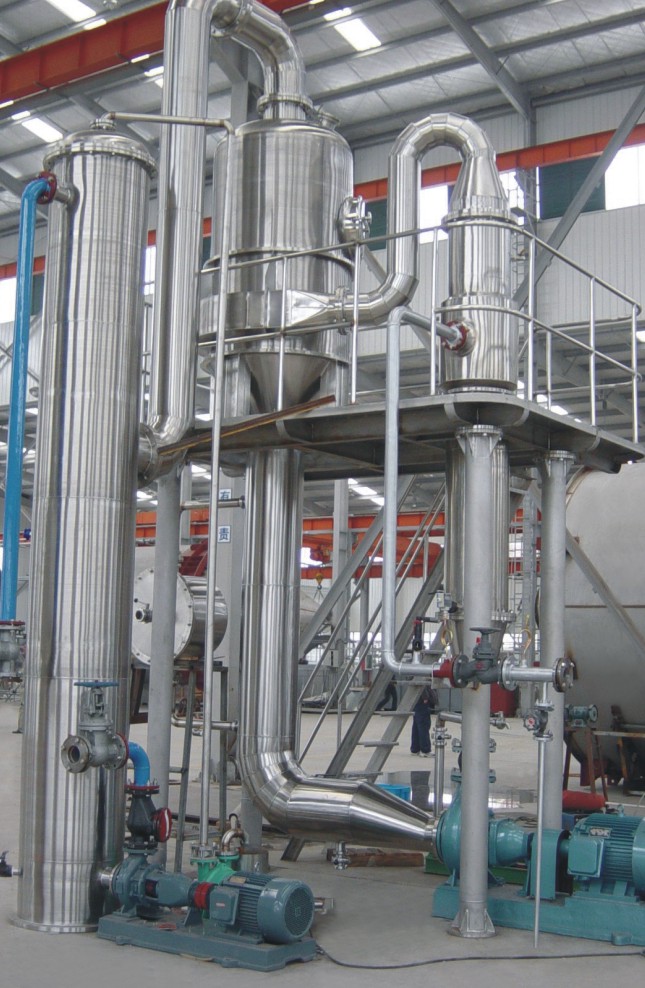
Here is one of the most useful points in equipment planning: MVR and multi-effect evaporation can be combined.
A plant might run:
Multi-effect evaporation → MVR pre-concentration → finishing stage
or another hybrid configuration built around the product and available utilities. MVR can act as a pre-concentrator while multi-effect evaporation handles the rest of the concentration duty.
Hybrids are worth a close look when the plant wants lower steam consumption without making the entire system dependent on one large MVR compressor.
The optimum configuration depends on how these factors interact:
- Evaporation load
- Steam price
- Electricity price
- Product temperature limits
- Compressor size
- Annual operating hours
- Required concentration
- Available electrical capacity
- Existing equipment
Zhongbo’s published evaporation systems can be configured around different combinations of falling film, multi-effect, MVR, and TVR technologies.
What Data Should Be Used for a Real CAPEX Comparison?
A supplier cannot compare MVR and multi-effect systems accurately from production capacity alone.
Before requesting quotations, prepare the following information.
Product Data
- Product name
- Feed flow rate
- Feed total solids
- Target total solids or Brix
- Product temperature
- Viscosity
- pH
- Suspended solids or pulp content
- Heat sensitivity
- Fouling tendency
Production Data
- Required evaporation capacity in kg/h
- Operating hours per day
- Operating days per year
- Batch or continuous operation
- Expected production changes over the next several years
Utility Data
- Steam pressure
- Steam cost
- Electricity cost
- Available electrical capacity
- Cooling-water temperature and flow
- Existing vacuum system
- Condensate recovery arrangements
Economic Data
- Maximum available CAPEX
- Required payback period
- Expected equipment lifetime
- Cost of production downtime
- Maintenance strategy
With this in hand, the supplier can evaluate the utility infrastructure and long-term operating cost alongside the evaporator itself.
Common Mistakes When Comparing MVR and Multi-Effect Systems
Mistake 1: Comparing only equipment prices
A lower quotation doesn’t always mean a lower lifetime cost. Steam burned over thousands of operating hours can easily become a far bigger cost category than the original equipment price.
Mistake 2: Assuming MVR means zero energy consumption
MVR cuts fresh steam demand by spending electricity to recompress vapor. The compressor therefore becomes a major part of the energy balance.
Mistake 3: Ignoring local electricity capacity
An MVR compressor can draw a serious electrical load. The plant has to verify that its transformer, switchgear, cabling, and power supply can support the system.
Mistake 4: Choosing too many effects
Every extra effect trims steam consumption, and every extra effect also adds equipment, space, piping, controls, and maintenance. There is an economic optimum, not a maximum number of effects.
Mistake 5: Ignoring fouling and CIP
An evaporator that saves energy on paper but needs constant cleaning may never deliver the expected annual savings. Put CIP design and product-side fouling behavior into the TCO calculation. Zhongbo’s CIP guidance stresses that cleaning conditions need to match the type of product soil, which matters a great deal in dairy and beverage processing.
Mistake 6: Selecting the evaporator before defining the product
Whey, clear juice, fruit pulp, and high-Brix concentrate can behave very differently during evaporation. The product should determine the evaporation configuration, not the other way around.
A Simple Decision Framework
For an initial feasibility study, work through these questions in order:
- How much water must be removed?
Calculate the evaporation load in kg/h.
- How many hours will the system operate?
A plant running 2,000 hours per year has a very different investment case from one running continuously.
- What does steam cost?
High steam prices generally improve the economics of energy-efficient configurations.
- What does electricity cost?
MVR transfers much of the energy demand to electricity.
- Does the site have sufficient electrical capacity?
If not, electrical infrastructure becomes part of MVR CAPEX.
- How sensitive is the product to heat?
For whey and juice, weigh temperature and residence time alongside energy consumption.
- How does viscosity change during concentration?
The final concentration stage may require a different evaporation technology.
- How frequently will the system require CIP?
Cleaning frequency affects both operating cost and available production time.
- What is the total cost over the expected operating life?
Compare CAPEX + utilities + maintenance + downtime rather than CAPEX alone.
Q&A
Q1. Is an MVR evaporator more energy efficient than a multi-effect evaporator?
MVR can reach very low fresh-steam consumption because the generated vapor is mechanically recompressed and reused. It burns more electricity to do it. Which system wins on total energy cost depends on the relative prices of steam and electricity and on the actual process conditions.
Q2. Is MVR more expensive than a multi-effect evaporator?
MVR can carry higher CAPEX: compressor, motor, electrical equipment, controls, and the surrounding infrastructure. A multi-effect system also gets more expensive as effects are added. Compare the complete installed system, not the evaporator vessel alone.
Q3. When is MVR particularly attractive?
MVR is worth evaluating when the plant has a large and stable evaporation load, long operating hours, high steam costs, reliable electricity, and sufficient electrical capacity.
Q4. Is a 4-effect evaporator always better than a 3-effect evaporator?
Not necessarily. A fourth effect can reduce steam consumption, but it also raises CAPEX and system complexity. The economic benefit depends on annual operating hours, steam price, evaporation load, and the required payback period.
Q5. Can MVR and multi-effect evaporation be used together?
Yes. Hybrid configurations are possible. MVR can be integrated with multi-effect evaporation or take over part of the concentration duty, depending on the process and utility strategy.
Q6. Which system is suitable for whey concentration?
For clean, relatively low-viscosity whey, falling film evaporation is the common choice. Multi-effect and MVR configurations are both on the table depending on evaporation capacity, thermal requirements, utility prices, and operating hours. Higher-solids stages may need additional circulation or finishing technology.
Q7. Which system is suitable for juice concentration?
Falling film evaporation is widely used for juice because it supports efficient heat transfer and controlled low-temperature evaporation. Multi-effect and MVR options can both be considered, while pulp content, viscosity, Brix, aroma recovery, and fouling all need to be evaluated during design.
Q8. How do I calculate the payback period of an MVR system?
First calculate the annual energy cost of the existing or baseline system. Then calculate the annual electricity cost of the proposed MVR system. The difference is the annual energy saving.
A simplified calculation:
Payback = Incremental MVR CAPEX ÷ Annual Energy Savings
For a reliable result, the MVR electricity consumption should come from an actual process and compressor calculation.
Q9. What information does an evaporator manufacturer need for a quotation?
At minimum, provide feed flow, feed solids, target concentration, product type, temperature limitations, viscosity, operating hours, available steam pressure, electricity cost, electrical capacity, cooling-water conditions, and CIP requirements.
Q10. Can Zhongbo design both MVR and multi-effect evaporation systems?
Zhongbo manufactures evaporation and concentration equipment for dairy, beverage, food, and other liquid-processing applications, including falling film and forced-circulation systems, and its published solutions include MVR and TVR configurations.
For a project evaluation, the most useful starting point is to provide the actual process and utility data rather than picking a technology based only on a nominal capacity.
Conclusion
Choosing between an MVR evaporator and a multi-effect evaporator is, at bottom, an energy-economics and process-design decision.
A multi-effect system reduces steam consumption by reusing vapor across several evaporation stages. More effects generally means lower fresh-steam demand, and also higher equipment and installation costs.
MVR takes a different route. It recycles evaporation vapor through mechanical compression and can push fresh steam demand very low during stable operation. The trade-off is higher electrical consumption and additional CAPEX for the compressor and electrical infrastructure.
For dairy whey, weigh product thermal sensitivity, protein quality, concentration level, fouling, and continuous operating hours alongside energy cost. For juice, Brix, viscosity, pulp content, aroma, color, oxidation, and heat exposure become part of the equipment specification.
In many cases the most appropriate answer is a multi-effect, MVR, or hybrid configuration, depending on the plant’s evaporation load and local utility economics.
Zhongbo can evaluate the evaporation duty based on your actual product and plant conditions. When requesting a proposal, provide your feed flow rate, feed solids, target concentration/Brix, product type, operating hours, available steam pressure, electricity cost, electrical capacity, cooling-water conditions, and CIP requirements. These details allow the evaporation system, energy balance, and CAPEX/OPEX trade-off to be evaluated as one complete process rather than as an isolated equipment purchase.
For more information about Zhongbo’s evaporation and concentration solutions, see the official Zhongbo website and its Evaporation & Concentration equipment.