Introduction
Process tanks are essential components in dairy and beverage production lines. They are used for mixing, heating, cooling, holding, buffering, and preparing liquid products before downstream processing. However, selecting the right process tank is more than choosing a suitable volume. Tank geometry, agitation, heating method, material, surface finish, and CIP integration can all affect product quality, production efficiency, and sanitation.
For food and beverage manufacturers, process tank selection should therefore be based on the complete process rather than tank capacity alone. A tank designed for simple liquid storage may not be suitable for high-viscosity mixing, while a high-shear application may require a completely different agitator configuration.
The right process tank should provide adequate mixing performance, efficient heat transfer, hygienic product contact surfaces, and reliable integration with upstream and downstream equipment.
This guide explains the main factors to consider when selecting a process tank for dairy and beverage lines, including agitation design, jacket heating, stainless-steel construction, and CIP integration.
What Is a Process Tank in Dairy and Beverage Processing?
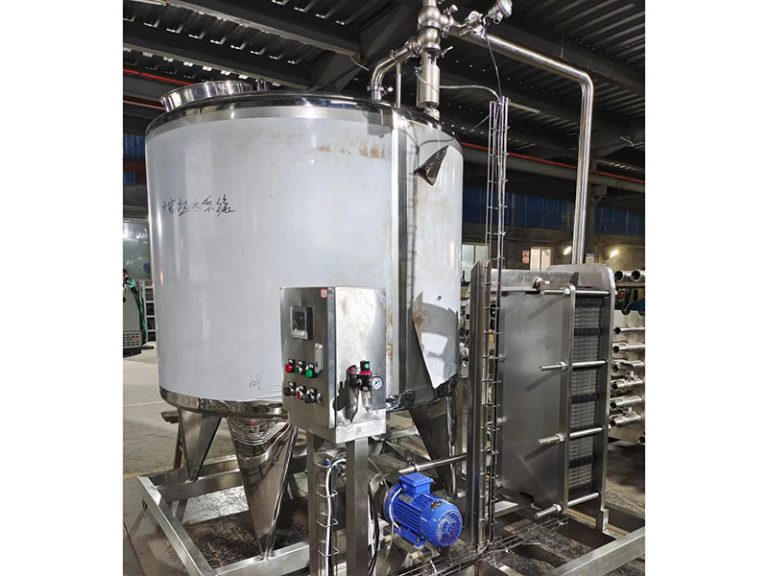
A process tank is a sanitary vessel designed to perform one or more controlled processing functions within a food or beverage production line.
Depending on its design, a process tank may be used for:
- Ingredient mixing
- Product blending
- Heating and cooling
- Temporary storage
- Buffering between process stages
- Product preparation before pasteurization or UHT treatment
- Holding before filling
Unlike a simple storage vessel, a process tank is usually designed around specific operating requirements such as agitation speed, heat transfer, temperature control, product viscosity, and cleaning.
For example, a beverage mixing tank may need an agitator to ensure that sugar, stabilizers, flavors, or other ingredients are evenly distributed. A dairy process tank may require controlled heating or cooling to maintain product temperature. A buffer tank, on the other hand, may primarily provide temporary product storage and balance the flow between upstream and downstream equipment.
Zhongbo’s mixing tank portfolio includes agitator tanks, high-speed emulsification tanks, and high-shear emulsification tanks. Its agitator tank is listed with capacities of 100–10,000 L/h and options for jacket, coil, or Miller-type heating/cooling structures.

Key Factors in Process Tank Selection
Tank Capacity and Buffer Tank Sizing
Capacity is one of the first parameters to determine when selecting a process tank, but the correct size should be based on the actual production process rather than simply the desired batch volume.
Important considerations include:
- Production capacity
- Batch size
- Product residence time
- Upstream flow rate
- Downstream processing capacity
- Cleaning and changeover requirements
- Available installation space
An undersized tank can create production bottlenecks, while an oversized tank can increase capital costs, product residence time, cleaning requirements, and energy consumption.
For buffer applications, tank sizing is particularly important because the tank needs to balance upstream and downstream processes. A buffer tank temporarily stores product and helps minimize product losses while maintaining a more stable production flow. Zhongbo describes its stainless steel buffer tanks as equipment for balancing upstream and downstream processes during production.
Zhongbo’s stainless steel buffer tank category includes several configurations, including reception tanks, aseptic tanks, high-level tanks, and refrigeration tanks. The listed capacities generally range from 300–10,000 L/h, with customized configurations available.
Capacity should therefore be evaluated together with the tank’s function. A mixing tank, aseptic tank, and refrigeration tank may have similar nominal volumes but very different process requirements.
Agitation Design for Food-Grade Mixing
Agitation is one of the most important engineering parameters for a food-grade mixing tank. The agitator must generate sufficient circulation and shear without unnecessarily damaging the product.
Different products require different agitation designs.
High-Shear Agitators
High-shear mixers are designed to generate intense mechanical forces and are suitable for applications requiring rapid dispersion, emulsification, or particle-size reduction.
They may be appropriate for:
- Emulsions
- Sauces
- Dressings
- Beverage concentrates
- Products containing difficult-to-disperse ingredients
Zhongbo’s high-shear emulsification tank is listed with a speed of approximately 2,800–3,000 rpm, while its high-speed emulsification tank is listed at 1,460 rpm with a bottom-emulsion configuration. (浙江中博机械科技)
High shear should not automatically be considered better. Excessive shear can be unnecessary for low-viscosity beverages and may introduce unwanted heat or affect sensitive formulations.
Anchor Agitators
Anchor agitators typically follow the tank wall and are useful for products with relatively high viscosity.
They can provide broad circulation throughout the vessel and are often considered for:
- High-viscosity liquids
- Creams
- Thick sauces
- Products requiring controlled wall-surface movement
Scraper Agitators
Scraper or anchor-scraper designs incorporate elements that move close to the vessel wall. They can help improve product circulation near heat-transfer surfaces and reduce product accumulation on the tank wall.
They are particularly useful when processing viscous products that are difficult to circulate using a conventional impeller.
Impeller Agitators
Conventional impellers are commonly used for lower-viscosity liquids where bulk circulation and blending are the primary objectives.
They can be suitable for:
- Milk
- Juice
- Tea beverages
- Syrups
- Liquid ingredient solutions
The key point is that agitator selection should follow the product rheology and mixing objective, not simply the tank size.
Important design variables include viscosity, density, solids content, desired mixing time, shear sensitivity, operating temperature, and whether the process requires simple blending or true emulsification.
Jacket Heating and Heat Transfer
When a process tank must heat or cool its contents, jacket design becomes an important part of the selection process.
A properly designed heating or cooling system should provide uniform temperature distribution while avoiding excessive local temperatures that could affect the product.
Common jacket configurations include:
Dimple Jacket
A dimple jacket uses formed or welded dimples to create channels for the heating or cooling medium.
It can provide a practical balance between heat-transfer performance, structural strength, and manufacturing cost.
Half-Pipe Coil Jacket
Half-pipe or half-pipe coil jackets use welded pipe sections around the vessel wall to circulate steam, hot water, or cooling media.
They can provide effective heat transfer and are particularly useful for larger or heavier-duty process vessels.
Insulation Layer
Insulation is also important when the tank operates at elevated or controlled temperatures.
A suitable insulation system can:
- Reduce heat loss
- Improve temperature stability
- Lower energy consumption
- Protect operators from hot surfaces
- Support more consistent process conditions
Zhongbo’s agitator tank portfolio lists multiple heating and cooling options, including jacket, coil, and Miller-type configurations, together with single-, double-, and three-layer structures.
The appropriate heating design should be selected according to product viscosity, target temperature, heating medium, required heating rate, tank geometry, and available utility conditions.
Stainless Steel and Sanitary Design
Material selection is critical in dairy and beverage processing because the tank comes into direct contact with the product.
SS304 and SS316L are two commonly considered stainless-steel grades for sanitary process equipment.
SS304 provides good corrosion resistance and is widely used for many food-processing applications. SS316L provides higher corrosion resistance, particularly in environments where chloride exposure or more aggressive cleaning conditions are concerns.
The appropriate grade should be selected based on:
- Product composition
- Cleaning chemicals
- Operating temperature
- Chloride exposure
- Regulatory requirements
- Required service life
Surface finish is another important consideration.
A smooth internal surface helps reduce product retention and makes cleaning easier. For demanding sanitary applications, an internal finish of approximately Ra ≤ 0.4 µm may be specified depending on the applicable hygienic design standard and process requirements.
However, surface roughness should not be considered in isolation. Hygienic design also depends on weld quality, drainability, dead-leg control, gasket selection, internal geometry, and cleaning-system design.
For facilities requiring specific sanitary certifications such as 3-A Sanitary Standards, the complete equipment design should be evaluated against the applicable standard rather than assuming that a particular stainless-steel grade or surface finish alone establishes compliance.
CIP Integration
Cleaning-in-place, or CIP, is an essential consideration when selecting a process tank for dairy and beverage applications.
A tank should be designed so that cleaning solutions can reach all relevant product-contact surfaces without extensive manual disassembly.
Key considerations include:
- Spray-ball or spray-device coverage
- Internal geometry
- Drainability
- Weld design
- Gasket and valve selection
- Dead-leg minimization
- Cleaning flow rate
- Cleaning temperature
- Chemical compatibility
CIP design should also be considered together with the rest of the processing line. A tank may have an effective cleaning system, but poor piping design or unsuitable downstream valves can still create hygiene risks.
Zhongbo’s product portfolio emphasizes integrated food-processing solutions and customization based on production capacity, energy, cleaning, and investment requirements.
For a process tank, the goal is not simply to make cleaning possible. The goal is to make the tank repeatably cleanable under defined CIP conditions.
Process Tank Applications in Dairy and Beverage Production
Mixing Tank for Beverage Production
Mixing tanks are commonly used during beverage preparation and formulation.
Typical applications include:
- Juice beverages
- Tea drinks
- Milk beverages
- Plant-based beverages
- Syrup preparation
- Ingredient blending
The agitator should be selected according to the formulation. Low-viscosity products may require conventional impeller mixing, while products containing stabilizers, emulsifiers, or difficult-to-disperse ingredients may benefit from higher-shear equipment.
Zhongbo’s mixing tank range includes agitator tanks and high-shear/high-speed emulsification tanks, allowing the mixing configuration to be matched to different processing requirements.
Dairy Processing Tanks
Dairy processing tanks are used throughout milk and dairy production, from receiving and preparation through temperature-controlled storage and downstream processing.
Applications can include:
- Milk storage
- Milk blending
- Yogurt beverage preparation
- Ingredient mixing
- Pre-treatment
- Refrigerated holding
Temperature control is especially important in dairy processing. Zhongbo’s refrigeration tank is designed for milk processing and is described as maintaining temperatures around 2°C–4°C, with a three-layer structure, cooling system, mixer, manhole, CIP spray ball, and air vent.
The exact operating temperature should always be determined by the specific dairy process and applicable food-safety requirements.
Stainless Steel Buffer Tanks
Buffer tanks provide temporary product storage between different stages of a production line.
Their main purpose is to decouple upstream and downstream processes so that variations in production speed do not immediately interrupt the entire line.
Typical applications include buffering between:
- Mixing and thermal treatment
- Thermal treatment and filling
- Processing and packaging
- Receiving and downstream processing
Zhongbo offers several stainless steel buffer-tank configurations. Its aseptic tank is designed to maintain sterile conditions using features such as a sterile respirator and sampling valve, while its high-level tank can be positioned at an elevated level to support downstream process requirements.
This makes buffer-tank selection closely connected to the overall process architecture.
How to Choose the Right Process Tank for Your Production Line?
A practical selection process should begin with the product and production requirements rather than the equipment catalogue.
Consider the following questions:
- What product are you processing?
Determine viscosity, solids content, sensitivity to shear, temperature requirements, and cleaning conditions. - What is the required production capacity?
Calculate batch size or continuous flow and account for peak production requirements. - What mixing performance is required?
Decide whether the process requires simple blending, circulation, dispersion, or high-shear emulsification. - Does the process require heating or cooling?
Select the appropriate jacket, coil, or other heat-transfer configuration based on the heating/cooling medium and required temperature-control performance. - What sanitary specifications apply?
Evaluate stainless-steel grade, surface finish, weld quality, drainability, internal geometry, and applicable hygienic standards. - How will the tank be cleaned?
Confirm that the tank can be integrated into the plant’s CIP system and that all product-contact areas can be reliably cleaned. - How will the tank connect to the rest of the production line?
Consider pumps, valves, heat exchangers, UHT or pasteurization systems, deaerators, buffer tanks, and filling equipment.
The final tank specification should be based on the complete process flow rather than one individual parameter.
Zhongbo Stainless Steel Mixing and Buffer Tanks
Zhongbo provides stainless steel mixing and buffer tank solutions for dairy, beverage, food, and related processing applications.
Its Mixing Tank portfolio includes agitator tanks, high-speed emulsification tanks, and high-shear emulsification tanks. The agitator tank range is listed at 100–10,000 L/h, with heating and cooling options including jacket, coil, and Miller-type configurations.

For buffer and holding applications, Zhongbo’s Stainless Steel Buffer Tank range includes reception tanks, aseptic tanks, high-level tanks, and refrigeration tanks. The listed configurations range from approximately 300–10,000 L/h and can be customized for different process requirements.
The company also states that its equipment and processing-line planning can be customized according to production capacity, energy consumption, cleaning requirements, and investment considerations.
For manufacturers designing a complete dairy or beverage line, this integrated approach is important. A process tank should not be selected independently from the rest of the system. Its capacity, agitation, heating, cooling, CIP, inlet/outlet configuration, and control system should work together with pumps, heat exchangers, UHT equipment, deaeration systems, and buffer tanks.
FAQs
- What is a process tank in food and beverage processing?
A process tank is a sanitary vessel used for functions such as mixing, heating, cooling, holding, or buffering liquid food and beverage products. Its design depends on the specific product and process requirements.
- What type of agitator is best for a food-grade mixing tank?
There is no single agitator that is best for every product. Impellers are commonly suitable for lower-viscosity liquids, while anchor or scraper agitators can be more suitable for viscous products. High-shear agitators are typically selected when dispersion or emulsification is required.
- What is the difference between SS304 and SS316L for process tanks?
Both are commonly used stainless-steel grades, but SS316L generally provides higher corrosion resistance than SS304. The appropriate material depends on the product, cleaning chemicals, operating conditions, and required sanitary specifications.
- What surface finish is suitable for a sanitary process tank?
For demanding sanitary applications, an internal surface finish of Ra ≤ 0.4 µm may be specified. The required finish should be determined by the applicable hygienic standard and process requirements, together with weld quality and overall sanitary design.
- What is the purpose of a jacketed process tank?
A jacketed tank allows a heating or cooling medium to circulate around the vessel to control product temperature. Jacket, coil, and other configurations can be selected according to heat-transfer requirements and tank design.
- Why is CIP integration important for dairy and beverage tanks?
CIP integration allows product-contact surfaces to be cleaned without removing the tank from the production line. Proper internal geometry, spray coverage, drainability, and piping design are important for achieving reliable and repeatable cleaning.
- What is a buffer tank used for?
A buffer tank temporarily holds product between processing stages. It helps balance upstream and downstream flow, reduce interruptions, and minimize product losses during continuous production.
- How do I choose the right process tank capacity?
Start with production capacity, batch size or flow rate, required residence time, and the capacities of connected equipment. The tank should provide sufficient working volume without creating unnecessary product residence time or cleaning requirements.
- Can one process tank be used for both mixing and storage?
In some applications, yes. However, the tank should be designed around the more demanding function. If the product requires intensive mixing, temperature control, or specialized sanitary features, a dedicated mixing tank may provide better performance than a general-purpose storage vessel.
- Can process tanks be customized for a production line?
Yes. Tank capacity, structure, heating/cooling configuration, agitation system, material, instrumentation, and connections can be customized according to the production process. Zhongbo states that it provides customization for its processing equipment.
Conclusion
Choosing the right process tank for a dairy or beverage production line requires a combination of process engineering, hygienic design, and production planning.
The key considerations include:
- Tank capacity and buffer requirements
- Agitator type and mixing performance
- Jacket and heat-transfer configuration
- SS304 or SS316L material selection
- Sanitary surface finish and construction
- CIP integration
- Compatibility with the complete processing line
For mixing applications, the agitator should match the product’s viscosity and required shear level. For temperature-sensitive products, jacket and insulation design can directly influence heating and cooling efficiency. For dairy and beverage plants, sanitary construction and CIP capability are equally important.
Most importantly, a process tank should be viewed as part of an integrated production system. When mixing tanks, buffer tanks, pumps, heat exchangers, UHT systems, and cleaning systems are properly coordinated, manufacturers can achieve more stable processing, better product consistency, and more efficient plant operation.
For customized solutions, explore Zhongbo’s stainless steel mixing tanks and stainless steel buffer tanks for dairy and beverage processing applications.