Introduction
Cleaning is a critical part of dairy and beverage production. Product residues can accumulate inside tanks, pipelines, heat exchangers, filling equipment, and other processing equipment, creating hygiene risks and affecting production efficiency.
A CIP (Cleaning-in-Place) system allows process equipment to be cleaned without dismantling the production line. By controlling cleaning chemicals, temperature, flow, pressure, and cleaning time, a properly designed CIP system can provide repeatable and efficient cleaning.
However, different plants have different cleaning requirements. A small beverage line may need a relatively simple single-circuit system, while a large dairy plant with multiple processing lines may require a multi-circuit CIP system.
This guide explains the key factors to consider when selecting a CIP system for a dairy or beverage processing plant.
What Is a CIP System and How Does It Work?
CIP, or Cleaning-in-Place, is an automated cleaning method that circulates water and cleaning solutions through process equipment without requiring manual disassembly.
A typical CIP cycle may include:
Pre-Rinse → Caustic Cleaning → Intermediate Rinse → Acid Cleaning → Final Rinse → Sanitization
The exact sequence depends on the product and equipment being cleaned.
During the process, cleaning solutions circulate through:
- Processing tanks
- Mixing tanks
- Pipelines
- Pumps
- Valves
- Heat exchangers
- UHT systems
- Filling equipment
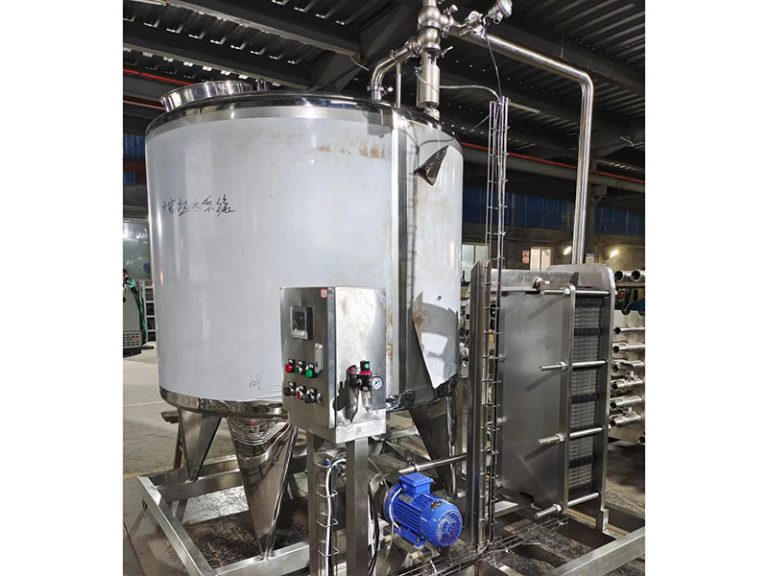
A CIP system typically includes solution tanks, pumps, valves, piping, heating equipment, instrumentation, and a control system.
The objective is to achieve sufficient time, temperature, chemical concentration, and mechanical action to remove product residues and maintain hygienic conditions.

Why Is CIP Important for Dairy and Beverage Plants?
Dairy and beverage products can leave residues such as proteins, fats, sugars, minerals, and other organic compounds inside processing equipment.
If these residues are not effectively removed, they can:
- Support microbial growth
- Cause cross-contamination
- Reduce heat-transfer efficiency
- Increase product losses
- Increase manual cleaning requirements
- Affect product quality
CIP provides a standardized cleaning process that can be repeated after each production cycle.
For dairy plants, controlling milk proteins, fats, and mineral deposits is particularly important. For beverage plants, cleaning requirements may vary considerably depending on whether the line processes juice, tea, syrup, carbonated drinks, or other formulations.
A well-designed CIP system therefore contributes to both food safety and production efficiency.
Key Factors When Choosing a CIP System
Cleaning Capacity and Tank Configuration
The first consideration is the number and size of circuits that need to be cleaned.
A CIP system may include separate tanks for:
- Caustic solution
- Acid solution
- Hot water
- Recovery water
- Sanitizing solution
Tank capacity should correspond to the volume of the largest cleaning circuit and the required circulation volume.
For larger plants, multiple CIP circuits can allow different processing areas to be cleaned independently.
The system should be sized according to:
- Pipeline volume
- Tank volume
- Heat exchanger capacity
- Number of circuits
- Number of cleaning cycles
- Production schedule
Oversizing the CIP system can increase water, chemical, and energy consumption, while undersizing it may result in insufficient cleaning performance.
Cleaning Time, Temperature, and Chemical Concentration
Effective CIP depends on controlling several interconnected parameters.
The most important are generally:
Time + Temperature + Chemical Concentration + Mechanical Action
Cleaning time must be sufficient to dissolve and remove residues.
Temperature affects both chemical activity and soil removal. However, excessive temperature can increase energy consumption or create problems with certain residues and equipment.
Chemical concentration must also be controlled within the appropriate operating range.
For example, alkaline cleaning is commonly used to remove organic residues such as fats and proteins, while acid cleaning can help remove mineral deposits.
The correct cleaning recipe should be established according to the product residue, equipment material, and validated cleaning procedure.
Flow Rate and Cleaning Pressure
CIP cleaning is not simply about circulating liquid through the equipment. The cleaning solution must reach sufficient velocity to create the mechanical action required to remove residues.
This is particularly important in pipelines and process equipment with complex geometries.
CIP performance can be affected by:
- Flow velocity
- Pump capacity
- Pipe diameter
- Pipeline length
- Spray device design
- Equipment geometry
- Pressure losses
For tanks, spray balls or rotary spray devices can distribute the cleaning solution across internal surfaces.
For pipelines, maintaining appropriate flow velocity is essential for effective mechanical cleaning.
The CIP pump should therefore be selected according to the hydraulic requirements of the complete cleaning circuit rather than simply the nominal plant capacity.
Automation and Process Control
Modern CIP systems increasingly use automated control to improve consistency and reduce operator intervention.
A control system can monitor and regulate:
- Temperature
- Flow
- Pressure
- Conductivity
- Chemical concentration
- Cleaning time
- Valve position
- Tank level
Automated sequencing can ensure that the correct cleaning solution is sent to the correct circuit at the correct stage.
Conductivity monitoring, for example, can help distinguish between water and cleaning solutions and support chemical concentration control.
Automation can also provide process records that help operators verify whether a cleaning cycle has been completed according to the predefined parameters.
Hygiene, Safety, and CIP Water Management
A CIP system itself must have a hygienic design.
Important considerations include:
- Sanitary stainless-steel construction
- Drainable piping
- Appropriate valve design
- Minimal dead legs
- Effective tank cleaning
- Proper separation of cleaning solutions
- Controlled chemical handling
Water management is also important.
A well-designed system can potentially recover suitable rinse water or cleaning solutions for subsequent use, depending on the plant’s process and hygiene requirements.
This can help reduce:
- Fresh-water consumption
- Chemical consumption
- Wastewater generation
- Cleaning costs
However, recovered water should only be reused where its quality is appropriate for the intended cleaning stage.
How to Choose the Right CIP System for Your Plant?
Dairy Processing Applications
Dairy processing typically involves residues containing proteins, fats, lactose, and minerals.
CIP systems for dairy plants may need to handle:
- Milk processing tanks
- Pasteurizers
- UHT systems
- Milk pipelines
- Separators
- Filling equipment
- Storage tanks
The cleaning program should account for both organic residues and mineral deposits.
A combination of alkaline and acid cleaning is therefore commonly used, followed by appropriate rinsing and sanitization.
For dairy plants, the CIP system should also be closely integrated with heat exchangers and UHT equipment because thermal processing can make certain residues more difficult to remove.
Beverage Processing Applications
Beverage plants can have significantly different CIP requirements depending on the product.
For example, juice and syrup lines may generate sugar and organic residues, while tea or dairy-based beverages may require different cleaning chemistry.
A beverage CIP system may clean:
- Mixing tanks
- Syrup tanks
- Beverage pipelines
- Heat exchangers
- Pasteurization systems
- Filling machines
- Storage tanks
The cleaning recipe should therefore be matched to the specific beverage rather than applying one universal CIP program to every product.
Single-Circuit vs. Multi-Circuit CIP Systems
The choice between single-circuit and multi-circuit CIP depends primarily on plant scale and production requirements.
Single-circuit CIP systems are suitable for simpler plants where cleaning operations can be performed sequentially.
Advantages include:
- Lower equipment complexity
- Lower initial investment
- Simpler operation
- Easier maintenance
Multi-circuit CIP systems allow several processing circuits to be managed separately.
They are more appropriate when a plant has:
- Multiple production lines
- Large processing capacity
- Different cleaning requirements
- Frequent cleaning cycles
- A need to reduce production downtime
Although multi-circuit systems require greater investment and more sophisticated control, they can improve production flexibility and cleaning efficiency in larger plants.
Interconnectivity with Tanks, UHT Lines, and Piping
CIP should not be designed as an isolated piece of equipment.
It needs to connect effectively with the entire processing system:
CIP System → Tanks → Pumps → Pipelines → Heat Exchangers/UHT → Filling Equipment
Correct valve configuration is essential to ensure that cleaning solutions reach the intended circuit without cross-contamination.
The system should also account for:
- Tank volume
- Pipeline routing
- Pump capacity
- Heat exchanger configuration
- UHT cleaning requirements
- Drainage
- Return-line design
This is particularly important in integrated dairy and beverage plants where multiple processing units share common pipelines or CIP resources.
Zhongbo CIP Systems

Zhongbo provides CIP Systems for food, dairy, and beverage processing applications.
A suitable CIP system can be configured around the plant’s processing equipment, cleaning circuits, capacity, and operating requirements.
When evaluating a CIP solution, manufacturers should consider the complete process rather than focusing only on the CIP skid itself. Tank configuration, circulation pumps, heating, valves, instrumentation, automation, and connection to production equipment all influence the final cleaning performance.
For plants with tanks, UHT systems, pipelines, and multiple processing circuits, an integrated CIP design can help establish a more consistent and manageable cleaning process.
Conclusion
Choosing the right CIP system is essential for maintaining hygiene, product safety, and efficient production in dairy and beverage plants.
A suitable system must provide more than cleaning chemicals and a circulation pump. It should deliver the correct combination of time, temperature, chemical concentration, and mechanical action, while integrating with the plant’s tanks, pipelines, heat exchangers, UHT equipment, and filling systems.
For smaller operations, a single-circuit system may provide a practical and cost-effective solution. Larger plants with multiple processing lines may benefit from multi-circuit CIP systems with automated control.
Ultimately, the best CIP solution is one designed around the plant’s actual production process, cleaning requirements, equipment configuration, and water-management strategy.
Zhongbo’s CIP Systems can be considered for customized dairy and beverage processing applications where hygienic cleaning, process integration, and automated control are required.
FAQs
- What does CIP mean in food processing?
CIP stands for Cleaning-in-Place. It is a method of cleaning tanks, pipelines, heat exchangers, and other processing equipment without dismantling them.
- What are the main stages of a CIP cycle?
A typical cycle may include pre-rinsing, caustic cleaning, intermediate rinsing, acid cleaning, final rinsing, and sanitization. The exact sequence depends on the product and equipment.
- What factors determine CIP cleaning effectiveness?
The key parameters are cleaning time, temperature, chemical concentration, and mechanical action, including appropriate flow velocity and spray coverage.
- What is the difference between single-circuit and multi-circuit CIP?
A single-circuit system cleans processing equipment sequentially, while a multi-circuit system can manage different cleaning circuits separately. Multi-circuit systems are generally more suitable for larger and more complex plants.
- What CIP system is suitable for dairy processing?
Dairy plants generally require CIP programs capable of removing protein, fat, and mineral deposits from tanks, pipelines, heat exchangers, and UHT equipment. The final system should be designed according to the specific dairy process.
- How does CIP flow rate affect cleaning?
Adequate flow velocity creates mechanical action that helps remove residues from pipelines and equipment surfaces. Insufficient flow can reduce cleaning effectiveness.
- Can CIP systems reduce water and chemical consumption?
Yes. Proper circuit design, automated control, and appropriate recovery of suitable rinse water or cleaning solutions can reduce water, chemical, and wastewater consumption.
- How do I choose the right CIP system?
Consider the number and size of cleaning circuits, equipment volume, product residues, cleaning chemistry, required temperature and flow rate, automation level, water consumption, and integration with tanks, UHT systems, and pipelines.