WATER TREATMENT & PROCESS EQUIPMENT
A practical comparison of single-pass vs. double-pass RO systems — covering conductivity targets, capital cost, energy use, recovery rates, and when each configuration makes sense for dairy, juice, bottled water, and CIP water applications.
Written By
Zhongbo Engineering Team
With over 15 years of experience designing and manufacturing reverse osmosis purification systems for food, beverage, and dairy processing plants worldwide, Zhongbo’s engineering team specializes in matching RO configuration — single-pass or double-pass — to your raw water quality, production capacity, and end-product standards.
Why RO Configuration Matters for Your Production Line
Water is the primary ingredient in most beverages — whether you are producing bottled water, carbonated drinks, juice, tea beverages, dairy-based drinks, or plant protein formulas. The quality of that water directly affects taste consistency, shelf stability, equipment lifespan, and regulatory compliance. Reverse osmosis (RO) is the standard method for removing dissolved salts, hardness ions, microorganisms, and organic impurities from feed water before it enters your production line.
However, not all RO systems are configured the same way. The fundamental design choice between a single-pass and a double-pass RO system determines the purity level of your treated water, the complexity of your equipment room, and your long-term operating costs. Choosing incorrectly can lead to either over-investing in unnecessary capacity or failing to meet downstream process requirements — such as conductivity limits for aseptic cold fill lines or CIP make-up water specifications.
This guide breaks down every factor that matters — from salt rejection percentages to membrane replacement schedules — so you can make a data-driven decision for your specific plant conditions.
What Does “Pass” Mean in an RO System?
In reverse osmosis terminology, a “pass” refers to one complete cycle where pressurized feed water flows through an RO membrane array, separating into two streams:
- Permeate (product water) — purified water that passes through the membrane.
- Concentrate (reject/brine) — water carrying the removed salts and impurities, discharged as wastewater.
Single-pass RO: Feed water goes through one set of membrane elements once. The permeate is collected directly into the pure water tank. This is the standard configuration for most industrial and commercial applications.
Double-pass RO: The permeate from the first pass is collected in an intermediate tank (or pumped directly), then pressurized again and sent through a second set of membrane elements. The second pass removes residual dissolved solids that the first pass could not fully reject, producing ultra-high-purity water.
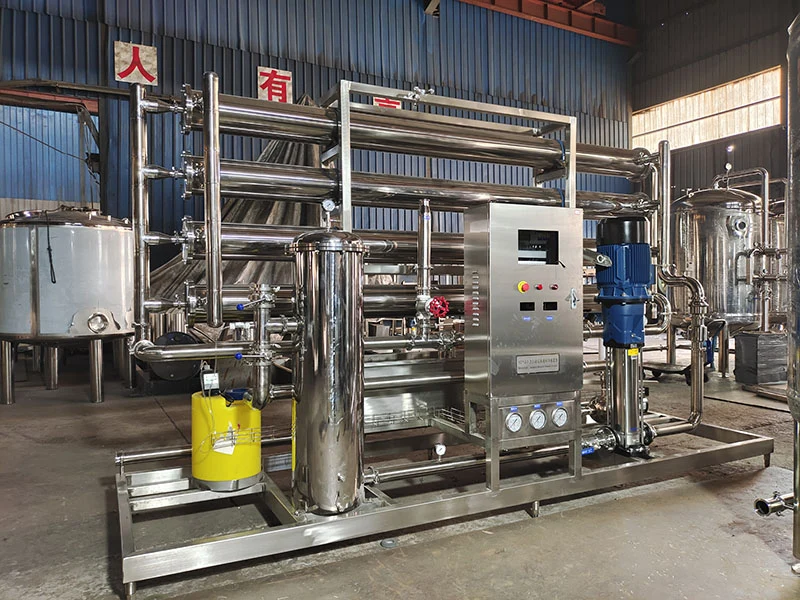
Figure 1: A complete single-pass RO system showing pretreatment vessels, membrane housing rack, high-pressure pump, PLC control panel, and stainless steel piping — typical configuration for standard beverage production lines.
Single-Pass vs. Double-Pass: Head-to-Head Comparison
Conductivity & Salt Rejection: The Numbers That Matter
Conductivity (measured in microsiemens per centimeter, μS/cm) is the key metric for RO-treated water quality. It indicates the concentration of dissolved ions remaining in the permeate after filtration. Lower conductivity means fewer dissolved solids — and therefore purer water.
For beverage production, here are the typical conductivity benchmarks:
The critical insight: most food and beverage applications do not require double-pass RO. If your raw water TDS (total dissolved solids) is below 500 ppm and your target conductivity is ≤10 μS/cm, a well-designed single-pass system with quality membranes will consistently meet spec. Double-pass becomes necessary only when your downstream process demands ultra-low ion content — such as aseptic filling lines where even trace minerals can affect microbial stability, or when your raw water has very high salinity and single-stage rejection alone cannot reach your target.
Capital Cost, Operating Cost & Energy Use
Capital expenditure (CapEx): A double-pass RO system costs roughly 30–60% more than an equivalent-capacity single-pass system. The additional investment covers a second set of membrane elements and housings, a second high-pressure pump, an intermediate buffer tank, extra instrumentation (conductivity meters, flow sensors, pressure gauges), and additional stainless steel piping and valves. For a 5T/h beverage line, this difference typically translates to $8,000–$20,000 USD depending on component brands and automation level.
Operating expenditure (OpEx): Double-pass systems consume 15–30% more electricity because two high-pressure pumps must run simultaneously. Membrane replacement costs are also approximately doubled since there are twice as many elements. Chemical cleaning (CIP) frequency may be similar or slightly higher due to the larger total membrane area. Over a 10-year equipment lifecycle, the total cost-of-ownership gap between single-pass and double-pass can reach $40,000–$80,000 USD for mid-sized plants — making the initial configuration decision financially significant.
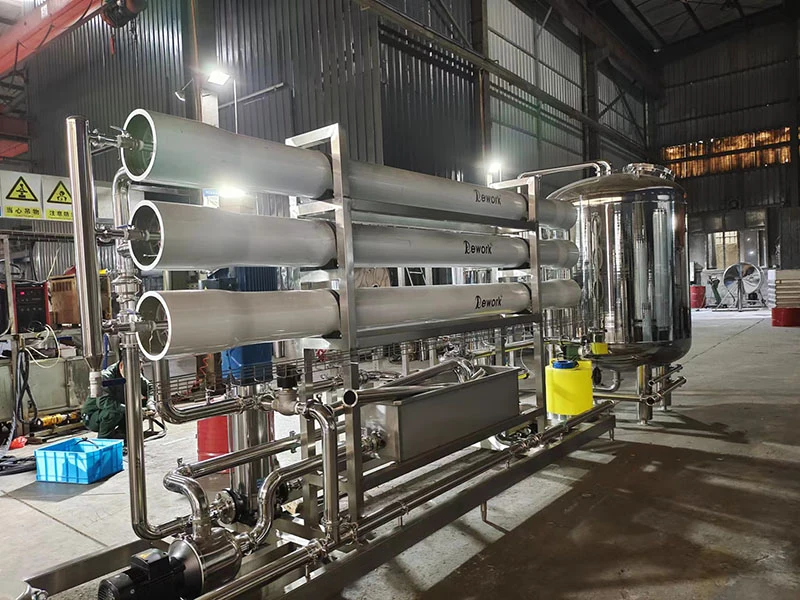
Figure 2: Close-up of RO membrane housing assembly — the core component whose quantity differs between single-pass and double-pass configurations.
Recovery Rate & Wastewater Considerations
The recovery rate is the percentage of feed water that is converted into purified permeate. The remainder is discharged as concentrate (brine). Higher recovery means less water waste but also higher scaling risk on the membrane surface.
- Single-pass recovery: Typically 70–75%. For every 100 liters of feed water, you get 70–75 liters of purified water and 25–30 liters of brine.
- Double-pass overall recovery: Typically 65–70%. The second pass adds another concentration step, slightly reducing overall water efficiency. However, some designs recycle the second-stage brine back to the first-stage inlet to improve overall recovery to 72–78%.
If your plant operates in a region with high water costs or strict discharge regulations, recovery rate matters. In such cases, discuss brine-recovery options with your equipment supplier — both single-pass and double-pass systems can be enhanced with concentrate recycling loops.
Application Scenarios: When to Choose Each Configuration
Choose Single-Pass RO When:
- Your raw water TDS is below 500 ppm and municipal or well-water sourced.
- Your target conductivity is ≤10 μS/cm — suitable for standard bottled water, carbonated drinks, juice, tea, dairy drinks, and CIP make-up water.
- Budget is a constraint and you want the lowest possible CapEx and OpEx.
- You need a compact footprint — limited equipment room space.
- Your maintenance team prefers simpler operation with one set of membranes to monitor.
Choose Double-Pass RO When:
- Your downstream process requires ultra-low conductivity (<1–3 μS/cm) — e.g., aseptic cold filling lines, UHT sterilizer make-up water for sensitive formulations, or pharma-grade pre-treatment.
- Your raw water quality is poor (high TDS, high hardness, seasonal fluctuation) and single-stage rejection cannot reliably hit your target.
- You are producing premium bottled water, sparkling water, or mineral-enhanced water where taste consistency demands minimal dissolved solids.
- You plan to integrate with EDI (electrodeionization) or mixed-bed polishing downstream — double-pass RO provides better feed quality for these tertiary treatments.
- Regulatory or customer specifications explicitly require >99% salt rejection documentation.
Key Components of a Beverage-Grade RO System
Whether single-pass or double-pass, a professional RO system for food and beverage production should include these essential components:
Quick Selection Guide
Use this table to quickly identify which RO configuration matches your production scenario. Match your situation to the closest row to get a clear recommendation.
Zhongbo RO Systems: Built for Beverage Producers
Zhejiang Zhongbo Machinery manufactures complete reverse osmosis purification systems in both single-pass and double-pass configurations, designed specifically for food and beverage production environments. Every system features:
- SUS304/SUS316L stainless steel frames, membrane housings, and all wetted parts — fully compliant with food-contact material standards.
- PLC + HMI touch-screen control with automatic flushing, conductivity monitoring, and fault alarm functions.
- Food-grade polyamide RO membranes (DOW/Filmtec, Hydranautics, or equivalent) with anti-fouling options available.
- Capacity range from 0.5 T/h to 50 T/h, matched to your filling line output and daily production schedule.
- Integrated pretreatment options including quartz sand & activated carbon filters, precision security filters, softeners, and chemical dosing systems.
- GMP-compliant design with sanitary ferrule connections, drainable piping, and clean-in-place (CIP) compatibility.
Frequently Asked Questions
Q1: Can I upgrade from single-pass to double-pass later if my needs change?
Yes, in most cases. A properly designed single-pass system can be retrofitted with a second pass by adding a booster pump, a second membrane skid, and an intermediate tank. However, retrofitting is typically 15–25% more expensive than specifying double-pass from the start, due to modification work and potential downtime. If there is any reasonable chance you will need ultra-pure water within 3–5 years, it is often more economical to install double-pass initially.
Q2: What is the typical membrane replacement interval?
Under normal operation with proper pretreatment and regular CIP cleaning, RO membranes last 3–5 years. Service life depends heavily on feed water quality, operating pressure, temperature, and cleaning discipline. Double-pass systems have twice as many elements, so annual membrane replacement cost is roughly double — factor this into your OpEx budget.
Q3: Does double-pass RO eliminate the need for UV or ozone disinfection?
No. RO removes dissolved solids and microorganisms physically through size exclusion (0.0001 micron pore size), but it does not provide active disinfection. For beverage production, UV sterilization or ozone treatment downstream of the RO unit is still recommended to ensure microbiological safety, especially for products with extended shelf-life claims. Double-pass improves chemical purity, not microbial sterility.
Q4: How much floor space does a double-pass RO system need compared to single-pass?
A double-pass system typically requires 40–60% more floor area than an equivalent single-pass system. The additional space accommodates the second membrane skid, intermediate buffer tank, second high-pressure pump, and extra piping runs. For a 5T/h system, allow approximately 12–18 m² for single-pass versus 18–28 m² for double-pass. Always provide your supplier with accurate equipment room dimensions during the quotation phase.
Q5: Which RO configuration is best for a new bottled water plant startup?
For a standard bottled water plant targeting the general consumer market, single-pass RO is the recommended starting point. It meets national drinking water purity standards (GB 5749 in China, FDA/EPA equivalents elsewhere), keeps initial investment manageable, and simplifies operator training. Upgrade to double-pass only if your market positioning is premium/mineral water, or if local raw water quality is particularly challenging. Many successful bottled water plants operate profitably on single-pass RO for their entire lifecycle.
Q6: Can double-pass RO reduce or eliminate the need for a water softener upstream?
Partially, but not entirely. Double-pass RO removes more hardness ions (calcium, magnesium) than single-pass, which can reduce scaling load on membranes. However, if your feed water hardness exceeds 150–200 ppm as CaCO₃, a softener or antiscalant dosing system is still strongly recommended before both single-pass and double-pass systems. Operating without adequate scale protection will shorten membrane life regardless of pass count.
Q7: What certifications should I look for in an RO system supplier?
For food and beverage applications, verify that your supplier provides systems built with SUS316L or SUS304 stainless steel (with material certificates), uses food-grade membranes and seals, offers CE certification for electrical components, and can provide GMP/HACCP compliance documentation. Zhongbo’s RO systems are manufactured under ISO 9001 quality management with full material traceability and factory acceptance testing (FAT) before shipment.
Conclusion: Match Configuration to Your Requirements, Not to Marketing Terms
Choosing between single-pass and double-pass RO is not about picking the “better” technology — it is about selecting the right tool for your specific raw water conditions, product specifications, and business constraints. For the majority of food and beverage producers, a well-engineered single-pass RO system delivers everything needed: 97–98% salt rejection, ≤10 μS/cm conductivity, lower capital and operating costs, simpler maintenance, and a smaller footprint.
Double-pass RO becomes the correct choice when your downstream process — aseptic filling, premium water branding, pharmaceutical pre-treatment, or high-salinity feed water — demands the extra purity that only a second membrane stage can provide. The trade-off is real: higher upfront cost, more energy consumption, more membrane replacements, and more floor space.
The most reliable way to decide is to share your raw water analysis report and target specifications with a qualified RO manufacturer. They can run projection calculations, recommend the optimal configuration, and provide a detailed quotation with lifecycle cost breakdown. Zhongbo has helped hundreds of beverage plants across Asia, Africa, and South America make this exact decision — and we can help you too.
Ready to Configure Your RO System?
Whether you need single-pass or double-pass, Zhongbo engineers will design the right solution based on your raw water report, capacity requirements, and budget.
Related Resources
- Falling Film vs Forced Circulation Evaporator: Which Suits Your Plant? — Compare evaporation technologies for juice and dairy concentration.
- CIP vs SIP: Which Cleaning System Does Your Plant Need? — Understand why CIP is the standard for food and beverage sanitation.
- Plate Heat Exchanger vs Tubular Heat Exchanger — Choose the right heat exchanger for your thermal treatment line.
- Zhongbo Reverse Osmosis Purification System — View technical specifications, capacities, and optional configurations.
- Quartz Sand & Activated Carbon Filtration Systems — Essential pretreatment for protecting your RO membranes.
This article is provided for informational purposes only. Specifications and recommendations may vary based on local regulations, raw water conditions, and specific project requirements. Consult a qualified engineer for your plant’s final design decisions.