Key Takeaways
- Plate heat exchangers are best for clean, low-viscosity liquids (milk, clear juice, beer, thin sauces) — they are 3–5× more efficient and easy to open for cleaning.
- Tubular heat exchangers handle viscous products, pulp, and particulates (tomato paste, fruit purée, sauces, cream) that would clog plate channels.
- The decision comes down to viscosity, solids content, pressure/temperature, floor space, and cleaning method — not a simple “which is better.”
- In HTST/UHT lines, the exchanger type is selected after you know your product’s physical properties.
Heat Exchange Technology
A practical, engineer-to-engineer guide to selecting the right heat transfer equipment for your dairy, beverage, or sauce production line.
By Zhongbo Process Engineering Team | Zhejiang Zhongbo Mechanical Technology Co., Ltd. | Updated August 2026
The Zhongbo engineering team has designed heat transfer and thermal processing systems for dairy, beverage, and food plants across 40+ countries for over 30 years. All recommendations are based on real project specifications and 3-A / EHEDG hygienic-design practice.
“Which heat exchanger should I buy — plate or tubular?” is one of the most common questions we hear from dairy and beverage plant managers. The honest answer is that neither is universally better. The right choice depends almost entirely on what you are pumping through it.
A plate heat exchanger moves heat with thin corrugated stainless plates and is unbeatable for clean, low-viscosity liquids. A tubular heat exchanger pushes product through wide tubes and shrugs off pulp, particles, and high viscosity that would choke a plate unit. Below, we break down exactly when to use each.
What a Heat Exchanger Actually Does in Food Processing
In liquid food plants, a heat exchanger is the component that heats or cools your product without mixing it with the heating medium (steam or chilled water). It is the heart of every pasteurization and UHT system. Its job is to:
- Heat raw milk to pasteurization temperature (72–75°C for HTST) or sterilization temperature (135°C+ for UHT).
- Cool the finished product rapidly before filling.
- Recover energy — in a regenerative section, outgoing hot product pre-heats incoming cold product, recovering up to 90–95% of thermal energy.
The two dominant hygienic designs are plate and tubular. A third specialist — the scraped-surface heat exchanger — exists for extremely viscous or sticky products (caramel, peanut butter, margarine) but is outside the scope of this plate-vs-tubular comparison.
Plate Heat Exchanger: How It Works, Pros & Cons
A plate heat exchanger (PHE) stacks dozens of thin, corrugated stainless-steel plates in a frame. Product flows through alternating channels on one side; the heating or cooling medium flows on the other. The corrugations create turbulence that maximizes heat transfer, and the large stacked surface area delivers a very high heat-transfer coefficient — typically 3–5× that of a tubular unit of equal duty.

Strengths:
- Very high thermal efficiency and a close temperature approach (down to ~1°C), which maximizes energy recovery.
- Compact footprint — roughly one-fifth the space of a tubular unit for the same duty.
- Easy to clean and inspect — plates can be unbolted, individually washed, and reassembled in hours (ideal for CIP and frequent sanitation).
- Scalable — add plates to the existing frame to raise capacity later.
Limitations:
- Narrow channels clog easily — any pulp, fiber, or particle above ~3–5 mm will block flow.
- Not for high viscosity — thick products cause extreme pressure drop.
- Gasket temperature/pressure limits (typically up to ~150°C and ~25 bar for gasketed designs).
Explore Zhongbo’s Plate Type Heat Exchangers → for milk, juice, and beverage pasteurization lines.
Tubular Heat Exchanger: How It Works, Pros & Cons
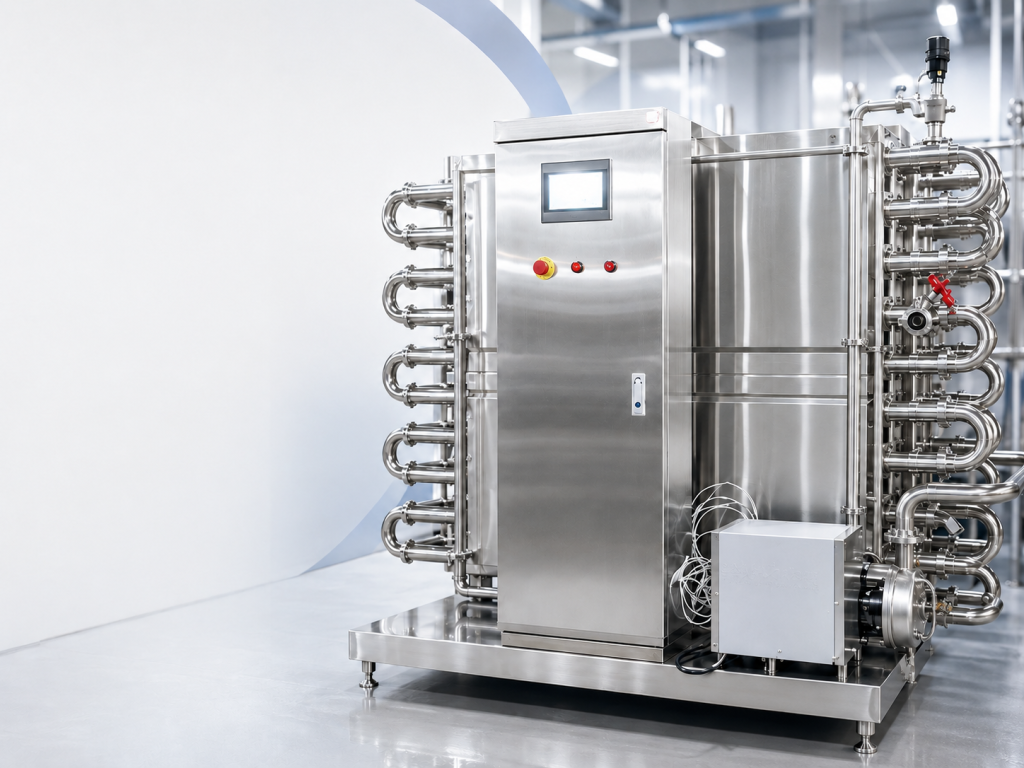
A tubular heat exchanger (THE) runs product through one or more inner tubes, surrounded by a shell carrying the service fluid. Common configurations are double-tube, triple-tube, and multi-tube bundles. Because there are no contact points or narrow plates, the wide flow path tolerates particulates, fibers, and higher viscosity.
Strengths:
- Handles pulp, particles, and high viscosity that would instantly clog a plate unit (tomato paste, fruit purée, sauces, cream).
- Higher pressure and temperature tolerance — fully welded designs run well beyond gasket limits.
- Longer run time between cleanings in demanding UHT duties.
- Robust, durable, and easy to CIP as a closed system.
Limitations:
- Lower heat-transfer coefficient — needs more surface area and a larger footprint for the same duty.
- Cannot be opened for visual inspection; cleaning is CIP-only.
- Higher capital cost than a comparable plate unit.
See Zhongbo’s Tubular Heat Exchangers → for viscous and particulate products.
Plate vs Tubular: Head-to-Head Comparison
| Factor | Plate Heat Exchanger | Tubular Heat Exchanger |
|---|---|---|
| Heat-transfer efficiency | Very high (3–5×) | Moderate |
| Best product viscosity | Low (water-like) | Medium to high |
| Particulate handling | Poor (clogs above ~3–5 mm) | Excellent (pulp, fibers, chunks) |
| Footprint | Compact (1/5 space) | Large |
| Pressure / temperature | Limited by gaskets | High (welded designs) |
| Cleaning & inspection | Open, plates washed individually | CIP only, no visual inspection |
| Energy recovery (regeneration) | Up to 90–95% | Moderate |
| Capacity expansion | Add plates to frame | Fixed at manufacture |
| Initial cost | Lower–moderate | Moderate–high |
6 Factors That Decide the Right Type
Use this checklist in order — the first factor that “votes tubular” usually wins:
- Viscosity. Thin, free-flowing liquids → plate. Anything that pours slowly or is gel-like → tubular.
- Particulates. Pulp, fibers, or solids larger than a few millimetres → tubular, every time.
- Pressure & temperature. Extreme duties beyond gasket limits → welded tubular.
- Floor space. Tight plant room → plate’s compact footprint is a major advantage.
- Cleaning access. If you need to physically inspect and wash surfaces between runs (e.g. allergen changeovers) → plate is serviceable; tubular is CIP-only.
- Budget & lifecycle. Plate is cheaper upfront and recovers more energy; tubular costs more but lasts longer in harsh duties.
Matching the Exchanger to Your Product
| Product | Viscosity / Solids | Recommended |
|---|---|---|
| Fresh milk, skim milk | Low / none | Plate |
| Clear juice, beer, wine | Low / filtered | Plate |
| Pulpy orange juice, smoothie | Low–med / pulp | Tubular |
| Tomato paste, ketchup | High / solids | Tubular |
| Cream, condensed milk | Medium–high | Tubular |
| Plant-based milk (no pulp) | Low–med | Plate |
| Oat/soy milk with fibre | Med / fibre | Tubular |
| Thin sauces, brine, CIP return | Low | Plate |
For a deeper dive into beverage-specific selection, read our guide on choosing a UHT processing line by beverage type →.
Where Heat Exchangers Fit in HTST & UHT Lines
Both exchanger types are the core of pasteurization and sterilization systems. In an HTST line for fresh milk, a plate exchanger with a regeneration section is the standard — it delivers the 72°C / 15 s treatment with minimal energy. In a UHT line for shelf-stable milk or aseptic beverages, the choice follows the product: clean liquids use plate UHT; pulpy or viscous products use tubular UHT. The exchanger is selected after the process temperature and product properties are defined.
Not sure whether your line needs HTST or UHT at all? Start with our comparison: HTST vs UHT: What Is the Difference? →
5 Common Heat Exchanger Selection Mistakes
- Choosing on price alone. A cheap plate unit that fouls every 4 hours on your sauce will cost more in downtime than a tubular unit.
- Ignoring future products. If you may add a pulpy SKU later, size the frame or specify tubular from the start.
- Underestimating particulates. “Fine pulp” still clogs narrow plate channels — be conservative.
- Forgetting regeneration. Plate’s 90%+ energy recovery is a major operating-cost advantage for clean liquids.
- Skipping CIP validation. Confirm the exchanger can be cleaned to your hygiene standard (3-A / EHEDG) before purchase.
Zhongbo’s Plate & Tubular Heat Exchangers
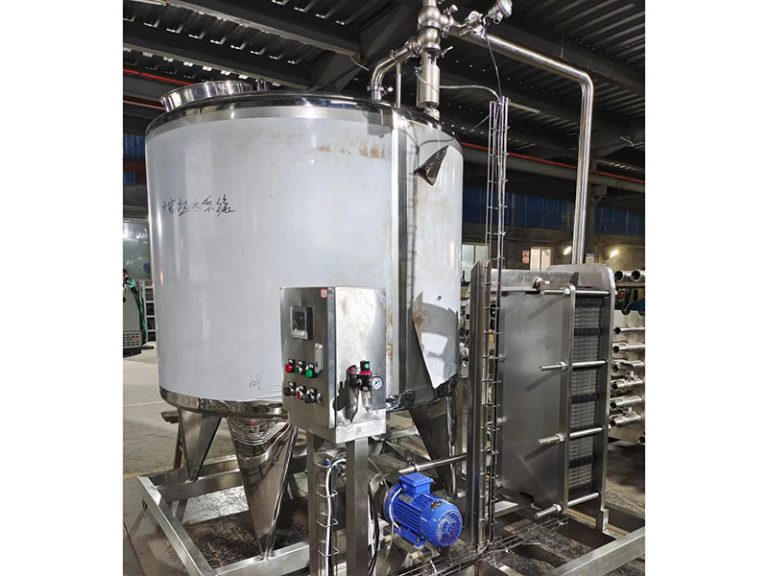
Zhongbo manufactures both plate type and tubular heat exchangers in 304 and 316L stainless steel, built to 3-A and EHEDG hygienic standards and supplied as part of complete pasteurization and UHT systems. Both are engineered for easy CIP integration and long service life in dairy and beverage plants.
Not sure which exchanger fits your product and capacity? Our engineers will size it from your product spec — free of charge.
Heat Exchanger Quick-Select Tool
Answer the three questions, then read your recommendation across.
| If your product is… | …and contains… | …choose |
|---|---|---|
| Water-like (milk, clear juice) | No solids | Plate |
| Sauce, purée, paste | Pulp / fibres | Tubular |
| Cream, condensed milk | High viscosity | Tubular |
| Any, but space is tight | Clean liquid | Plate |
| UHT duty, extreme T/P | Any | Tubular (welded) |
FAQs
Can a plate heat exchanger handle products with pulp or particles?
Generally no. Plate channels are only a few millimetres wide and clog quickly with pulp, fibre, or solids larger than about 3–5 mm. For pulpy juice, tomato paste, or sauces, use a tubular heat exchanger with its wide, open flow path.
Which heat exchanger is easier to clean — plate or tubular?
Plate units are easier to service: you unbolt the frame and wash each plate individually, which also lets you visually inspect for fouling. Tubular units are cleaned by CIP only and cannot be opened for inspection. Both work with CIP systems, but plate offers superior access.
Is a tubular heat exchanger more expensive than a plate type?
Upfront, yes — tubular units need more material for the same duty and cost more. But for viscous or particulate products they avoid the downtime and fouling losses of an undersized plate unit, so total cost of ownership can favour tubular. Request a Zhongbo quote → to compare for your duty.
Which heat exchanger is better for milk pasteurization (HTST)?
For standard fresh milk, a plate heat exchanger with a regeneration section is the industry standard — high efficiency, compact, and easy to clean. Tubular is chosen only when the milk product is viscous (e.g. concentrated or with particulates).
Can I upgrade a plate heat exchanger if my capacity grows?
Yes — one of the main advantages of plate design is scalability. You simply add plates to the existing frame (up to its maximum), avoiding the cost of a whole new unit. Tubular capacity is fixed at manufacture, so plan headroom carefully if you choose tubular.
Which heat exchanger should I choose for plant-based milk with pulp?
Oat or soy milk containing fibre or fine pulp should use a tubular heat exchanger to avoid channel blockage. Clear, filtered plant milks can use a plate unit for better energy recovery.
Conclusion
There is no universal winner between plate and tubular heat exchangers. Plate wins on efficiency, footprint, and cleanability for low-viscosity, particle-free liquids. Tubular wins on robustness for viscous, pulpy, and particulate products and extreme duties. Match the exchanger to your product’s viscosity and solids first — everything else follows.
Related Resources
From Zhongbo:
- HTST vs UHT: What Is the Difference?
- How to Choose a UHT Processing Line for Beverages
- Zhongbo Plate Type Heat Exchangers
- Zhongbo Tubular Heat Exchangers
Recommended future reads:
- Falling Film vs Forced Circulation Evaporator: Which Is Better for Your Product?
- How to Choose the Right CIP System for a Dairy or Beverage Plant
- How to Choose a Sanitary Pump: Centrifugal vs Positive Displacement
Ready to Specify the Right Heat Exchanger?
Send us your product type, capacity, and viscosity — Zhongbo engineers will recommend plate or tubular and size the system for you.
Zhongbo is a manufacturer of thermal processing and filling equipment for the dairy, beverage, and food industries. Specifications cited reflect common industry practice (3-A, EHEDG) and typical project data; final selection should be validated against your product’s lab properties.