


Introduction
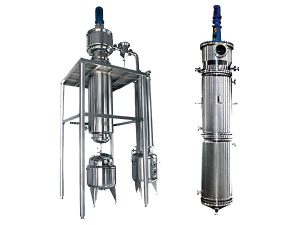
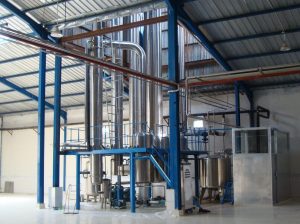
Concentration is where herbal and juice extracts live or die. Push the temperature too high, or hold the product too long, and the color browns, the volatiles flee, and the active compounds you spent a whole extraction step recovering start to break down. For heat-sensitive botanicals and juices, the answer is not a bigger boiler—it is a double-effect vacuum concentrator that removes water at low temperature while reusing its own vapor energy.
This article explains why thermal degradation happens, how vacuum and the “double-effect” principle cut both the heat load and the steam bill, what quality metrics to watch, and how to specify a unit that actually protects your product instead of just boiling it faster.
Why Heat Degradation Happens in Concentration
Concentration is simply removing water, but water in a botanical miscella is bound to everything you care about. As temperature rises and residence time extends, several things go wrong at once:
- Maillard browning. Sugars and amino acids react above ~80 °C, darkening color and generating off-notes. In a clear juice concentrate this is the difference between premium and reject.
- Vitamin and flavonoid loss. Vitamin C and many polyphenols drop sharply above 70 °C; a 30-minute hold at 90 °C can erase 30–50 % of labelable actives.
- Volatile loss. Aromatic compounds (the “smell” of mint, citrus, or ginseng) flash off well below boiling, so open concentration throws away your fragrance along with the water.
- Viscosity runaway. As solids climb past 40–50 °Brix, the liquid insulates itself, hot spots form, and local scorching caramelizes the product on the heating surface.
The target for most herbal and juice concentrates is to keep the bulk temperature under 50–55 °C during concentration and the residence time under a few minutes per pass.
How a Vacuum Concentrator Lowers the Thermal Load
The Role of Vacuum
Water boils at 100 °C at atmospheric pressure, but at an absolute pressure of about 15–20 kPa it boils near 55–60 °C. A vacuum concentrator pulls the evaporator below that pressure so water leaves at a temperature herbs and juices can tolerate. The relationship is predictable: drop the pressure, drop the boiling point, drop the thermal damage. A typical vacuum concentrator holds the evaporator at 45–60 °C while the vapor is condensed and removed.
Short Residence Time
Vacuum alone is not enough if product lingers. Forced-circulation and falling-film designs move the miscella through the heater in seconds, not minutes, then separate vapor from liquid immediately. Short residence time means even the small fraction of product near the heating wall sees heat only briefly, so local degradation stays negligible.
What “Double-Effect” Actually Saves
Energy Economy
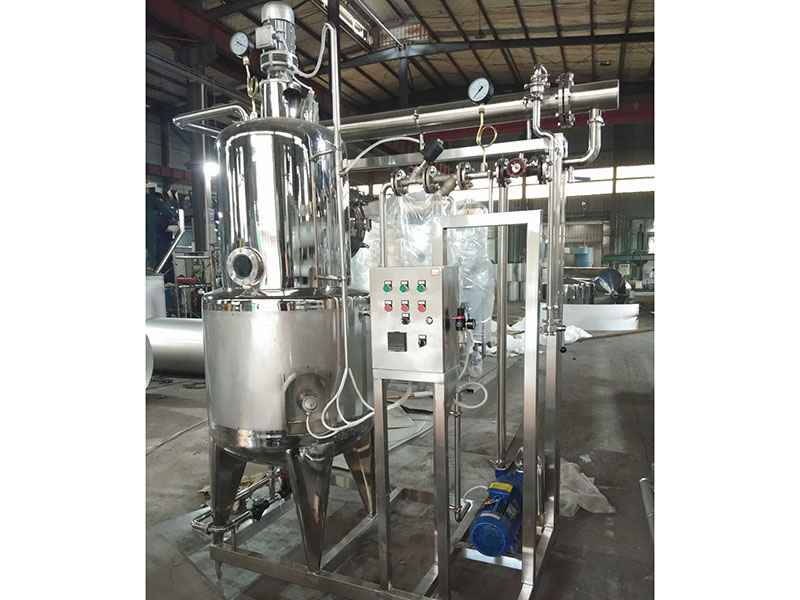
A single-effect evaporator uses roughly 1 kg of steam to remove 1 kg of water. A double-effect unit uses the vapor from the first effect as the heating medium for the second effect, so one kilogram of live steam removes about 1.8–2.0 kg of water. Against a single-effect unit, that is close to half the steam for the same evaporation duty—and steam is usually the largest operating cost in a concentration hall.
Cascaded Temperature Profile
In a double-effect design the first effect runs hotter (still under vacuum, but at the higher of the two pressures) and the second effect runs cooler. The product can be routed so it meets the gentler, lower-temperature effect last, which is exactly where heat-sensitive botanicals want to finish. The cascade also means the final vapor is condensed at a low temperature, protecting volatiles captured in a separate aroma recovery loop if fitted.
Protecting Herbal & Juice Quality
What “protected” looks like in numbers:
| Quality metric | Open pan (90–100 °C) | Single-effect vacuum | Double-effect vacuum |
|---|---|---|---|
| Bulk temp during concentration | 90–100 °C | 55–65 °C | 45–60 °C |
| Color (vs. fresh, lighter = better) | Markedly darker | Moderate change | Minimal change |
| Vitamin C retention | 40–60 % | 70–85 % | 80–90 % |
| Volatile aroma | Largely lost | Partly retained | Retained + recoverable |
| Steam per kg water removed | ~1.0 kg | ~1.0 kg | ~0.5 kg |
The table is why double-effect vacuum is the default for any herbal or juice line that labels an active or sells on appearance. The energy column is the bonus that pays back the extra capital.
Design Details That Matter
- Heating surface material. 304 or 316L stainless; 316L for acidic juices and chloride-rich botanicals to resist pitting.
- Separator design. A properly sized vapor-liquid separator stops product entrainment, which otherwise wastes solids and fouls the condenser.
- Condenser & vacuum source. A barometric or surface condenser plus a liquid-ring vacuum pump sets the final pressure; size the pump for the vapor load, not the nameplate.
- CIP access. Every effect must be cleanable-in-place; narrow passes that cannot be flushed will foul within weeks.
Specifying a Double-Effect Vacuum Concentrator
Get these inputs right before you ask for a quote:
- Feed rate and feed °Brix. e.g., 2 t/h at 8 °Brix.
- Target outlet °Brix. e.g., 50–60 °Brix for herbal paste, 65–72 for juice concentrate.
- Vacuum level / boiling temperature. Specify the maximum bulk temperature your actives can survive.
- Steam pressure available. Most plants supply 0.3–0.6 MPa; the first effect is tuned to it.
- Volatile recovery need. If fragrance matters, request an aroma scrubber on the second-effect vapor.
From these, evaporation duty (kg water/h) follows directly, and the effect sizes are set. Underspecify the feed rate and the unit fouls; overspecify it and you paid for idle steel.
Juice vs Herbal: Different Tuning
Juice concentrates are usually higher-volume and more acid-sensitive; they favor forced-circulation double-effect units with aggressive CIP and an aroma loop. Herbal extracts are often lower-volume, higher-solid, and more variable in viscosity; they benefit from scraped-surface or wider-pass heaters to avoid scorching at high °Brix. We size the two differently on purpose, and a unit tuned for one will underperform on the other.
Integration with Extraction & Storage
A concentrator is only as steady as its feed. A stable, high-concentration miscella from a multifunctional extraction tank or percolation column keeps the evaporator at design point. After concentration, an aseptic tank holds the finished extract under sanitary conditions before filling. Plan the three together so the concentrator is never starved or flooded.
Common Pitfalls
- Chasing steam savings over product. Double-effect halves steam, but if your actives are ultra-heat-sensitive, a single-effect at a lower temperature may protect quality better. Decide on the product first.
- Skipping aroma recovery. On a premium juice or herbal fragrance line, lost volatiles are lost margin.
- Wrong pass geometry. High-°Brix herbal pastes scorch in tight falling-film tubes; use forced or scraped circulation.
- No spare condenser capacity. The vacuum pump, not the heater, is usually the first bottleneck in summer.
FAQ
Is double-effect always better than single-effect?
For volume above a few hundred kg water/hour, yes on energy—but for extremely heat-sensitive, low-volume actives a single-effect at a lower temperature can protect quality better. Match the effect count to the product and the run size.
Can it handle both herbal and juice extracts?
Yes, with tuning: forced-circulation and an aroma loop for juice; wider or scraped passes for thick herbal pastes. One skid can serve both if specified for the worse case.
What vacuum level should I target?
Aim for an absolute pressure around 15–20 kPa, which holds boiling near 55 °C. Go lower only if your actives demand it and your vacuum source can hold it under full vapor load.
How much steam does a double-effect unit save?
Roughly half versus single-effect—about 0.5 kg steam per kg water removed versus ~1.0 kg. At continuous plant scale that difference is a large part of the payback.
Will it darken my juice?
Far less than open or atmospheric concentration. Kept under 60 °C with short residence time, color change is minimal and usually within spec.
Conclusion
A double-effect vacuum concentrator protects heat-sensitive herbal and juice extracts by combining low-temperature vacuum evaporation with reuse of its own vapor energy. The result is better color, higher active retention, recoverable aroma, and roughly half the steam of a single-effect unit. Specify it from feed rate, target °Brix, and the maximum bulk temperature your product can survive—and integrate it with extraction and aseptic storage so the whole line runs steady. For botanical lines where the label claims an active, double-effect vacuum is not a luxury; it is the only way to concentrate without destroying what you extracted.