

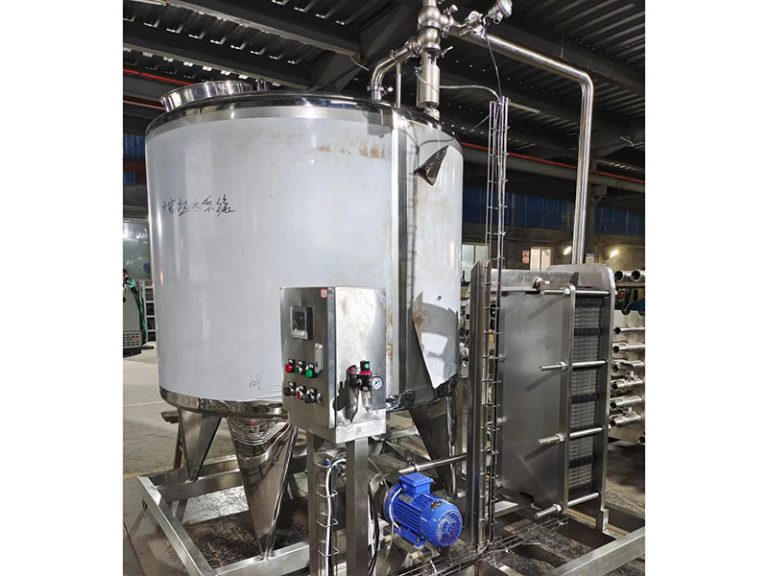

Introduction
Evaporation is the largest energy user in many dairy, juice, and herbal processing plants. The biggest lever on that energy bill is how many times the same heat is reused. Multi-effect evaporators do exactly that by sending the vapor from one effect to heat the next, and the key design number that makes it work is the temperature difference, ΔT, between effects. Get ΔT right and you halve the steam bill; get it wrong and you pay for steel that does nothing. This guide explains secondary vapor recovery and how to calculate the thermal delta that drives it.
Multi-Effect Evaporation Basics
In a single-effect evaporator, steam enters the first calandria, boils the product, and the resulting vapor is condensed and thrown away. Roughly 1 kg of steam removes 1 kg of water. In a double-effect unit, the vapor from the first effect is used as the heating medium for the second effect. Because vapor condensation releases latent heat, one kilogram of steam now removes about 1.8–2.0 kg of water. Triple-effect roughly triples the water removed per kilogram of live steam. The economics are simple: more effects mean less steam, but each additional effect needs a larger ΔT budget.
What ΔT Means Across Effects
Each effect operates at a lower pressure and therefore a lower boiling point than the one before it. The total available ΔT is the difference between the heating steam temperature in the first effect and the vapor temperature leaving the last condenser. That total ΔT must be split across all effects, the boiling-point rise (BPR) of the product, and the losses across each heat-transfer surface. A typical total ΔT for a dairy evaporator might be 40 °C; in a triple-effect unit that leaves roughly 12–13 °C per effect once losses are counted.
Secondary Vapor Recovery
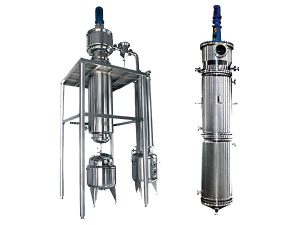
Secondary vapor is the vapor leaving any effect that is not the first. Instead of condensing it immediately, it is routed to the next effect’s heating surface. The challenge is that this vapor is at a lower temperature and pressure than live steam, so the next effect must be held at an even lower pressure to create a useful ΔT. A vacuum concentrator uses this principle aggressively: the second effect boils under deep vacuum so the vapor from the first effect still has enough temperature to drive it.
Calculating ΔT Effect by Effect
A practical two-effect dairy evaporator might have:
- First effect steam temperature: 90 °C
- First effect boiling temperature: 82 °C (ΔT across heater ≈ 8 °C)
- Second effect boiling temperature: 65 °C (ΔT across inter-effect transfer ≈ 17 °C)
- Condenser vapor temperature: 55 °C (ΔT across second effect heater ≈ 10 °C)
The total ΔT from 90 to 55 is 35 °C. The useful ΔT per effect (driving heat transfer) is smaller because some ΔT is consumed by the boiling-point rise of the concentrated product and by the temperature drop across each heat-transfer film. Designers aim for at least 5–8 °C of useful ΔT per effect; below that, heat-transfer area grows prohibitively.
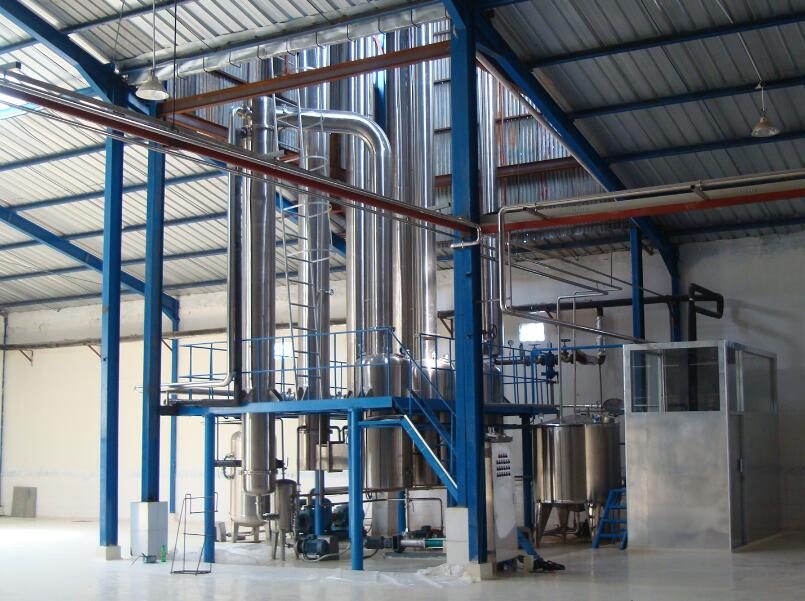
Energy Savings of Double-Effect
| Configuration | Steam per kg water removed | Approx. relative energy |
|---|---|---|
| Single-effect | ~1.0–1.1 kg | 100 % |
| Double-effect | ~0.5–0.6 kg | 50–55 % |
| Triple-effect | ~0.33–0.4 kg | 33–40 % |
The savings are real, but they are bounded by the total ΔT available. You cannot keep adding effects unless you have a high-pressure steam supply or a very low condenser temperature.
Vacuum and Boiling Point Depression
Vacuum is what makes multi-effect possible with moderate steam. At 15 kPa absolute, water boils near 55 °C; at 8 kPa it boils near 42 °C. A vacuum concentrator uses this to run the final effect at a temperature low enough to protect heat-sensitive extracts while still accepting vapor from the upstream effect. The deeper the vacuum, the lower the boiling point, but the larger and more expensive the vacuum pump and condenser become.
When ΔT is Too Small
If the ΔT across an effect falls below about 5 °C, the required heat-transfer area becomes impractical and the effect is essentially idle. Causes include fouled heating surfaces, excessive boiling-point rise from over-concentration, too-low steam pressure, or an undersized condenser pulling too high a vacuum. The fix is usually to clean the heat exchanger, reduce final concentration, raise steam pressure modestly, or enlarge the condenser.
Specifying a Multi-Effect Unit
Give the supplier: feed rate and inlet solids, target outlet solids, available steam pressure and temperature, cooling-water temperature, maximum allowable product temperature, and whether volatiles must be recovered. From these the designer chooses the number of effects and the ΔT split. Do not ask for a triple-effect unit if your total ΔT only supports two; the third effect will be dead steel.
Common Mistakes
- Ignoring boiling-point rise. Concentrated juices have a BPR of 5–10 °C, which consumes a large part of the ΔT budget.
- Designing at catalogue U-values. Fouled U-values can be half the clean value; size for the fouled case.
- Too many effects. More effects only save energy if there is enough ΔT to drive them.
- Undersized condenser. The condenser sets the final pressure; if it cannot pull enough vacuum, the last effect stalls.
FAQ
What is a good ΔT per effect?
5–8 °C of useful ΔT per effect is practical. Below 5 °C the heat-transfer area becomes uneconomical.
Can I recover vapor from a single-effect evaporator?
Only as a heat source for another process, not as a true multi-effect cascade. Real multi-effect needs at least two boiling stages at different pressures.
Why does the last effect run under vacuum?
To lower the boiling point so the vapor from the previous effect is hot enough to drive it. Without vacuum, the upstream vapor would be too cold.
How do I know if I can add a third effect?
Check the total available ΔT from steam temperature to cooling-water temperature, subtract BPR and losses, and divide by the number of effects. If the result is above 5 °C, a third effect is viable.
Does multi-effect reduce product quality?
No—if designed correctly. The later effects run at lower temperatures, which is gentler on heat-sensitive products. The first effect sees the highest temperature but only briefly.
Conclusion
Secondary vapor recovery is the reason multi-effect evaporators dominate energy-intensive concentration. The economics depend on ΔT: the total temperature difference from live steam to condenser must be split across effects, boiling-point rises, and heat-transfer losses. A falling-film evaporator paired with a vacuum concentrator can realize those savings while keeping product temperatures low. Specify from the real ΔT budget, not from the number of effects you wish you had, and the plant will save steam without sacrificing quality.