


Introduction
Heating or cooling a process tank is a heat-transfer problem. The effectiveness of the jacket or coil is captured by the overall heat-transfer coefficient, U, in W/m²·K. A higher U means more heat moves across the wall for the same temperature difference. In stainless steel processing tanks, the two most common heat-transfer surfaces are the dimple jacket and the internal or external steam coil. Each has its own U-value range, cost profile, and cleaning implications. This guide compares them so you can specify the right one.
What U-Value Represents
U-value combines the resistance of the heating medium film, the metal wall, any fouling layer, the product film, and the wall roughness. It is the inverse of total resistance:
1/U = 1/hheating + rwall/k + rfouling/k + 1/hproduct
In practice U-values for jackets and coils in food processing span from 100 W/m²·K for viscous, slowly agitated products up to 1,000 W/m²·K for thin fluids with good agitation.
Dimple Jacket Design
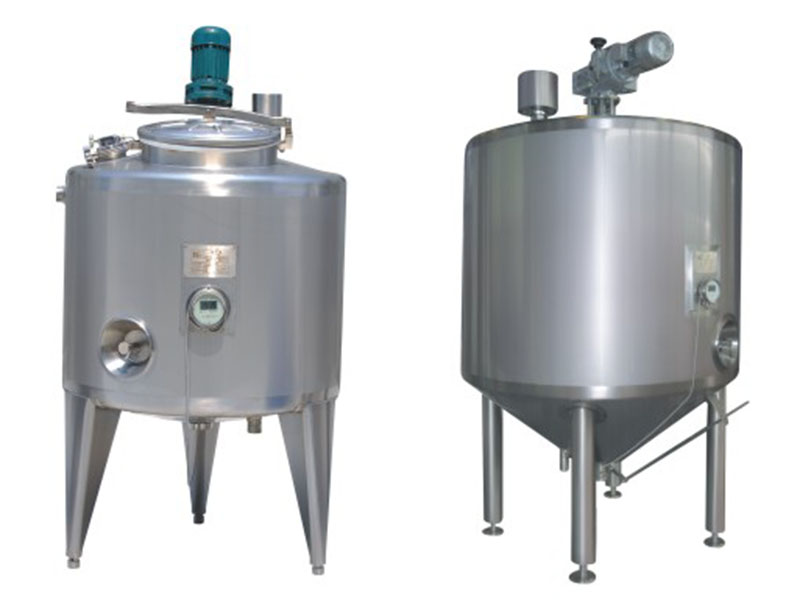
A dimple jacket is a thin stainless steel sheet stamped with dimples and welded to the tank shell. The dimples create a narrow, turbulent channel for the heating or cooling medium, which greatly increases the film coefficient on the utility side. Because the jacket is outside the tank, it does not intrude into the product and is easy to clean. Typical U-values for a dimple jacket with agitation:
- Water heating: 400–700 W/m²·K
- Steam heating: 500–900 W/m²·K
- Glycol cooling: 250–450 W/m²·K
Steam Coil Design
A steam coil is a tube or half-pipe welded to the tank wall or suspended inside the product. Internal coils give excellent heat transfer because both sides see strong convection, but they are harder to clean and can obstruct agitation. External half-pipe coils are easier to clean but transfer less effectively than internal coils. Typical U-values:
- Internal steam coil, agitated: 600–1,000 W/m²·K
- External half-pipe coil: 400–700 W/m²·K
- Coil in viscous product: 200–400 W/m²·K
Side-by-Side Comparison
| Factor | Dimple Jacket | Steam Coil |
|---|---|---|
| U-value range | 400–900 W/m²·K | 400–1,000 W/m²·K |
| Internal intrusion | None | Yes (internal coils) |
| CIP cleanability | Excellent | Poor to moderate |
| Pressure rating | Moderate | Can be very high |
| Repair access | Difficult | Moderate |
| Cost | Lower | Higher |
| Best for | Food, dairy, CIP-required | High-pressure or heavy viscous duty |
When Dimple Jackets Win
Dimple jackets are the default for hygienic tanks. They leave the interior free for agitation and cleaning, they cover a large surface area, and they are cheaper to fabricate. For dairy, beverage, and food tanks that need frequent CIP, a dimple jacket is almost always the right choice. The U-value penalty versus an internal coil is usually acceptable because the interior is easier to keep clean and inspect.
When Steam Coils Win
Internal steam coils win when the product is very viscous or when very high heating intensity is needed. Heavy sauces, caramel, and starch slurries transfer poorly at the wall; an internal coil brings heat directly into the bulk. External half-pipe coils are also used when the utility pressure is high, because a half-pipe can be designed to a higher pressure rating than a thin dimple jacket.
Agitation and Fouling
Agitation is the biggest lever on the product-side coefficient. A stationary film of viscous product against the wall can drop the effective U by 50 %. Tangential or axial agitation keeps the wall swept. Fouling also matters: milk proteins burn on hot surfaces and create an insulating layer that lowers U over time. Dimple jackets generally foul less because they are easier to CIP; internal coils often need mechanical cleaning.
Specifying the Heat Transfer Surface
To size a jacket or coil, calculate the required heat duty Q = m × c × ΔT ÷ t, then the required area A = Q ÷ (U × ΔTlm), where ΔTlm is the log mean temperature difference. If U is uncertain, use the lower end of the range and add 15 % area. For batch heating of milk, typical values are Q ≈ 30–50 kW/m³ of tank volume and U ≈ 500 W/m²·K for a dimple jacket with good agitation.
Common Mistakes
- Using internal coils in CIP-required tanks. They block spray balls and trap soil.
- Ignoring agitation. A beautiful jacket with no agitation performs like a poor one.
- Using catalogue U-values. Always de-rate for viscosity and expected fouling.
- Undersizing the jacket. If area is short, the only fix is longer batch time.
FAQ
Which has a higher U-value?
Internal steam coils can reach higher peak U-values, but dimple jackets are close enough for most hygienic applications and far easier to clean.
Can I use steam in a dimple jacket?
Yes, steam heating in dimple jackets is common and gives U-values in the 500–900 W/m²·K range.
Does agitation affect U-value?
Dramatically. Poor agitation can halve the effective U by letting a stagnant product film build against the wall.
How much fouling should I allow?
For dairy and food, add 15–25 % extra area or use a conservative low-end U-value to account for protein burn-on and scale.
Is a half-pipe coil better than a dimple jacket?
Half-pipe coils handle higher pressure and are easier to repair, but dimple jackets usually give more surface area per tank diameter and cost less.
Conclusion
Dimple jackets and steam coils both heat and cool tanks, but they suit different duties. For hygienic dairy and beverage tanks where CIP and cleanability matter, the dimple-jacketed agitator tank is the practical choice, with U-values in the 400–900 W/m²·K range. For heavy, viscous products or very high-pressure heating, internal or half-pipe steam coils deliver more intense heat transfer. Size on the real product viscosity and fouling rate, not the catalogue U, and always pair either surface with enough agitation to keep the wall swept.