Introduction
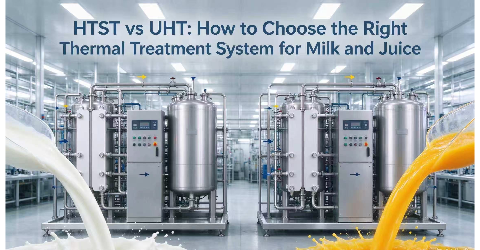
When choosing a thermal treatment system for milk or juice, the first question is usually: Should we use HTST or UHT?
The more useful question is actually: What shelf life, distribution model, product quality, and process conditions does the product require?
HTST (High-Temperature Short-Time) and UHT (Ultra-High Temperature) are both thermal processing methods, but they serve different production objectives. HTST is the common choice for refrigerated products where a cold chain is acceptable. UHT comes in when the target is commercial sterility and ambient distribution, provided the product is processed and packaged under an appropriate aseptic system.
For milk and juice manufacturers, a second decision follows: what type of heat exchanger should you use? Plate and tubular systems have different strengths depending on viscosity, suspended solids, fouling behavior and the required process conditions.
This guide works through those choices step by step.
What Is the Difference Between HTST and UHT?
HTST: High-Temperature Short-Time Treatment
HTST heats the product to a pasteurization temperature for a relatively short holding time, then cools it rapidly.
For milk, a commonly referenced HTST condition is around 72°C for 15 seconds, although the legally applicable treatment depends on the product, jurisdiction and regulatory requirements.
The objective is to reduce pathogenic microorganisms while avoiding unnecessary heat exposure.
HTST is commonly used for:
- Fresh milk
- Flavored milk
- Cream
- Yogurt milk
- Refrigerated dairy beverages
- Some refrigerated juices
After HTST, the product normally stays refrigerated throughout storage and distribution.
UHT: Ultra-High Temperature Treatment
UHT runs much hotter for a very short time. Industrial UHT systems commonly operate around 135–150°C for several seconds, depending on the product and process design.
The objective differs from conventional pasteurization: UHT is designed to achieve commercial sterility, when combined with appropriate hygienic or aseptic handling and packaging.
UHT is commonly used for:
- Long-life milk
- Shelf-stable dairy beverages
- Some plant-based beverages
- Low-acid formulated beverages
- Certain shelf-stable juice products
The result is a product that can be distributed without a conventional refrigerated cold chain, provided the complete process and packaging system support ambient stability.
HTST vs UHT: The Practical Comparison
| Factor | HTST | UHT |
| Main objective | Pasteurization | Commercial sterility |
| Typical temperature range | Product/regulation dependent; milk commonly around 72°C | Commonly around 135–150°C |
| Holding time | Seconds | Usually only a few seconds |
| Storage | Refrigerated | Ambient when aseptically processed and packaged |
| Shelf-life strategy | Shorter refrigerated shelf life | Long ambient shelf life |
| Cold chain | Required | Generally not required before opening |
| Heat exposure | Lower | Higher |
| Flavor impact | Generally closer to fresh product | Greater risk of cooked/heat-related notes |
| Packaging | Conventional hygienic filling can be used | Aseptic packaging normally required for shelf-stable products |
| Equipment complexity | Lower | Higher |
| Typical market | Local/regional refrigerated distribution | Wider distribution and ambient logistics |
One caution before you read on: don’t choose UHT simply because it delivers a higher temperature. The extra thermal intensity has to be justified by the product’s shelf-life and distribution requirements.
Start With the Distribution Model
For a new processing plant, distribution is often a better starting point than equipment.
Ask where the finished product needs to go.
Local or Regional Refrigerated Distribution
If milk is produced and sold within a region that has reliable refrigeration, HTST may be appropriate.
The product can follow this route:
Raw milk → HTST → cooling → hygienic filling → refrigerated storage → refrigerated distribution
This model avoids the additional aseptic infrastructure that a shelf-stable UHT product requires.
National or Export Distribution
If the product has to travel long distances, sit in warehouses, or reach markets where refrigeration is unreliable or expensive, UHT becomes more relevant.
A typical strategy:
Raw material → pre-treatment → UHT → aseptic holding → aseptic filling → ambient distribution
This changes the economics of the entire production line. Instead of paying for continuous refrigerated logistics, the manufacturer invests more heavily in thermal processing, aseptic equipment, packaging, validation and process control.
So the HTST-versus-UHT decision is partly a processing decision and partly a supply-chain decision.
How Does the Choice Change for Milk?
Milk is one of the clearest examples of the difference between HTST and UHT.
Fresh Milk
For refrigerated fresh milk, HTST is widely used.
The process generally involves:
- Raw milk reception
- Filtration or clarification
- Standardization
- Preheating
- Homogenization, where required
- HTST treatment
- Rapid cooling
- Refrigerated storage
- Filling
The short thermal exposure is what preserves the fresh characteristics customers expect from refrigerated milk.
UHT Milk
UHT milk follows a different production philosophy.
The product receives a much more intensive thermal treatment, and then it must be protected from recontamination during downstream handling. The system therefore needs to cover:
- High-temperature heat transfer
- Precise holding time
- Temperature and pressure control
- Sterile or aseptic product handling
- Aseptic storage/holding where applicable
- Aseptic filling
- Package integrity
A UHT system should never be evaluated as a more powerful pasteurizer. It isn’t one.
What About Juice?
Juice requires more careful analysis, because there is no single universal juice pasteurization temperature.
pH, solids, viscosity, particle content, product formulation and the target microorganism can all affect the required process.
For example, FDA guidance states that juice processors subject to the U.S. Juice HACCP regulation generally need a process capable of achieving at least a 5-log reduction of the pertinent pathogen, and the exact time-temperature combination depends on the specific juice and process.
Copying a milk HTST recipe onto juice and assuming it carries over doesn’t work.
For Refrigerated Juice
A validated HTST-type thermal process may be suitable when the product is intended for refrigerated distribution.
The process needs to be established and validated for the particular juice. Important variables include:
- pH
- °Brix
- Viscosity
- Pulp or particle content
- Target microorganism
- Product temperature
- Holding time
- Packaging conditions
For Shelf-Stable Juice
A shelf-stable juice may require a more intensive thermal process combined with appropriate filling and packaging.
The key distinction: shelf stability comes from the complete validated process and packaging system, not from turning up the pasteurization temperature. FDA guidance specifically notes that shelf-stable thermally processed juices require the thermal process to be included in the processor’s hazard analysis.
HTST Does Not Mean “Low Temperature”
One terminology point worth clearing up.
HTST is defined by the relationship between temperature and holding time, not by any single universal temperature.
For example, FDA guidance discusses a milk pasteurization condition of approximately 71.7°C (161°F) for 15 seconds, while juice processes can use different validated combinations depending on the product.
When you specify a pasteurizer, don’t just tell the equipment manufacturer:
“We need an HTST machine.”
Give them the required process conditions instead. For example:
- Product: orange juice
- Capacity: 5,000 L/h
- pH: specified value
- °Brix: specified value
- Pulp: specified concentration
- Target temperature: validated value
- Holding time: validated value
- Outlet temperature: required filling temperature
- Packaging: refrigerated or shelf-stable
That information allows the thermal system to be engineered around your actual process.
Plate or Tubular: Which Heat Exchanger Should You Use?
HTST vs UHT and plate vs tubular are two separate decisions.
A plate heat exchanger can be used in suitable high-temperature applications, and tubular systems can also handle pasteurization. The correct configuration depends on the product and the process.
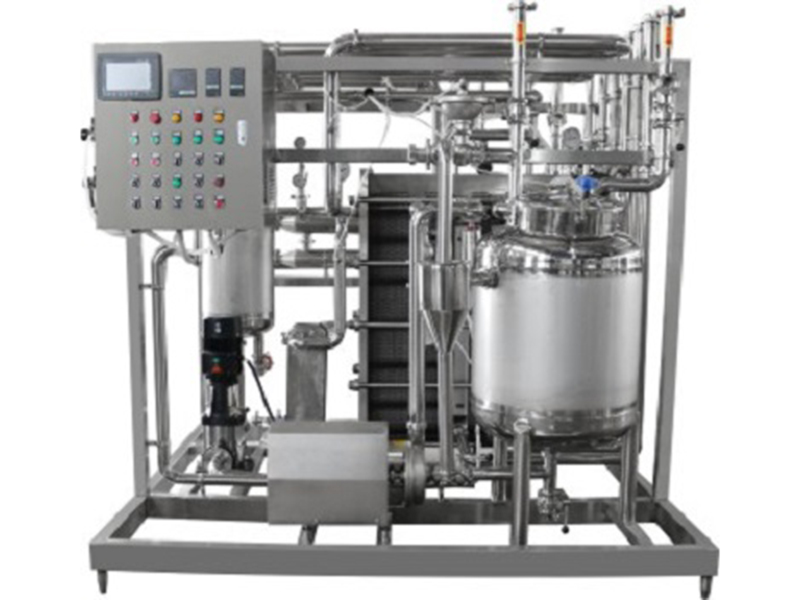
Plate Heat Exchanger
Plate systems are particularly attractive for relatively low-viscosity liquids.
Advantages include:
- High heat-transfer efficiency
- Compact structure
- Effective regeneration
- Convenient integration into continuous processing
Zhongbo’s plate pasteurizer lists a maximum pasteurization temperature of 140°C, holding times of 5–30 seconds, and capacities from 300 to 10,000 L/h. The company lists applications including milk, flavored milk, cream, yogurt drinks, soy milk, juice, tea, and coffee.
For fluid milk and clear, low-viscosity beverages, a plate system is often the practical configuration.
Tubular Heat Exchanger
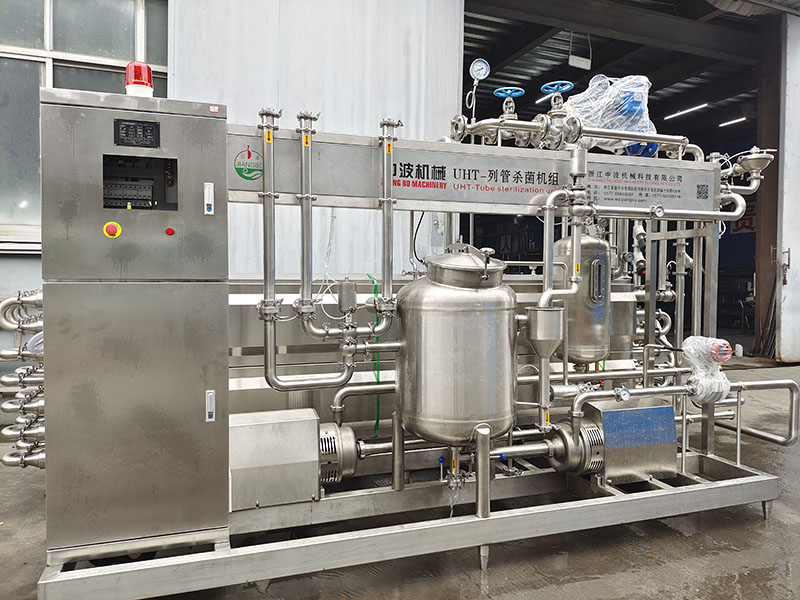
Tubular systems generally provide wider flow passages, which makes them more suitable where viscosity, suspended solids or fouling behavior makes narrow plate channels a liability.
They can be considered for:
- Viscous dairy beverages
- Products containing particles
- Certain pulpy juices
- Higher-solids formulations
- Products with demanding fouling characteristics
Zhongbo’s tubular pasteurizer is listed with a maximum temperature of 140°C, holding times of 5–300 seconds, and capacities of 300–10,000 L/h. The manufacturer also highlights applications involving viscous liquid materials and fouling-control considerations.
The rule to remember:
Choose the thermal process first, then select the heat-exchanger configuration according to the product and process requirements.
A Simple Selection Matrix
| Your Requirement | HTST | UHT |
| Fresh refrigerated milk | ✓ | Possible, but usually unnecessary |
| Long-life ambient milk | — | ✓ |
| Refrigerated juice | ✓ | Possible |
| Shelf-stable juice | Possible, depending on process | ✓ |
| Reliable cold chain | ✓ | Not essential |
| Ambient distribution | Not suitable as the sole strategy | ✓ |
| Fresh flavor priority | Generally favorable | Requires careful process design |
| Long-distance distribution | More logistics dependent | Stronger fit |
| Aseptic packaging | Not normally required | Required for shelf-stable UHT products |
| Lower initial process complexity | ✓ | — |
A starting framework, not a substitute for process validation.
Don’t Forget Product Quality
Food safety comes first, but it isn’t the only consideration.
Thermal treatment can affect:
- Flavor
- Color
- Protein functionality
- Vitamins and other heat-sensitive components
- Texture
- Enzyme activity
- Fouling behavior
The harsher the thermal treatment, the more carefully these effects need to be evaluated.
For milk, UHT produces more noticeable cooked characteristics than conventional pasteurization. For juice, excessive heat can damage volatile flavor compounds and color.
That leaves you with a plain engineering trade-off:
The objective is not to maximize temperature. It is to reach the required microbial target with the appropriate thermal load.
Fouling Can Change the Equipment Decision
Fouling is another reason two products with the same nominal thermal treatment may need different equipment.
Milk deposits protein and mineral material on heated surfaces. Juices can contain:
- Pulp
- Suspended solids
- Sugars
- Organic acids
- Concentrated fruit components
As fouling builds up, heat-transfer efficiency drops and pressure drop rises. That affects:
- Production stability
- Energy consumption
- Product quality
- CIP frequency
- Production downtime
If the product fouls heavily, equipment selection should account for the actual cleaning cycle and the production run length you can realistically expect. A system that looks economical on the quotation can lose its appeal once frequent cleaning interruptions enter the picture.
HTST and UHT Have Different CIP Requirements
Think about CIP when you select the thermal treatment system, not after the equipment has been purchased.
A typical thermal-processing CIP system may need to clean:
- Heat-exchanger surfaces
- Holding tubes
- Product pipelines
- Pumps
- Valves
- Balance tanks
- Product-contact instruments
UHT systems can be especially demanding, because deposits formed under high-temperature conditions are difficult to remove.
The cleaning program therefore needs to be matched to:
- Product composition
- Thermal load
- Fouling behavior
- Flow velocity
- Cleaning temperature
- Chemical concentration
- Cleaning time
That’s why a complete thermal-processing line should be evaluated together with its CIP system.
What Should You Tell the Equipment Manufacturer?
Before requesting a quotation for an HTST or UHT system, prepare the following information.
Product
- Product name
- Ingredients
- pH
- °Brix
- Viscosity
- Total solids
- Fat/protein content
- Particle or pulp content
Process
- Required thermal treatment
- Target temperature
- Holding time
- Inlet temperature
- Outlet temperature
- Required flow rate
- Production hours per day
Distribution
- Refrigerated or ambient
- Target shelf life
- Local, regional, national, or export market
- Cold-chain availability
Packaging
- Bottle
- Carton
- Pouch
- Aseptic packaging
- Conventional hygienic filling
- Hot filling, where applicable
Utilities
- Steam
- Electricity
- Cooling water
- Compressed air
- Available installation space
Leave this information out, and equipment selection turns into a comparison of catalogue specifications rather than a genuine process-engineering exercise.
Common Mistakes When Choosing HTST or UHT
Mistake 1: Choosing UHT just because it provides longer shelf life
Longer shelf life only helps if the distribution model and product economics justify the additional process and packaging requirements.
Mistake 2: Assuming HTST parameters apply to every juice
Juice thermal processes need to be established and validated for the specific product. FDA guidance explicitly notes that processing requirements vary according to the juice and target microorganism.
Mistake 3: Treating UHT as a standalone machine
A UHT project is more than the heating section. Aseptic handling and filling are what keep the commercial-sterility objective intact.
Mistake 4: Choosing plate or tubular equipment based only on capacity
Two systems with the same L/h rating can perform very differently with different viscosities, particle contents and fouling behavior.
Mistake 5: Ignoring CIP
The thermal process may run well on the first production pass, then turn inefficient once fouling and cleaning requirements catch up.
Mistake 6: Selecting the equipment before defining the product
This reverses the correct engineering sequence.
Product → process target → thermal treatment → heat exchanger → CIP → filling and packaging
Q&A
- Is HTST better than UHT for milk?
Neither method is universally better. HTST is the common choice for refrigerated milk; UHT applies when commercial sterility and ambient shelf stability are required. The appropriate choice depends on the product and the distribution strategy.
- Can UHT replace HTST for fresh milk?
Technically, a milk product can be processed using UHT, but that changes the product’s thermal history, packaging requirements, storage conditions and sensory characteristics. If the commercial objective is fresh refrigerated milk, HTST is generally the process to evaluate.
- Can juice be processed using HTST?
Yes, provided the thermal process is appropriate and validated for the specific juice. FDA guidance notes that juice processing parameters depend on factors including the product and target microorganism.
- Does UHT always require a tubular heat exchanger?
No. UHT systems can use different heat-transfer configurations. The appropriate equipment depends on product properties, thermal requirements, fouling behavior and system design.
- Is a plate heat exchanger suitable for UHT?
It can be, for certain products and configurations. Zhongbo lists its plate pasteurizer with a maximum temperature of 140°C and 5–30 second treatment times.
- When should I consider a tubular UHT system?
When the product is relatively viscous, contains suspended material, or fouls in ways that make a plate configuration less attractive. Base the final decision on actual product data.
- What is the biggest difference between HTST and UHT?
The processing objective. HTST is generally used to achieve pasteurization for products that stay under refrigerated distribution, while UHT is designed to achieve commercial sterility as part of a system capable of producing shelf-stable products.
- Can one production line handle both HTST and UHT products?
Some plant designs use a flexible system for multiple thermal processes, but it depends on the equipment configuration, product portfolio, cleaning requirements and downstream filling system. In many cases, separate or specially configured processing circuits are more practical.
- What information is needed to size an HTST or UHT system?
At minimum: product properties, required capacity, inlet and outlet temperatures, target thermal treatment, viscosity, solids or particle content, desired shelf life, packaging method and available utilities.
Conclusion
The decision between HTST and UHT should start with the product and the market, not with the equipment catalogue.
For refrigerated milk or juice, HTST provides the required microbial control while supporting a fresh-product distribution model. For products intended for ambient distribution and long shelf life, UHT becomes relevant, but the project must be designed around the complete thermal and aseptic process.
Next comes the heat exchanger. Plate systems suit many relatively fluid products; tubular systems give you more room with viscous, particulate or fouling-prone ones.
Juice carries an additional requirement: the thermal process must be established and validated for the specific product and the applicable regulatory framework. FDA guidance, for example, requires juice processors covered by the U.S. Juice HACCP regulation to establish controls capable of achieving the applicable 5-log pathogen-reduction performance standard.
So for a new milk or juice line, don’t open with “HTST or UHT?” Open with:
What is the product, what treatment does it require, where will it be sold, how long must it last, and how will it be packaged?
Zhejiang Zhongbo Mechanical Technology Co., Ltd. provides plate and tubular thermal-processing equipment for dairy, beverage, and food applications, with listed capacities from 300 to 10,000 L/h for its plate and tubular pasteurizer systems.
Providing the product formulation, target capacity, thermal process, viscosity, particle content, shelf-life target and packaging method allows the thermal treatment system to be designed around your actual production requirements rather than selected from a generic HTST/UHT specification.