Introduction
Dissolved oxygen can negatively affect beverage quality, shelf life, color, flavor, and nutritional stability. For many dairy and beverage manufacturers, removing excess oxygen before thermal treatment and filling is therefore an important part of process design.
A deaeration system uses controlled vacuum and product conditions to remove dissolved and entrained air from liquids. However, different beverages have different deaeration requirements.
This guide explains the key factors to consider when selecting a deaeration system for beverage production, including product characteristics, processing capacity, vacuum performance, temperature, and integration with UHT and filling systems.
What Is a Deaeration System for Beverage Production?
A deaeration system is processing equipment designed to reduce dissolved and entrained oxygen in liquid products.
A typical vacuum deaeration process can be summarized as:
Product Preheating → Vacuum Deaeration → Oxygen Removal → Downstream Processing
Under controlled vacuum conditions, dissolved gases become easier to release from the liquid. The system then separates the released air from the product before the deaerated liquid continues through the production line.
Depending on the process, deaeration can be positioned before:
- UHT treatment
- Pasteurization
- Homogenization
- Filling
- Other thermal processing stages
A properly designed system can help improve product stability while supporting the requirements of continuous beverage production.
Why Is Deaeration Important in Beverage Processing?
Oxygen is an important factor in beverage quality. Excess dissolved oxygen can accelerate oxidation reactions during processing and storage.
Potential effects include:
- Flavor deterioration
- Color changes
- Nutrient degradation
- Oxidation of sensitive ingredients
- Reduced product stability
- Shorter perceived shelf life
This is particularly relevant for beverages containing fruit components, tea extracts, dairy ingredients, vitamins, or other oxidation-sensitive compounds.
Deaeration can also be beneficial before thermal processing. Reducing dissolved oxygen before UHT or other heat treatment can help limit oxidation-related quality changes during subsequent processing.
Therefore, oxygen removal in beverage processing is not simply a storage consideration. It can be an important part of the overall thermal-processing strategy.

Key Factors When Choosing a Deaeration System
Beverage Type and Product Characteristics
The first step is to evaluate the product itself.
Different beverages can have significantly different deaeration requirements.
Consider:
- Viscosity
- Temperature
- Solids content
- Dissolved oxygen level
- Foaming tendency
- Product sensitivity to oxidation
- Particle content
For example, juice, tea, dairy beverages, and other formulated drinks may respond differently to vacuum treatment.
Products that contain sensitive flavors, colors, or nutritional ingredients may benefit more from effective oxygen control.
The deaerator should therefore be selected based on the actual formulation rather than using a standard configuration for every beverage.
Processing Capacity
The deaeration system must match the required production flow rate.
Important parameters include:
- Hourly production capacity
- Product inlet flow rate
- Peak production rate
- Holding or residence time
- Upstream equipment capacity
- Downstream filling capacity
If the deaerator is undersized, it can become a bottleneck in the production line.
If it is significantly oversized, the additional equipment and operating costs may not provide corresponding benefits.
The system should therefore be designed according to the complete production-line capacity.
Vacuum and Oxygen Removal Performance
Vacuum performance is one of the most important technical considerations.
A deaeration system should provide stable vacuum conditions that allow sufficient gas release without unnecessarily affecting the product.
When evaluating a system, manufacturers should consider:
- Vacuum level
- Oxygen removal efficiency
- Product residence time
- Vacuum stability
- Product temperature
- Gas separation performance
The objective is not simply to achieve the deepest possible vacuum. The vacuum conditions should be optimized together with temperature, flow rate, and product characteristics.
The required dissolved oxygen level should also be established according to the product and downstream processing requirements.
Temperature and Product Quality
Temperature has a significant influence on deaeration performance.
In general, controlled preheating can facilitate the release of dissolved gases before the product enters the vacuum chamber.
However, excessive temperature can negatively affect heat-sensitive products.
The system should therefore balance:
Temperature → Vacuum → Oxygen Removal → Product Quality
For oxidation-sensitive beverages, effective deaeration should be achieved without introducing unnecessary thermal exposure.
This is particularly important when deaeration is installed upstream of UHT or pasteurization.
Integration with UHT and Filling Systems
A deaeration system should be designed as part of the complete processing line.
A typical configuration may be:
Mixing Tank → Deaerator → Homogenizer/UHT → Buffer Tank → Filling
Positioning the deaerator before thermal treatment can help reduce dissolved oxygen before the product experiences further heat exposure.
Integration should consider:
- Product flow rate
- Pump selection
- Pipeline pressure
- UHT capacity
- Buffer tank capacity
- Filling speed
- CIP connections
- Control-system communication
The deaerator should not create unnecessary pressure fluctuations or become a restriction in the downstream process.
For high-hygiene dairy and beverage production, the equipment should also support sanitary operation and effective CIP.
How to Choose the Right Deaerator for Your Production Line?
A practical selection process can follow these steps:
Step 1: Define the Beverage Characteristics
Determine viscosity, solids content, temperature, foaming behavior, and oxidation sensitivity.
Step 2: Establish the Required Capacity
Match the deaerator’s processing capacity with the production line’s actual and peak flow rates.
Step 3: Define the Oxygen Removal Target
Determine the required dissolved oxygen level before selecting the vacuum configuration and operating parameters.
Step 4: Evaluate Temperature and Vacuum Conditions
Select operating conditions that provide effective oxygen removal while protecting product quality.
Step 5: Check Line Integration
Confirm compatibility with the mixing tank, pumps, UHT system, buffer tank, filling machine, and CIP system.
Step 6: Consider Hygienic Design
For food and beverage applications, ensure that product-contact components, piping, valves, and cleaning procedures meet the plant’s sanitary requirements.
The best deaeration system is therefore not necessarily the one with the strongest vacuum. It is the system that achieves the required oxygen removal while maintaining product quality, production capacity, and reliable integration with the complete processing line.
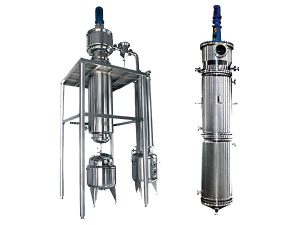
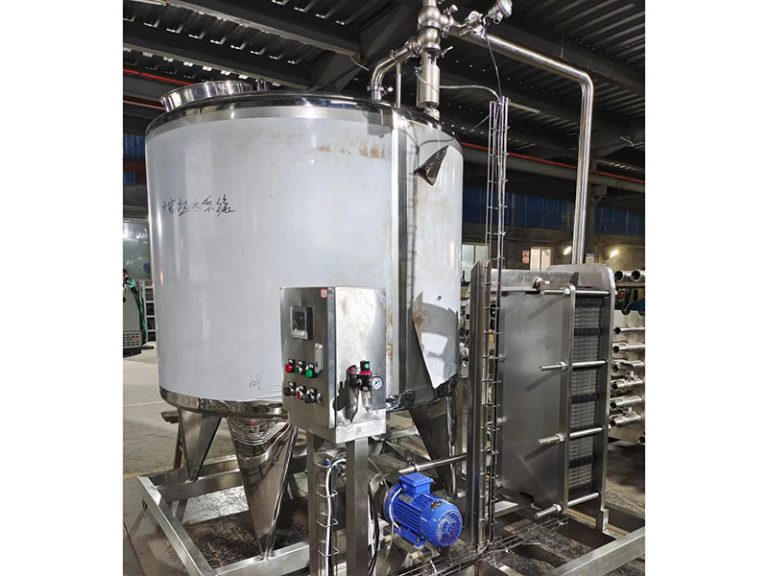
Zhongbo Vacuum Deaeration System
Zhongbo provides a Vacuum Deaeration System for beverage and food-processing applications where dissolved and entrained air needs to be reduced.
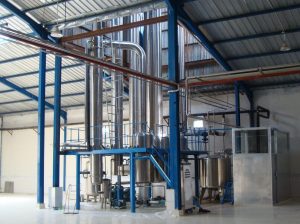
The vacuum deaeration system can be integrated into a broader beverage-processing line according to product characteristics, processing capacity, and downstream equipment requirements.
For manufacturers evaluating a vacuum deaerator for dairy and beverage processing, important considerations include vacuum performance, product temperature, flow capacity, sanitary construction, CIP compatibility, and connection with UHT, buffer tanks, and filling equipment.

Conclusion
Choosing the right deaeration system for beverage production requires more than comparing vacuum specifications. Product characteristics, processing capacity, oxygen removal requirements, temperature, and downstream integration all need to be considered together.
For many beverage applications, effective oxygen removal before thermal treatment can help control oxidation and support better flavor, color, and shelf-life stability.
A well-designed system should provide the required deaeration performance while maintaining hygienic operation, product quality, and continuous compatibility with UHT, buffer tanks, filling, and CIP systems.
Zhongbo’s Vacuum Deaeration System can be considered for beverage production lines requiring controlled dissolved-oxygen removal and integration with downstream thermal-processing equipment.
FAQs
- What is a deaeration system used for?
A deaeration system removes dissolved and entrained air from liquid products, helping control oxidation and improve beverage quality and stability.
- Why remove oxygen from beverages?
Excess oxygen can contribute to oxidation, which may affect flavor, color, nutrients, and product stability during processing and storage.
- Should deaeration be performed before UHT?
For products where dissolved oxygen is a significant quality concern, deaeration before UHT can help reduce oxygen-related oxidation during subsequent thermal processing.
- What beverages can use vacuum deaeration?
Vacuum deaeration can be applied to various liquid products, including juices, tea beverages, dairy products, and other formulated beverages. The appropriate configuration depends on product characteristics.
- How does a vacuum deaerator remove oxygen?
Controlled vacuum conditions reduce the pressure above the liquid, encouraging dissolved and entrained gases to separate from the product. The released gas is then removed from the system.
- Does temperature affect deaeration?
Yes. Product temperature influences gas solubility and deaeration performance. However, the temperature must be controlled to avoid unnecessary thermal damage to the beverage.
- How do I size a deaeration system?
Consider the required production flow rate, product characteristics, target dissolved oxygen level, operating temperature, vacuum conditions, and the capacities of upstream and downstream equipment.
- Can a deaerator be integrated with a UHT system?
Yes. A deaerator can be installed upstream of UHT and integrated with mixing tanks, pumps, UHT equipment, buffer tanks, and filling systems as part of a continuous processing line.