Key Takeaways
- Falling film evaporators are best for heat-sensitive, low-viscosity liquids (milk, juice, pharma) — residence time under 30 seconds preserves nutrients and flavor.
- Forced circulation evaporators handle high-viscosity, scaling, or crystallizing feeds (brines, wastewater, salt solutions) via pump-driven high-velocity flow.
- Falling film systems use ~0.3–0.5 kg steam per kg water evaporated; forced circulation adds 0.5–1 kW/ton of pumping power.
- Both types support CIP (Clean-in-Place), but falling film units are easier to clean and maintain.
- The right choice depends on feed characteristics, concentration target, and total cost of ownership — not just upfront price.
Evaporation & Concentration Guide
A practical comparison for dairy, beverage, pharmaceutical, and industrial processing engineers selecting between the two most widely used evaporator designs.
By Zhongbo Engineering Team · Updated August 2026 · 9 min read
About the Author: This guide is produced by Zhongbo’s process engineering team, which has designed and delivered over 200 evaporation and concentration systems for dairy, beverage, and pharmaceutical plants across Southeast Asia, Africa, and the Middle East since 2007. All recommendations are based on field-tested performance data from installed equipment.
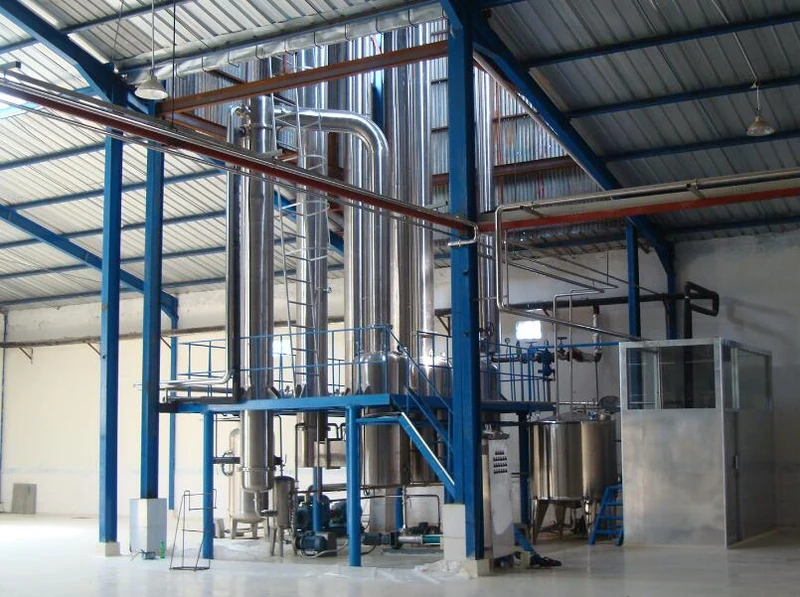
Why This Comparison Matters for Your Plant
Evaporators are among the most capital-intensive pieces of equipment in any liquid concentration plant. A single multi-effect system can represent 30–50% of your processing line budget. More importantly, the evaporator type you select directly determines:
- Product quality — nutrient retention, flavor preservation, color stability
- Operating costs — steam consumption, electricity use, cleaning frequency
- Downtime risk — fouling rate, maintenance intervals, spare parts availability
- Scalability — whether you can expand capacity without replacing the entire system
Falling film and forced circulation are the two dominant evaporator technologies used today in food, dairy, pharmaceutical, and chemical industries. Understanding their differences is not academic — it is a make-or-break engineering decision that affects your plant’s profitability for 10–15 years.
What Is a Falling Film Evaporator?
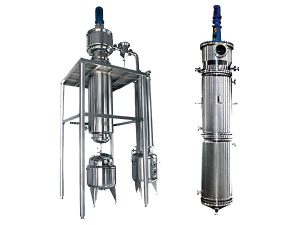
A falling film evaporator (FFE) is a vertical-tube evaporator where feed liquid enters at the top of the heating tubes and flows downward as a thin, continuous film along the inner tube wall. Steam or hot water on the shell side supplies heat through the tube wall, causing the liquid to partially evaporate as it travels down.
How It Works — Step by Step
- Feed distribution: Liquid enters a distributor head at the top of each tube. Nozzles or spray plates ensure uniform wetting across all tubes.
- Film formation: Gravity pulls the liquid down the inner wall as a thin film (typically 0.25–1.0 mm thick). The wetting rate must stay above ~0.25 kg/m·s to prevent dry patches.
- Heat transfer and evaporation: Shell-side steam heats the tube wall. Heat conducts through the stainless steel into the film, causing rapid boiling. Vapor forms inside the film and accelerates downward flow.
- Vapor-liquid separation: The mixture exits the bottom of the tubes into a separator vessel where vapor is drawn off by vacuum and concentrated liquid collects at the bottom.
- Multi-effect operation (optional): In a 2–7 effect system, vapor from one effect becomes the heating medium for the next effect at lower pressure, reducing fresh steam demand by up to 80%.
Key Design Parameters
| Parameter | Typical Range | Design Note |
|---|---|---|
| Residence time | 5–30 seconds per pass | Shortest of all evaporator types |
| Overall U-value | 2,000–4,000 W/m²·K | 2–4× higher than forced circulation |
| Tube inner diameter | 25–65 mm | Larger diameters for higher viscosity feeds |
| Tube L/D ratio | 200:1 – 400:1 | Optimizes wetting vs. installation height |
| Operating pressure | 5–20 kPa absolute (vacuum) | Boiling point drops to 40–60°C |
| Max solids concentration | 60–70% total solids | Depends on product rheology |
| Steam economy (multi-effect) | 0.3–0.5 kg steam/kg H₂O evaporated | Best-in-class energy efficiency |
FFE systems are typically built from AISI 304 or 316L stainless steel and designed to ASME Section VIII, Division 1 standards. They integrate seamlessly with CIP (Clean-in-Place) systems, making them the default choice for GMP-regulated facilities in dairy and pharmaceutical sectors.

What Is a Forced Circulation Evaporator?
A forced circulation evaporator (FCE) uses an external circulation pump to drive liquid through the heating tubes at high velocity (typically 1.5–2.5 m/s), regardless of natural convection forces. The pump maintains turbulent flow that continuously scrubs the tube walls, preventing scale buildup even with heavily fouling feeds.

How It Works — Step by Step
- Pump-driven circulation: A centrifugal or axial-flow pump draws liquid from the separator bottom and forces it through the heating tubes at controlled velocity.
- High-velocity heat transfer: The fast-moving liquid creates excellent turbulence inside the tubes, giving good heat transfer coefficients despite higher viscosity or suspended solids.
- Flash evaporation: As the heated liquid enters the lower-pressure separator chamber, part of it flashes to vapor. The remaining liquid recirculates back to the pump inlet.
- Crystallization handling (optional): For crystallizing feeds (e.g., NaCl solutions), the system can operate with a slurry recirculation loop and crystal separation device.
- Anti-scaling advantage: High shear velocity prevents salts from depositing on tube walls — the primary reason FCE is chosen for brine, wastewater, and chemical concentration duties.
Key Design Parameters
| Parameter | Typical Range | Design Note |
|---|---|---|
| Circulation velocity | 1.5–2.5 m/s | Prevents deposition and fouling |
| Residence time | Variable (recirculation-dependent) | Longer than FFE due to recirculation loops |
| Overall U-value | 800–1,800 W/m²·K | Lower than FFE but stable with fouling feeds |
| Max solids / crystallization | Up to 50% solids; 80–90% crystallization | Handles slurries FFE cannot |
| Additional power consumption | 0.5–1.0 kW per ton evaporated | Pump energy overhead |
| Steam economy | Similar to single-effect baseline | Less efficient than multi-effect FFE |
| Maintenance interval | Pump service every 3–6 months | Higher mechanical complexity |
Head-to-Head Technical Comparison
| Criterion | Falling Film Evaporator | Forced Circulation Evaporator |
|---|---|---|
| Working principle | Gravity-driven thin film down vertical tubes | Pump-driven high-velocity flow through tubes |
| Residence time | 5–30 seconds (shortest) | Minutes (recirculation dependent) |
| Heat transfer coefficient | 2,000–4,000 W/m²·K (high) | 800–1,800 W/m²·K (moderate) |
| Viscosity limit | Up to ~100 cP (with recirculation) | Up to ~500+ cP (pump handles it) |
| Suspended solids tolerance | Low — solids block distributors | Moderate-High — pump keeps solids moving |
| Scaling / crystallization | Not suitable — causes dry spots & fouling | Excellent — velocity prevents deposition |
| Heat sensitivity | ✅ Best choice — lowest ΔT, shortest contact | ⚠️ Higher ΔT needed; longer exposure |
| Energy efficiency | ✅ Lowest — ideal for MVR & multi-effect | ⚠️ Moderate — extra pump power required |
| Capital cost | Low-to-medium | Medium-high (pump + larger vessels) |
| Maintenance | Easy; CIP every 1–2 months | Pump service $3k–7k/year; more complex |
| Footprint | Compact (vertical design) | Larger (pump + separator + recirculation loop) |
| Typical applications | Milk, whey, fruit juice, glucose syrup, herbal extracts, pharma APIs | Brine, wastewater ZLD, caustic lye, salt solutions, crystallizing liquors, tomato paste |
When to Choose Each Type
Choose a Falling Film Evaporator If:
- Your feed is clear, low-viscosity, and heat-sensitive — milk (8% → 45–55% TS before spray drying), fruit juice (to 65–70° Brix), whey protein concentrate, herbal extracts, or fermentation broth.
- You need maximum product quality — short residence time preserves vitamins, enzymes, volatile aromas, and prevents Maillard browning.
- Energy cost is a priority — FFE achieves the highest steam economy in multi-effect configurations (up to 6–7 effects) and pairs efficiently with MVR (Mechanical Vapor Recompression).
- Your facility has limited floor space — vertical tube design minimizes footprint compared to horizontal or recirculating systems.
- You require GMP compliance — FFE integrates easily with automated CIP/SIP cycles and meets FDA/EMA hygiene requirements.
Zhongbo offers both single-effect and multi-effect falling film evaporators with capacities from 500 kg/h to 20,000 kg/h water evaporation, configurable for TVR (Thermal Vapor Recompression) or MVR integration.
Choose a Forced Circulation Evaporator If:
- Your feed contains suspended solids, fibers, or pulp — tomato paste, fruit purees, or fiber-rich extracts that would block falling film distributors.
- Your product tends to scale or crystallize during concentration — NaCl or ammonium sulfate solutions, calcium-bearing streams, or any feed with inverse solubility salts.
- You need high final concentrations with crystallization capability — up to 80–90% crystallization rates for zero-liquid-discharge (ZLD) applications.
- Your feed has high viscosity (>100 cP) that would break the thin film in a falling film unit.
- You are concentrating wastewater or effluent streams where fouling resistance matters more than energy efficiency.
Zhongbo’s forced circulation evaporators are engineered with heavy-duty circulation pumps, abrasion-resistant materials, and modular separator designs for easy access during maintenance.
Energy Consumption and Total Cost of Ownership
The decision between FFE and FCE should be based on Total Cost of Ownership (TCO) over 10–15 years, not just the initial purchase price. Here is how the two compare across key cost categories:
| Cost Category | Falling Film | Forced Circulation |
|---|---|---|
| Capital investment (per ton/h capacity) | $15,000–$30,000 | $25,000–$45,000 |
| Steam consumption (kg steam/kg H₂O) | 0.30–0.50 (multi-effect) | 0.50–0.80 (+ pump load) |
| Electricity (kW/ton evaporated) | 0.3–0.5 | 0.8–1.5 |
| Annual maintenance | $2,000–$5,000 | $5,000–$12,000 |
| Cleaning frequency | Every 1–2 months (CIP) | Every 1–3 months (CIP + pump service) |
| Expected service life | 15–20 years | 15–20 years |
Key insight: For a 5,000 kg/h dairy concentration plant running 330 days/year, a falling film system can save $80,000–$150,000 annually in steam costs alone compared to a less efficient alternative. However, if your feed fouls the FFE tubes every week, those savings vanish in downtime and cleaning chemicals. Match the technology to your feed — always.
Quick Selection Tool
Use this table to quickly identify which evaporator type matches your feed characteristics. Find the row that best describes your situation, then check the recommendation column.
| Your Feed Characteristic | Recommended Type | Why |
|---|---|---|
| Milk, skim milk, whey (clear, low visc, heat-sensitive) | ✅ Falling Film | Shortest residence time; preserves proteins & lactose quality |
| Fruit juice, coffee extract, glucose syrup | ✅ Falling Film | Retains volatile aroma compounds; highest energy efficiency |
| Pharma API broth, herbal extracts (GMP required) | ✅ Falling Film | Gentle low-temp operation; full CIP compatibility |
| Tomato paste, fruit puree (with pulp/fiber) | ⚡ Forced Circulation | Pump handles suspended solids; no distributor blockage risk |
| Brine, salt solution, caustic lye (crystallizing) | ⚡ Forced Circulation | High velocity prevents salt deposition on tube walls |
| Industrial wastewater, ZLD effluent (scaling) | ⚡ Forced Circulation | Designed for fouling resistance; handles variable feed quality |
| High-viscosity concentrate (>200 cP) + heat-sensitive | 🔄 Hybrid (FFE → FCE or ATFD) | Use FFE for initial concentration, then switch to FCE or agitated thin film for final stage |
| Not sure about your feed behavior? | Contact Zhongbo for a free feed analysis and pilot test recommendation | |
Common Mistakes When Selecting an Evaporator
⚠️ Watch Out for These Pitfalls
- Choosing by price alone: A cheaper forced circulation unit may cost more in 3 years of steam and pump maintenance than a properly sized falling film system. Always calculate TCO.
- Ignoring feed variability: If your raw material composition changes seasonally (e.g., fruit juice Brix varies), design for the worst-case condition, not the average.
- Over-specifying effects count: More effects = better steam economy on paper, but each additional effect increases fouling risk, cleaning downtime, and control complexity. 3–5 effects is the sweet spot for most food applications.
- Undersizing the vacuum system: An undersized vacuum pump cannot maintain the target operating pressure when non-condensable gas load spikes, causing temperature excursions and product degradation. Size for peak load, not average.
- Skip pilot testing for new products: Lab-scale or pilot-scale tests reveal wetting behavior, foaming tendency, and fouling rate that calculations alone cannot predict. Always test unfamiliar feeds before committing to a full-scale design.
Related Resources
- How to Choose the Right UHT Processing Line for Milk, Yogurt and Cream Production — Evaporators often feed into UHT lines; understand the downstream requirements.
- Plate Heat Exchanger vs Tubular Heat Exchanger — Heat exchangers are core components inside every evaporator system.
- What Products Are Suitable for UHT Treatment? — Reference guide covering thermal sensitivity thresholds for common food products.
FAQs
Q1: What products are best processed with a falling film evaporator?
Falling film evaporators excel with clear, low-viscosity, heat-sensitive liquids. The most common applications include milk concentration (8% to 45–55% total solids before spray drying), fruit juice concentration (apple, orange, pineapple to 65–70° Brix), whey protein concentration, glucose syrup production, herbal extract concentration, and pharmaceutical API fermentation broth processing. The short residence time (5–30 seconds) preserves over 95% of heat-labile nutrients, vitamins, and volatile flavor compounds. Need help matching your product to the right evaporator? Request a Free Consultation →
Q2: How does a forced circulation evaporator handle high-salinity or crystallizing feeds?
The circulation pump maintains liquid velocity at 1.5–2.5 m/s inside the heating tubes, creating enough shear force to prevent dissolved salts (NaCl, ammonium sulfate, calcium salts) from depositing on the tube walls. For crystallizing applications, the system operates with a controlled supersaturation level in the separator, allowing crystals to grow to target size while the mother liquor continues recirculating. Crystallization rates of 80–90% are achievable. This makes FCE the standard choice for ZLD (Zero Liquid Discharge) wastewater treatment, brine concentration, and chemical recovery operations. Discuss your crystallization requirements with Zhongbo’s engineers: Talk to Our Team →
Q3: What is the difference in energy consumption between falling film and forced circulation?
A multi-effect falling film evaporator consumes approximately 0.3–0.5 kg of steam per kilogram of water evaporated, depending on the number of effects (3–7 effects typical). A forced circulation evaporator consumes roughly 0.5–0.8 kg steam/kg H₂O plus an additional 0.5–1.0 kW of electrical power per ton for the circulation pump. Over a year of continuous operation, this difference can translate to $50,000–$150,000 in utility costs for a mid-sized plant. However, if a falling film unit fouls frequently due to mismatched feed properties, the cleaning-related downtime can erase those savings. The right answer depends on your specific feed and operating profile. Get a customized TCO analysis: Get Your TCO Report →
Q4: Can falling film evaporators handle high-viscosity liquids?
Standard falling film evaporators work reliably up to viscosities of approximately 50–100 cP. Beyond that, the thin film becomes unstable — it may channel, form dry patches, or break entirely. Solutions include: (1) using larger-diameter tubes (50–65 mm instead of 25–40 mm), (2) adding a recirculation loop to reduce the per-pass concentration ratio, or (3) switching to a hybrid configuration where a falling film unit handles the dilute stage and a forced circulation or agitated thin film unit finishes the concentration. For products exceeding 500 cP (tomato paste, gelatin, some APIs), forced circulation or scraped-film evaporators are the appropriate choice. View Zhongbo Falling Film Specs →
Q5: Which evaporator type suits small factories or pilot-scale operations?
For small facilities processing under 1,000 kg/h of water evaporation, a single-effect or double-effect falling film evaporator is usually the best fit. Capital investment ranges from $15,000 to $30,000, footprint is minimal (often skid-mounted), and the simple design requires minimal operator training. Forced circulation systems become economically viable at larger scales (typically 3,000+ kg/h) where the higher capital and operating costs are offset by the ability to handle difficult feeds that would otherwise cause constant downtime in a falling film unit. Zhongbo offers compact pilot-scale falling film systems starting at 200 kg/h for R&D and trial production. Explore Forced Circulation Options →
Q6: Can I combine falling film and forced circulation in one production line?
Yes — hybrid configurations are common and often optimal. A typical arrangement uses a multi-effect falling film system for the bulk of the evaporation duty (where the feed is still relatively dilute and heat-sensitive), followed by a forced circulation finisher for the final concentration stage where viscosity rises and scaling risk increases. Another common pattern in dairy plants: falling film evaporator concentrates milk to 45–50% TS, then the concentrate goes to a spray dryer. In ZLD wastewater plants: membrane pre-concentration → falling film intermediate concentration → forced circulation crystallizer. Zhongbo has delivered dozens of hybrid systems and can engineer the optimal sequence for your specific process. Discuss Hybrid Configuration →
Q7: What daily and periodic maintenance does each type require?
Both types support fully automated CIP (Clean-in-Place) cycles. For falling film units: daily checks include vacuum pump oil level, condensate drain, and distributor spray pattern inspection. CIP cleaning runs every 1–2 months depending on product. For forced circulation units: add circulation pump inspection (seal wear, bearing temperature, vibration) to the daily checklist. Pump seals typically last 6–12 months; bearings 2–3 years. Budget $3,000–$7,000/year for forced circulation pump maintenance versus $2,000–$5,000/year for falling film routine upkeep. Both should undergo a full internal inspection annually. Schedule Maintenance Consultation →
Conclusion
The choice between a falling film and a forced circulation evaporator comes down to one question: What does your feed look like, and what do you need the concentrate to achieve?
- If your feed is clear, low-viscosity, and heat-sensitive → Falling film is almost always the better choice for product quality, energy efficiency, and ease of operation.
- If your feed is viscous, scaling-prone, or contains suspended solids → Forced circulation will give you reliable uptime that a falling film unit cannot match.
- If your process spans both regimes → consider a hybrid system that leverages the strengths of each type at different concentration stages.
Zhongbo has been designing and manufacturing both types of evaporators since 2007, with installations in over 30 countries. Whether you need a compact single-effect falling film unit for a pilot dairy plant or a large-scale forced circulation crystallizer for a ZLD wastewater project, our engineering team can provide a custom proposal with detailed TCO analysis, 3D layout drawings, and delivery timeline.
Ready to Select the Right Evaporator for Your Plant?
Get a free technical consultation, feed analysis, and customized quotation from Zhongbo’s evaporation specialists.
Disclaimer: All specifications and cost ranges in this article are based on industry-standard data and Zhongbo’s project experience. Actual values depend on site conditions, local regulations, feed composition, and specific configuration. Contact Zhongbo for a project-specific engineering study.