

Introduction
Between the UHT steriliser and the aseptic filler there is a tank, and everything about that tank is about keeping sterility rather than storing volume. One unsterile valve seat, one cold spot in the jacket during SIP, one spray ball that misses the shoulder, and a whole shift of product is at risk. This guide covers the three design areas that decide whether your aseptic tank holds the barrier or breaks it: sterile air and pressure, spray ball coverage, and how you prove the tank was sterile before filling.
What Makes a Tank Aseptic
An aseptic tank is not a pressure vessel with a lid. It is a closed system where the headspace is continuously protected by sterile air at positive pressure, every connection is isolated by a valve that cannot leak product into a sterile space, and the whole interior can be sterilised in place with saturated steam and proven to have reached temperature everywhere.
Four elements have to work together: a sterile air supply with the right overpressure, a valve and piping arrangement with no unsterile dead volume, a spray ball pattern that covers every internal surface, and a SIP procedure with temperature mapping. Miss any one and you have a tank that looks aseptic on a P&ID and behaves like an open vessel in practice.
The Sterile Air Barrier
The headspace sits at a positive pressure, usually 0.2 to 0.5 bar above atmosphere, supplied through a hydrophobic 0.2 µm filter. That overpressure does two jobs: it stops unfiltered air being drawn in as the tank empties, and it gives you a measurable indicator that the barrier is intact. If the pressure falls, you have a problem before any microbiology result tells you.
- Filter housing mounted so condensate cannot run onto the element, with a drain at the low point.
- Pressure gauge and transmitter on the headspace, plus a low-pressure alarm and interlock to the filler.
- Sterile air supply sized for the maximum draw-off rate, not the average — the level drop during filling pulls air in fast.
- A backup filter path or a spare element on site, because a wetted hydrophobic filter will not pass air.
Pressure hold test: before each production run, pressurise the empty sterile tank and watch the decay. A tank that will not hold sterile air pressure will not hold sterility, and the test takes minutes compared with a lost batch.
Valves: Where Aseptic Design Is Won or Lost
Every connection to an aseptic tank is a potential bridge between sterile product and the outside world. The standard answer is a double-seat aseptic valve with a vented cavity between the two seats, so a leak in either seat escapes to atmosphere rather than crossing into the product. That cavity should be steam-sterilisable or fitted with a sterile barrier.
The common mistakes are a standard single-seat valve on the outlet, a sample valve with a long spigot, and an instrument connection made with a threaded fitting. Each of those creates either a leak path or a dead volume that SIP steam will not reach. If you are reviewing a quotation, ask for the valve schedule and check that every product-side connection is a double-seat or a sterile-coupled design.

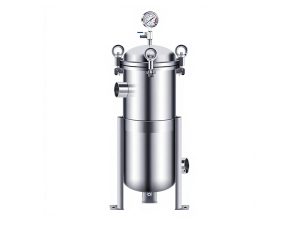
Aseptic holding tank: sterile air filter on the headspace, aseptic valve on the outlet, spray ball for SIP coverage.
Spray Ball Coverage and Drainability
Sterilising steam and cleaning solution both travel the same way: out of a spray device and down the walls. If the ball does not reach the top head or the shoulder, that area stays at a lower temperature during SIP and you will not detect it with a single probe in the outlet.
The practical checks are coverage testing with a dye or UV tracer at commissioning, a spray ball sized to the tank diameter rather than to the pump, and a vent that lets air out so steam can fill the headspace. A tank with a blocked or undersized vent will never distribute steam evenly, no matter how long you hold it.
- Bottom dished to a flush outlet; no flat floor, no standpipe, no pocket behind the outlet flange.
- Interior finish around Ra 0.8 µm or better, welds ground flush and passivated.
- No horizontal surfaces inside the tank where condensate can pool.
- Instrument ports flush-mounted, with aseptic connections rather than threaded bosses.
SIP: Proving It, Not Just Doing It
Sterilisation in place means saturated steam at 121–130 °C held long enough for every surface to reach temperature. The usual specification is a minimum of 121 °C for 30 minutes at the coldest point, with the coldest point identified by measurement rather than assumed.
Commissioning should include a temperature mapping run: data loggers placed at the top head, the shoulder, the outlet, the spray ball stem and the far side of the tank from the steam inlet. If the spread exceeds a few degrees, you have an air pocket or a condensate trap, and adjusting the hold time will not fix it.
Two details cause most SIP failures. The first is air that cannot escape, because the vent is blocked or the vent filter is wet. The second is condensate that cannot drain, because the outlet is piped with a low point or the tank has no trap. Steam that cannot displace air will not sterilise the space the air occupies.
Aseptic Processing
Building the barrier between your UHT and your filler
Tell us your UHT output, filling rate and available steam. Zhongbo will size the aseptic tank, sterile air supply and valve schedule as one system, with SIP mapping points agreed up front.
Holding Product Before Aseptic Filling
The tank exists to decouple the steriliser from the filler. A UHT unit wants to run continuously at a steady rate; a filler stops for reel changes, nozzle cleaning and faults. The tank absorbs those stops so the UHT does not have to cycle, which matters because repeated heat-up and cool-down is where flavour damage and fouling accumulate.
Sizing follows from the longest filler stop you want to ride through. Fifteen minutes at 10,000 L/h is 2,500 L of buffer; thirty minutes is 5,000 L. Add the volume needed for level control and the unusable heel, and you have the geometric volume. Going beyond about 40 minutes of buffer rarely pays, because product held that long at 25–30 °C starts to show quality drift even under sterile conditions.
If the filler stops longer than the buffer allows, the correct response is to divert and reprocess or dump, not to hold longer. Decide that limit before commissioning and write it into the operating procedure.
Design Checklist
| Item | What to specify |
|---|---|
| Headspace pressure | 0.2–0.5 bar sterile air, alarmed and interlocked |
| Air filtration | Hydrophobic 0.2 µm, integrity-testable, drainable housing |
| Valves | Double-seat aseptic on every product connection |
| Interior finish | Ra ≤ 0.8 µm, welds flush, passivated |
| SIP | 121 °C / 30 min at mapped coldest point |
| Level | Radar or load cells — no sight glass |
For how this vessel differs from a pressure or atmospheric buffer, aseptic vs atmospheric vs pressure buffer tanks sets out the selection logic, and hot fill vs aseptic cold fill explains when you need the whole aseptic chain rather than a simpler process. The aseptic tank specification lists capacities and connection options, and the wider stainless steel buffer tank range covers the non-aseptic alternatives.
Frequently Asked Questions
What sterile air pressure should the headspace hold?
Most designs run 0.2 to 0.5 bar, with 0.3 bar a common setpoint. Higher pressure costs filter life and air consumption; lower pressure risks losing the barrier during a fast draw-off. Choose the number from the maximum level drop rate, then set the alarm below it with a sensible deadband.
Can an aseptic tank be cleaned with CIP and sterilised with SIP in one sequence?
Yes, and that is the normal arrangement: caustic wash, rinse, acid if needed, final rinse, then steam sterilisation. The step people forget is drying the interior before steam, because residual water takes a long time to heat and dilutes the steam at the start of the cycle.
Why does SIP take so much longer than CIP?
Steam has to displace air, heat the steel mass and reach every surface before the hold time starts. A 10 m³ tank can take 40 minutes just to come up to temperature, then 30 minutes of hold. Insulation and a pre-heat step shorten it, and removing air pockets is the difference between 45 minutes and 90.
Does the tank need a jacket?
A jacket helps hold product temperature and speeds SIP by reducing heat loss, but it adds a surface that must be drained and can trap condensate. If you fit one, specify a full drain and make sure the jacket cannot be Pressurised while the tank is under SIP vacuum conditions.
How do I verify sterility after SIP?
With temperature records from the mapped coldest points, a pressure hold test, and media fills or swab checks at a defined frequency. Temperature records prove the process was delivered; they do not prove the tank was clean before it started, which is why cleaning verification and sterilisation verification are separate activities.
Can I hold product in an aseptic tank overnight?
Some plants do, under sterile air and with the tank held at a controlled temperature, but it is a quality decision as much as a sterility one. Flavour and vitamin degradation continue, and the risk of losing the whole tank to a pressure excursion grows with time. Most operations treat four to eight hours as the practical limit.
What happens if the sterile air filter gets wet?
A wetted hydrophobic filter stops passing air, the headspace pressure drops and the interlock should stop the filler. That is the correct failure, but it stops production. Mount the housing so condensate drains away from the element and fit a coalescing pre-filter if your air supply is damp.
Is a sight glass acceptable on an aseptic tank?
Generally not. A sight glass is a dead volume, a breakage risk and a difficult surface to sterilise. Use radar, guided wave or load cells, and keep a local indication on the instrument rather than a window in the shell.
How much buffer do I need between UHT and filler?
Enough to cover the longest routine filler stop, typically 15 to 30 minutes of line flow. Beyond 40 minutes the quality cost of holding product outweighs the uptime benefit. Size the vessel for that time plus the level control band and the heel.
Which material is used for aseptic tanks?
316L on all product contact surfaces, with 304 acceptable on the jacket and frame. The interior is mechanically polished and usually electropolished to reduce the surface area available for attachment. Chloride-containing cleaning chemicals are the reason 316L is standard rather than optional.
Final Thoughts
An aseptic tank is judged on the days it does nothing remarkable. Sterile air holding pressure, valves that cannot cross, a spray ball that reaches the shoulder, and a SIP record that shows every mapped point reached temperature. Those four things decide whether the tank protects your UHT product or quietly undoes it. Spec them at the drawing stage, test them at commissioning, and keep testing them every run. Keep the written record somewhere a customer audit can find it, because sterility you cannot document is sterility you cannot sell. The microbiology results will follow.