

Introduction
Every CIP system does the same four things: rinse, wash, rinse, sanitise. What separates them is what happens to the liquid afterwards. Throw it away and you have a single-use system. Store it, reheat it and top it up, and you have a recovery system. Split the plant into separate circuits and you have a multi-circuit design. The choice drives your water bill, your chemical bill, your floor space and how much validation work lands on your quality team.
The Three Architectures
Single-use (once-through)
Detergent is made up at the required concentration, circulated once, and sent to drain. There are no recovery tanks to manage, no concentration drift, and no risk of carrying soil from one cleaning cycle to the next. The price is consumption: you pay for fresh caustic, fresh acid and fresh sanitizer every cycle, and you pay to treat the effluent.
This is the right architecture for small plants, for allergen changeovers where cross-contact is the main risk, and for circuits that run once a day. It is the wrong architecture for a plant cleaning six circuits a day, every day.
Recovery (reuse)
Caustic and acid are collected in insulated tanks at the end of the wash, held at temperature, and reused for the next cycle. Conductivity sensors track the concentration and a dosing pump tops it up; a conductivity-based interface detection sends the transition slug to drain rather than into the recovery tank. Typical savings are 30 to 50% of chemical and a similar share of water.
The cost is complexity. You now have tanks to clean, concentration to verify, and a real risk of accumulating soil and microbial load in the recovered solution. Recovery tanks need periodic dumping on a documented schedule, not “when it looks dirty”.
Multi-circuit
Instead of one supply pump and one return, the plant is divided into circuits that can be cleaned independently or in parallel: raw side, pasteurised side, filler, tank farm, services. Each circuit has its own supply valve, return pump and often its own flow meter. This is not a different cleaning chemistry; it is a different piping and control philosophy.
Multi-circuit earns its cost when you have products that must not share a cleaning solution, when some circuits need a different temperature or chemical, or when the plant is large enough that cleaning sequentially would take longer than production allows. It is also the only practical way to clean a filler while the rest of the line is still running.
Compared Side by Side
| Criterion | Single-use | Recovery | Multi-circuit |
|---|---|---|---|
| Water and chemical use | Highest | 30–50% lower | Low per circuit, higher total volume |
| Capital cost | Lowest | Middle — tanks, insulation, dosing | Highest — valves, pumps, instruments |
| Floor space | Small | Large — recovery tanks dominate | Large, distributed around the plant |
| Validation burden | Simple, repeatable | Concentration and soil control to prove | Per-circuit coverage and flow to prove |
| Best fit | Small plants, allergen changeovers, low cycles | High-cycle dairy or beverage plants | Multi-product plants with a running filler |
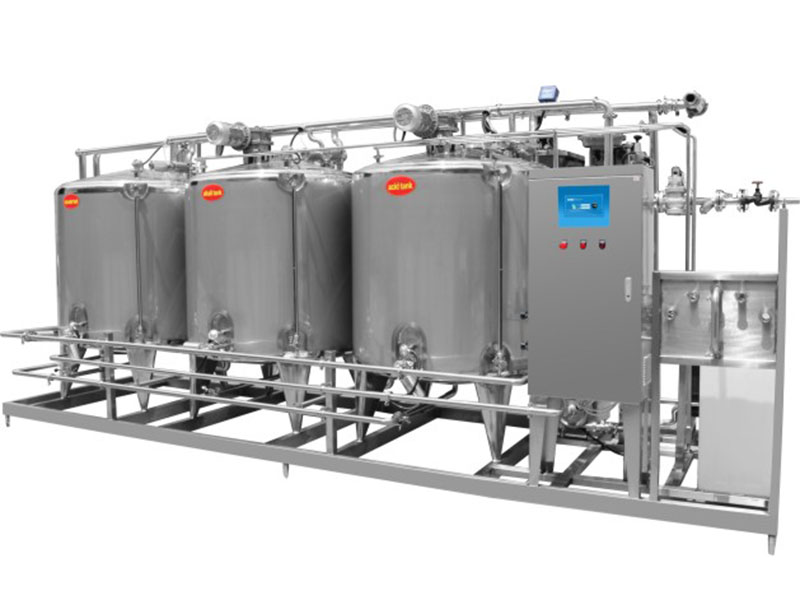
A recovery CIP set: caustic and acid tanks, heat exchanger and circulation pump on one skid.
Sizing the Tanks, Not Just the Pump
A recovery system needs enough solution to fill the circuit and still leave the pump with a stable suction. The usual starting point is three to five times the volume of the largest circuit, which covers the pipework, the vessel being cleaned and the liquid held in the return line.
Worked example. A circuit with 400 m of 50 mm pipe holds about 0.8 m³, plus 2 m³ in the tanks being cleaned: 2.8 m³. At four times that volume, the caustic tank should be around 11 m³, and the acid tank the same if you run an acid step. That is a big tank, and it is the number people underestimate when they budget for “a CIP skid”.
- Flow velocity in the return line at least 1.5 m/s, higher on large-diameter mains.
- Caustic at 1.5–2.5% and 75–80 °C for dairy; verify against your soil and water hardness.
- Conductivity probes on supply and return, with the interface diverted to drain rather than to the recovery tank.
- Insulated tanks, because holding 80 °C overnight is cheaper than reheating from cold every morning.
The number that decides it: count cleaning cycles per day. Under about four, a recovery system rarely pays back before the tanks need replacing. Above eight, not recovering is usually the more expensive mistake.
Choosing by Plant Type
A small yogurt plant running one product and cleaning twice a day can use single-use and never miss the savings. A dairy running HTST around the clock with six circuits and a daily CIP window should be looking at recovery, and probably at multi-circuit for the filler. A juice plant making several products with allergens and colours needs the circuit separation before it needs the recovery tanks.
There is a fourth variable people forget: cleanability of the plant itself. No CIP architecture compensates for a dead-leg, an unsloped line or a spray ball that misses the top of a tank. If your cleaning failures are already frequent, adding recovery tanks will simply let you spread the problem further. Start with the seven common causes of CIP failure before you spend on hardware.
Cleaning In Place
Which CIP architecture fits your cleaning schedule?
Send us your circuit list, pipe volumes and cycles per day. Zhongbo will size tanks, pumps and heat exchanger for the architecture that actually pays back in your plant.
Where the Money Actually Goes
Heating dominates the operating cost of any CIP system, not chemicals. Raising 10 m³ of water from 15 °C to 80 °C takes roughly 760 kWh of heat, and you do it at least once a day. That is why tank insulation, a correctly sized heat exchanger and a schedule that does not reheat cold solution three times are worth more than a cheaper detergent.
After heat comes water. A once-through cycle on a mid-size plant can use 20–30 m³ per cleaning; recovery cuts the make-up volume but adds a rinse between recovered solution and product, so the saving is real but smaller than the marketing suggests. Measure it on your own plant rather than accepting a percentage from a brochure.
The split CIP system is the usual starting point for recovery designs, and the cleaning in place range covers tank, pump and heat exchanger options. For the difference between cleaning and sterilising, CIP vs SIP is the place to start, and how to choose a CIP system covers the sizing inputs in order.
Frequently Asked Questions
Can I add recovery to an existing once-through CIP?
Usually yes: add two insulated tanks, a conductivity control loop and a diverter valve on the return. The constraint is floor space and the condition of the existing pump and heat exchanger. Check that the pump can handle the higher suction lift from a tank rather than a mains supply before committing.
How often should recovered caustic be dumped?
Base it on soil load, not on a fixed calendar: track conductivity, turbidity and the cleaning result, then dump when the trend degrades. Most plants land on weekly to fortnightly. A tank that is never dumped accumulates protein and fat that redeposit on clean surfaces.
Does multi-circuit mean more water or less?
More in total, because each circuit gets its own rinse and its own fill, but less per circuit and far less risk of cross-contamination. If water cost is your driver, recovery on a single circuit usually beats multi-circuit. If product safety is the driver, the extra water is cheap.
What flow velocity does CIP need?
At least 1.5 m/s in the main lines for turbulent scour, and higher in large-diameter pipe where the same velocity needs much more flow. Vessel cleaning is a different mechanism — spray ball impact and coverage — so do not size the pump on pipe velocity alone and assume the tank is covered.
Can the same CIP clean tanks and pipelines?
Yes, if the circuit is designed for both. Tanks need flow and pressure at the spray ball; pipes need velocity. A single pump rarely does both well, which is why many systems use a separate tank-cleaning pump or a bypass that raises pressure for the spray phase.
Is an acid step always necessary?
Not always. Acid removes mineral scale, which builds up on hot surfaces and in hard-water areas. If your water is soft and your hot surfaces are clean, caustic plus sanitizer may be enough. If you see white deposits on plates or tank walls, you need the acid step and probably a water softener.
Where should the conductivity sensor go?
On the return line, close to the tank, so it sees the interface before it reaches the recovery tank. A sensor on the supply only tells you what you are sending out, not what is coming back. Two sensors let you calculate the recovery efficiency as well as control the diverter.
How long should a CIP cycle take?
A typical dairy circuit runs 60 to 90 minutes including rinses, with the caustic phase at 15 to 20 minutes at temperature. Shorter cycles are possible with higher velocity or better chemical control, but shortening the contact time is the most common cause of a cleaning failure that only shows up weeks later.
Do I need a separate CIP for the filler?
Almost always. Fillers have small passages, seals and nozzles that need different flow and often a different chemical strength, and they usually need cleaning while the rest of the line is still in production. A dedicated filler CIP circuit is the standard solution.
What records does a CIP system need to keep?
Per cycle: circuit, start and end time, temperatures at each phase, conductivity or concentration, flow rate, and who initiated it. Add the result of any verification swab or ATP test. A chart recorder trace is not a substitute for a per-cycle record that names the circuit.
Final Thoughts
The right CIP architecture is the one that matches how often you clean, how many products you run and how much floor space you can spare. Single-use is honest and simple; recovery saves water and chemicals but asks for discipline; multi-circuit buys you separation at the cost of valves and instruments. Whichever you choose, remember that no tank or pump can clean a line that was never designed to drain. Fix the geometry first, then spend money on the skid.
Related Resources
Equipment on this site
- Aseptic Tank — where cleaning and sterilising requirements diverge.
Further reading