

Introduction
After a herbal extraction you are left with a dilute alcohol solution — usually somewhere between 40% and 70% ethanol by volume, carrying colour, sugars and the compounds you spent energy extracting. Sending it to drain is expensive. Recovering it badly is worse, because you lose the volatiles you were trying to keep. A distillation column is the piece of equipment that decides which of those two outcomes you get. Here is how it works and where the money goes.
What the Column Actually Does
The job is separation by boiling point, repeated many times in one vessel. Vapour rising from the reboiler meets liquid falling from the top. Because ethanol is more volatile than water, the vapour gets richer in ethanol at every contact stage, and the liquid gets leaner. A single flash gives you one enrichment step; a column with 15 to 20 theoretical stages gives you the concentration you need.
In an extraction plant the column usually has three zones. The stripping section at the bottom removes the last useful ethanol from the spent liquid so the residue going to drain is below your recovery target. The rectifying section at the top concentrates the vapour to product strength. The reflux split at the top decides how much of the condensed ethanol goes back down the column as liquid and how much leaves as product.
Purity: What 96% Really Means
Ethanol and water form an azeotrope at about 95.6% by weight (roughly 97% by volume) at atmospheric pressure. At that point the vapour and liquid have the same composition and ordinary distillation stops working, no matter how tall the column or how much reflux you throw at it. This is the single most misunderstood number in alcohol recovery.
| Product target | What it takes | Typical use |
|---|---|---|
| 85–92% v/v | Rectifying column alone | Re-use in the next extraction batch |
| 94–96% v/v | More stages, higher reflux, tighter control | Pharmaceutical and food-grade solvent |
| 99%+ (anhydrous) | Azeotrope break: molecular sieve or pressure swing | Blending, fuel, moisture-sensitive reactions |
If your specification says 96% and your column is a plain rectifier, the specification is wrong, not the equipment. Get that conversation out of the way before the purchase order.
Check the basis: 96% by volume and 96% by weight are different products. 96% v/v is roughly 94% w/w. When you compare quotations from two suppliers, confirm which basis each one used before you compare prices.
Energy: Where the Steam Goes
Distillation is a heat pump with a poor sense of economy. Almost all the energy you put in at the reboiler leaves again at the condenser, and the reflux ratio sets how many times you pay for it. Doubling reflux from 1.5 to 3 roughly doubles the boil-up for the same product rate. That is the trade: purity against steam.
Three things move the number in your favour. Preheating the feed with hot bottoms or overhead vapour recovers heat you would otherwise dump. Running under vacuum lowers the boiling temperature, which protects heat-sensitive compounds and lets you use lower-grade steam or hot water. And a packed column with structured packing gives more stages per metre at a lower pressure drop than trays, which matters when the whole column runs under vacuum.
- Feed preheated to within 10–15 °C of its bubble point reduces reboiler duty measurably.
- A reflux ratio of 1.5–2.5 covers most 90% recovery duties; 3 or more is usually a symptom of too few stages.
- Condenser heat can preheat the next batch’s solvent instead of going to a cooling tower.
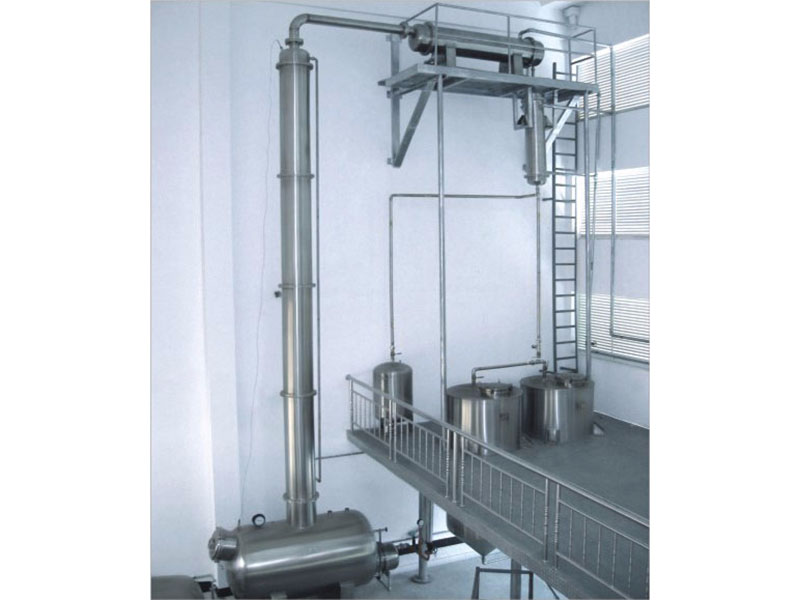
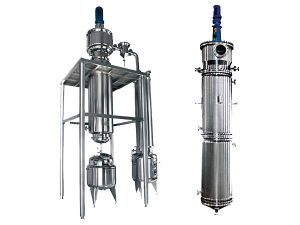
A rectifying column with reflux line and condenser: stage count and reflux ratio set both purity and steam cost.
What the Column Needs From Upstream
A distillation column is unforgiving about its feed. Solids will block trays and foul packing; you cannot clean a packed bed in place the way you clean a tank. If your extract carries plant fibre or precipitated resin, filter or centrifuge it first, and consider concentrating it in a falling film evaporator before it reaches the column. Removing water upstream saves you the energy of boiling it off downstream.
Foaming is the other common surprise. Saponins and proteins in botanical extracts foam in the column and carry liquid into the condenser, which shows up as cloudy distillate. A feed with more than a trace of surfactant needs either an antifoam addition point or extra disengagement height above the top tray — a detail worth settling at the design stage rather than after commissioning.
Solvent Recovery
Let us size the column against your actual extraction batch
Send the feed concentration, batch volume, target strength and available steam pressure. Zhongbo will propose stage count, reflux ratio and heat recovery for the duty — including whether 96% needs a sieve stage.
Controls That Decide Product Quality
Three loops do most of the work. Reflux ratio control keeps the top composition steady; it needs a reliable reflux flow measurement, and a ratio controller rather than a fixed valve position. Bottom temperature or level control protects the reboiler from running dry and from cooking the residue. And a small continuous draw of fusel oils from a side point keeps the middle cut clean — skip it and the aroma of your recovered solvent changes batch to batch.
For a column fed from a multifunctional extraction tank, the batch rhythm sets everything. A column sized for average flow will be starved at the start of a batch and overloaded at the end. Buffer the feed in a small tank and run the column continuously.
Mistakes That Cost Real Money
Buying on diameter alone. A column quoted by shell size can hide a short packed bed that will never reach the specified strength. Ask for stage count, HETP, and the reflux ratio at which the guarantee holds.
Ignoring the vacuum system. Under vacuum, a small air leak through a flange drops the top pressure and the whole separation shifts. Specify leak testing and a vacuum pump with margin, not one sized exactly to the calculated load.
Treating the residue as waste. The bottoms stream still holds heat and some ethanol. A small flash or a second stage can recover both, and it usually pays back faster than expected on a plant running daily. Our guide to falling film evaporators in solvent extraction and ethanol recovery covers that combination, and the tea extraction line guide shows how the stages fit together end to end.
Frequently Asked Questions
Can I reach 96% ethanol without a molecular sieve?
Not with ordinary distillation at atmospheric pressure. The azeotrope caps you near 95.6% by weight. Pressure-swing distillation can break it with two columns at different pressures, and that is a legitimate alternative to a sieve, but it needs more equipment and more steam than a 3A sieve bed for the same output.
How tall does the column need to be?
Height follows from stage count and packing efficiency. Going from 40% to 92% feed strength typically needs somewhere around 12 to 18 theoretical stages. With structured packing at 0.3–0.5 m HETP, that is a packed bed of 5–8 m plus disengagement space. Trays need more height for the same stage count.
What recovery rate should I expect from the spent liquid?
A well-designed stripping section gets the bottoms down to well under 1% ethanol, and 0.2–0.5% is achievable. Below that the marginal steam cost rises faster than the value of the recovered solvent. Decide the target from the cost of fresh ethanol and the cost of effluent treatment, not from a round number.
Why does my distillate come out cloudy?
Usually entrainment: liquid droplets carried over by vapour, most often because the column is running above its design boil-up or foaming. Check the pressure drop across the bed, reduce boil-up, and look at the feed for surfactants. A demister above the top bed is the mechanical fix.
Is vacuum operation always better for botanical extracts?
It is better for heat-sensitive compounds and lets you use lower-grade heating, but it costs vacuum pump power and demands tighter flanges. For a robust extract going back into the next extraction batch, atmospheric operation is simpler and cheaper. Choose vacuum when flavour or actives are the product.
How do I handle the first runnings?
The first fraction carries the light esters and aldehydes, and often the strongest aroma. Either return it to the next batch, blend it back into product at a controlled ratio, or sell it as a separate aromatic fraction. Sending it to drain throws away the most valuable part of the recovery.
What material should the column be built from?
316L is the default for food and pharmaceutical ethanol service, with sanitary clamps and a polished interior. Carbon steel is cheaper and used in fuel-ethanol plants, but it will discolour product and is a poor fit if the same column handles botanical extracts you intend to sell.
How is the column cleaned between campaigns?
Caustic circulation followed by a rinse is standard for organic fouling, with the packing removed for inspection if the deposit is heavy. Design in a cleaning connection at the top and a drain at the bottom, and make sure the packing can be taken out and put back without damaging it. A column with no access to its internals will foul permanently.
Can the same column serve two different products?
Yes, if you can clean between them and accept a changeover loss. The constraint is usually aroma carry-over rather than mechanical fouling: a column that last ran a strong herbal extract will taint a delicate one for a batch or two. Allocate the column by product family rather than by convenience.
What is the usual payback on solvent recovery?
It depends on your solvent price and how much you currently send to drain, but plants recovering more than a few hundred litres a day usually see payback inside two years, before counting effluent savings. The number that kills projects is a column oversized for the batch rhythm, because it idles most of the week.
Final Thoughts
Solvent recovery pays back on two numbers: how much ethanol you stop buying and how much steam you stop wasting. Get the stage count and reflux ratio right for your duty, filter the feed so the packing stays clean, and recover heat from the bottoms before it goes to drain. The column itself is straightforward engineering. The expensive mistakes are all made earlier, when the feed spec, the batch rhythm and the product strength are agreed without anyone checking whether they fit together.
Related Resources
Equipment on this site
- Ethanol Distillation Column — rectifying column for solvent recovery after extraction.
Further reading