


Introduction
Every dairy, beverage, and food plant uses stainless steel, but not all stainless is the same. The two most common grades are 304 and 316L. They look identical, machine similarly, and both pass a magnet test, but their corrosion resistance differs sharply once they meet chlorides, CIP acids, or acidic fruit juices. Choosing the wrong grade can mean pitting within months, product contamination, and expensive re-welding. This guide gives a practical corrosion-resistance matrix for the conditions you actually face.
The Alloy Difference
Both grades are austenitic stainless steels with about 18 % chromium and 8–10 % nickel. The key difference is molybdenum:
- 304: ~18 % Cr, 8–10 % Ni, no intentional molybdenum.
- 316L: ~16–18 % Cr, 10–14 % Ni, 2–3 % Mo, low carbon (≤ 0.03 %).
The molybdenum in 316L improves resistance to pitting and crevice corrosion in chloride environments. The low carbon (“L”) reduces sensitization during welding, so the heat-affected zone keeps its corrosion resistance after fabrication.
Corrosion Resistance Matrix
| Environment | 304 | 316L | Recommendation |
|---|---|---|---|
| Fresh milk and cream | Good | Excellent | 304 acceptable; 316L preferred for long life |
| Whey / salted dairy | Risk of pitting | Good | Use 316L |
| CIP acids (nitric, phosphoric) | Good at low temp | Excellent | 316L for hot CIP or high acid |
| Caustic CIP (NaOH) | Good | Good | Either grade |
| Orange / lemon / pineapple juice | Risk of pitting | Good | Use 316L |
| Tomato and acidic sauces | Risk | Good | Use 316L |
| Process water, low chloride | Excellent | Excellent | 304 is fine |
| High-chloride water / brine | Poor | Good | Use 316L or higher alloy |
| Weld zones | May sensitize | Low-carbon resists | 316L for welded product contact |
Dairy and CIP Acids
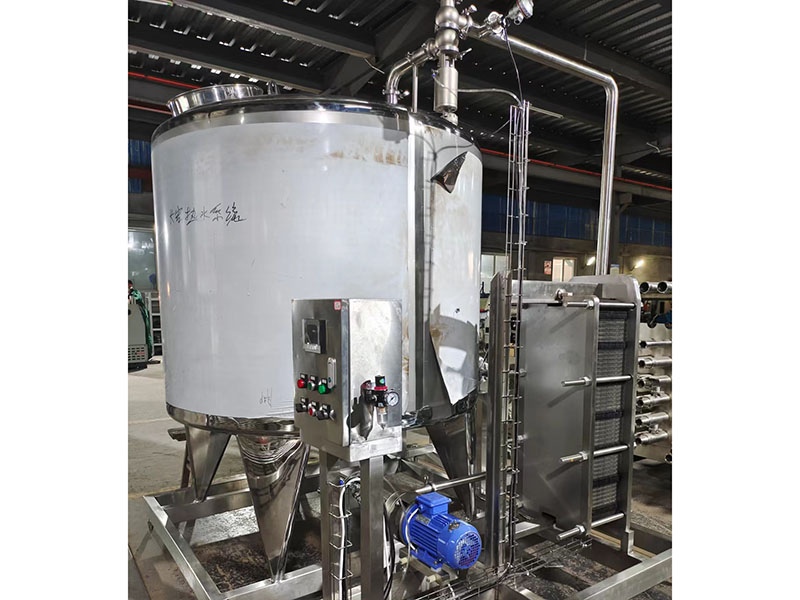
Milk itself is mild, but CIP is not. A typical dairy cycle uses 1–1.5 % nitric or phosphoric acid followed by caustic. At ambient temperature 304 handles dilute nitric well, but when the acid is hot or when the cycle includes whey and salted product, chloride levels rise. 316L tolerates both the acid and the chloride far better. For plate heat exchangers where hot CIP flows through thin channels, 316L is the safe default.
Fruit Juices and Acidic Beverages
Citric acid, malic acid, and natural chlorides from fruit create an environment that 304 can survive for a while but will eventually pit. The first signs are tiny rust-coloured spots under gaskets, in weld craters, and inside threaded fittings. Once pitting starts it propagates quickly because the bottom of the pit becomes anodic. For orange, lemon, pineapple, tomato, and acidic plant milks, specify 316L on all product-contact surfaces, including tubular heat exchangers, pasteurizers, and tanks.
Chloride Pitting and the PREN
A quick way to rank alloys is the Pitting Resistance Equivalent Number:
PREN = %Cr + 3.3 × %Mo + 16 × %N
Typical values:
- 304: ~18–20
- 316L: ~23–26
The higher the PREN, the more chloride the alloy tolerates before pitting starts. For dairy with brine or acidic juice, 316L is the minimum sensible choice; for very high chlorides you may need 904L or duplex.
When 304 is Enough
304 is cheaper and widely available. Use it where the product is non-acid, non-chloride, and at moderate temperature: low-chloride water circuits, steam lines, structural supports, jacket shells that do not contact product, and some clean-in-place supply piping in soft-water plants.
When 316L is Required
Specify 316L wherever product is acidic, salty, hot, or any combination: milk pasteurizers, UHT heaters, fruit-juice pasteurizers, whey and salted-butter processing, brine circuits, high-shear emulsification tanks, and any welded product-contact surface that will see CIP acids.
Passivation and Maintenance
Even 316L needs a passive oxide layer. After welding and mechanical polishing, passivate with nitric or citric acid to restore the chromium-rich layer. Routine inspection should look for rust stains at welds, gasket grooves, and threads—these are early warnings that the passive film has been damaged. Re-passivation is far cheaper than replacing pitted plates.
Common Mistakes
- Buying 304 to save money on acidic product. The savings disappear with the first pit repair.
- Ignoring the weld. Heat tint left on a weld removes passivity; all welds must be cleaned and passivated.
- Mixing grades. A 316L tank with 304 fittings creates galvanic differences and traps corrosion at the interface.
- No passivation after CIP burn. A caustic or acid incident can strip the passive film; re-passivate afterwards.
FAQ
Is 316L always better than 304?
For corrosion resistance, yes. But 304 is adequate for many non-acid, low-chloride applications and costs less. Match the grade to the duty.
Can I use 304 for orange juice?
No. The citric acid and chlorides will eventually pit 304. Use 316L for citrus and tomato products.
What does the “L” in 316L mean?
Low carbon. It reduces carbide precipitation during welding, keeping the heat-affected zone corrosion-resistant.
Does passivation make 304 as good as 316L?
Passivation helps both grades, but it cannot add molybdenum. In chlorides, 316L still wins.
How do I check if a supplier used 316L?
Request mill certificates and, for critical welds, a PMI (Positive Material Identification) test using XRF or spark spectroscopy.
Conclusion
The 304 versus 316L decision is not about prestige; it is about chloride, acid, and temperature. Use 304 for mild water and steam, and 316L for dairy, CIP acids, acidic juices, and any welded product-contact surface. The small material premium for 316L is almost always recovered by avoiding pitting, rework, and unplanned downtime. For heat exchangers, pasteurizers, and tanks handling aggressive media, 316L is not optional—it is the spec that makes the rest of the stainless steel investment last.