Introduction
Evaporation shows up all over food processing, dairy production, pharmaceuticals, chemicals and wastewater treatment. The goal is always the same: remove water or another volatile component and raise the concentration of a liquid product.
But products don’t behave the same way once they hit a heated surface. A milk-based product, a fruit juice, a sugar solution and saline wastewater can differ widely in viscosity, solids content, fouling tendency and heat sensitivity. Pick an evaporator on capacity or price alone, and those differences will catch up with you later in production.
Two technologies come up most often: the falling film evaporator and the forced circulation evaporator. Both are built for evaporation and concentration. How the liquid moves through them is completely different.
A falling film design is generally associated with continuous processing of relatively low-viscosity liquids, particularly where short residence time and gentle heat treatment matter. A forced circulation evaporator uses mechanical circulation to keep the product moving through the heating system, which makes it the better fit for high-viscosity, high-concentration, fouling or crystallizing products.
Keep these differences in mind, and equipment selection gets much easier.
What Is a Falling Film Evaporator?
A falling film evaporator uses vertical heating tubes. Feed liquid is distributed at the top of the tubes and flows down the inner tube walls as a thin film.
As the liquid moves through the heated tubes, part of the water evaporates. The concentrated liquid and vapor are then separated downstream.
The thin liquid film is the whole point. Only a relatively small amount of liquid touches the heated surface at any one time, so heat transfers efficiently while the product spends very little time at elevated temperature.
That’s why falling film evaporation suits heat-sensitive products so well.
Typical applications include:
- Milk and dairy products
- Fruit and vegetable juices
- Sugar solutions
- Herbal and plant extracts
- Pharmaceutical liquids
- Other relatively low-viscosity food and process liquids
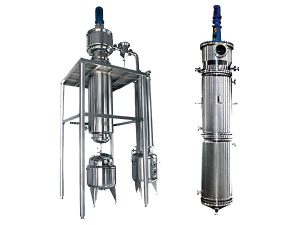
Zhongbo’s evaporation and concentration equipment includes falling film solutions designed for industrial liquid concentration applications. The company also provides other evaporation technologies, so the system configuration can be matched to the characteristics of the product.

Why Liquid Distribution Matters
A falling film evaporator lives or dies by its liquid distribution.
The feed has to spread evenly across the heating tubes to form a stable film. Poor distribution creates dry areas, uneven heating and localized fouling.
So the distributor, tube arrangement, feed conditions and operating parameters all need attention when a falling film system is designed. A falling film evaporator is not just a set of heated tubes. The entire liquid distribution system has to work together with the heating and separation sections as one unit.
What Is a Forced Circulation Evaporator?
A forced circulation evaporator takes a different approach.
Instead of relying on gravity-driven film flow, a circulation pump continuously moves the liquid through the heating system. The heated liquid then enters a separator, where evaporation takes place under controlled conditions. Part of the concentrated liquid returns to the circulation loop.
This design earns its keep when the liquid gets difficult to process as concentration rises. Highly concentrated liquids turn viscous. Some solutions foul heavily or form crystals. Keeping the liquid moving helps maintain stable heat transfer and reduces the risk of excessive deposits on the heating surface.
According to Zhongbo’s product information, its forced circulation evaporators are used for high-concentration and crystallization applications, including saline solutions and materials with high viscosity or a high tendency to foul. They can also serve as a high-concentration stage together with falling film evaporators.

Falling Film vs Forced Circulation: Key Differences
Five areas separate the two designs: flow pattern, product characteristics, fouling tendency, heat sensitivity and system configuration.
| Factor | Falling Film Evaporator | Forced Circulation Evaporator |
| Liquid movement | Mainly downward film flow | Pump-driven circulation |
| Typical feed | Low to medium viscosity liquids | High-viscosity or difficult-to-concentrate liquids |
| Residence time | Generally short | Longer because of recirculation |
| Fouling tendency | More sensitive to poor distribution and deposits | Better suited to fouling-prone products |
| High concentration | Better suited to earlier concentration stages | Suitable for high-concentration stages |
| Crystallization | Generally not the first choice | Well suited to crystallizing solutions |
| Heat-sensitive products | Strong advantage | Application-dependent |
| Pumping requirement | Lower circulation requirement | Requires circulation pump |
| Typical role | Efficient bulk evaporation | High-concentration or difficult evaporation |
Treat the table as a starting point rather than an absolute rule. Actual equipment selection depends on feed composition, target concentration, throughput, temperature limits and the complete process design.
-
Flow Pattern
The most visible difference is how the liquid moves.
In a falling film evaporator, liquid enters at the top of the heating tubes and flows downward as a thin film. Gravity does the work.
In a forced circulation evaporator, a pump drives the liquid through the heating section, so the liquid keeps moving even when its viscosity or solids content climbs.
The difference matters most toward the end of a concentration run. A product that flows easily at the beginning can get much thicker as water is removed.
-
Viscosity and Solids Content
Falling film systems work best when the feed has relatively good flowability.
As viscosity rises, holding an even thin film gets harder. Distributing the product uniformly across the heating tubes gets harder too.
Forced circulation is the alternative for these conditions. The circulation pump supplies the driving force to move more difficult liquids through the heating system.
That’s one reason Zhongbo identifies forced circulation evaporation as suitable for highly viscous liquids and high-concentration products such as tomato sauce, jam, fruit pulp juice and concentrated sugar solutions.
-
Fouling and Scaling
Fouling is one of the bigger running costs in industrial evaporation.
Proteins, sugars, minerals, salts and other components accumulate on heat-transfer surfaces. As deposits build up, heat transfer becomes less effective and cleaning requirements climb.
A falling film evaporator can perform very well with an appropriate feed, but distribution and operating conditions have to be right. A poorly distributed film means dry spots, and dry spots mean localized fouling.
Forced circulation is often selected for products with a greater tendency to foul because the continuous circulation keeps liquid moving across the heating surface.
Zhongbo specifically notes that in its forced circulation design, boiling does not occur directly on the heating surfaces but in the separator. That keeps fouling from incrustation and precipitation out of the heating section, where it does the most damage.
-
Heat-Sensitive Products
With heat-sensitive materials, temperature exposure goes straight to product quality.
Milk, fruit juice, pharmaceutical solutions and certain plant extracts can change in color, flavor, nutrients or active components if they sit at excessive heat for too long.
The thin-film structure of a falling film evaporator helps here: the liquid passes through the heating section relatively quickly. Vacuum operation can bring the boiling temperature down further, depending on the process design.
That’s why falling film evaporation is commonly the first option considered for food, dairy and pharmaceutical concentration, where product quality counts as much as evaporation capacity.
-
High-Concentration and Crystallization Applications
Concentration gets considerably harder as it progresses.
The liquid thickens. Dissolved salts and other components begin to crystallize. At this stage, a conventional falling film system may no longer be the most practical solution, and a forced circulation evaporator takes over the final concentration stage because its circulation loop is designed to handle more challenging liquid conditions.
In some industrial systems, the two technologies aren’t competitors at all.
A falling film evaporator performs the initial bulk concentration. A forced circulation evaporator handles the high-concentration or crystallization stage behind it. Zhongbo specifically describes forced circulation equipment being used in combination with falling film evaporators in this type of process configuration.
Which Evaporator Should You Choose?
Start with the product rather than the equipment name.
A Falling Film Evaporator May Be Suitable If:
- Your feed has relatively low or moderate viscosity.
- The product is sensitive to heat.
- Short product residence time is important.
- You need continuous, high-volume concentration.
- The product has relatively low fouling and crystallization tendencies.
- Energy efficiency is an important consideration.
A Forced Circulation Evaporator May Be More Appropriate If:
- The product becomes highly viscous during concentration.
- Fouling or scaling is a significant concern.
- The process involves high solids concentration.
- Crystallization occurs during evaporation.
- You are processing saline or wastewater streams.
- The evaporator will operate as a final high-concentration stage.
These aren’t strict boundaries. A properly engineered system may combine several evaporation technologies across the different stages of the process.
Why a Combined Evaporation System Can Make Sense
One common selection mistake is asking a single evaporator to perform every stage of concentration.
Take a liquid that starts with relatively low viscosity but becomes increasingly concentrated during processing. A falling film evaporator may be highly effective in the earlier stages, when large amounts of water still need to come out efficiently. Further downstream, the product turns thick and more prone to fouling or crystallization.
That’s where forced circulation takes over.
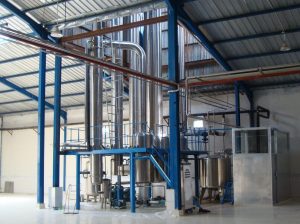
Staging the equipment this way lets each evaporator operate within the conditions its design was made for. For industrial projects, the final configuration may include multiple effects, separators, pumps, condensers, vacuum equipment and CIP systems. Treat the evaporator as part of the complete process rather than as a standalone machine.
What Should You Consider Before Purchasing?
Before requesting an evaporator quotation, pull together as much process information as you can.
Important parameters include:
- Feed composition – What is in the liquid?
- Initial solids content – How concentrated is the feed?
- Target concentration – What solids content is required at the outlet?
- Viscosity – How does viscosity change during concentration?
- Heat sensitivity – Is there a maximum allowable product temperature?
- Fouling tendency – Does the product contain proteins, sugars, salts, or suspended solids?
- Crystallization behavior – Will crystals form at high concentration?
- Required capacity – How much liquid needs to be processed per hour?
- Cleaning requirements – Is CIP required, and how frequently?
- Available utilities – What steam, cooling water, electricity, and vacuum conditions are available?
Handing over this information lets the manufacturer design around your actual process instead of picking an evaporator off a nominal capacity figure.
Q&A
Q1. What is the main difference between a falling film evaporator and a forced circulation evaporator?
How the liquid moves through the heating system. A falling film evaporator distributes liquid at the top of vertical tubes and lets it flow downward as a thin film. A forced circulation evaporator uses a pump to circulate the liquid continuously through the heating section.
Q2. Which evaporator is better for heat-sensitive products?
A falling film evaporator is usually the better fit for heat-sensitive products, since the liquid passes through the heating section quickly and can be processed under vacuum conditions. The exact suitability still depends on the product and the required operating temperature.
Q3. Can a forced circulation evaporator handle high-viscosity products?
Yes. Forced circulation systems are common where products become highly concentrated or viscous. Pump-driven circulation keeps liquid moving through the heating system, which makes the configuration workable where a falling film would struggle.
Q4. Can falling film and forced circulation evaporators be used together?
Yes. The two combine naturally in a multi-stage evaporation system: a falling film evaporator handles the initial concentration, and a forced circulation evaporator takes the later high-concentration or crystallization stage. Zhongbo’s product information specifically describes this combined application.
Q5. Which type is better for crystallization?
Forced circulation. The system is designed around continuous liquid circulation and high-concentration operation, which suits crystallizing solutions. It’s used in applications involving saline solutions and recovered salts, among others.
Q6. Is a falling film evaporator always more energy-efficient?
Not necessarily. Energy performance depends on the complete system design: number of effects, heat recovery, operating temperatures, feed conditions and evaporation load. A forced circulation system needs additional pumping energy, but it may still be the more practical choice when the product has high viscosity, fouling or crystallization issues.
Q7. How do I select the right evaporator for my product?
Start from the product characteristics and process requirements rather than the capacity figure. Feed composition, viscosity, solids content, target concentration, heat sensitivity, fouling tendency and crystallization behavior all belong in the conversation. For more complicated processes, a combination of falling film and forced circulation evaporation may give you a better overall solution.
Conclusion
Falling film and forced circulation evaporators serve different roles in industrial concentration.
A falling film evaporator suits continuous concentration of relatively low-viscosity liquids, particularly when heat sensitivity, short residence time and efficient evaporation matter.
A forced circulation evaporator earns its place when the process involves high viscosity, high concentration, fouling, scaling or crystallization. Rather than viewing the two technologies as direct substitutes, many industrial processes get the best result from using them at different stages.
The most suitable configuration comes down to the product, evaporation capacity, target concentration and operating conditions.
With its range of evaporation and concentration equipment, Zhongbo can develop equipment configurations around different processing requirements, including falling film and forced circulation evaporation. The company also offers these technologies as part of broader process solutions for food, pharmaceutical, chemical and environmental applications.
Looking for an evaporator for your specific process? Contact Zhongbo with your feed characteristics, required capacity and target concentration, and they’ll help you find a suitable evaporation and concentration solution.