Introduction
Pasteurization is one of the core heat-treatment processes in food and beverage manufacturing. It reduces unwanted microorganisms while keeping the quality and character of the product intact.
For milk, dairy beverages, fruit juices, sauces and other liquid foods, the choice of pasteurization equipment directly affects production capacity, heat transfer, cleaning and product quality.
A tubular pasteurizer is one common option for continuous thermal treatment. Instead of passing the product between flat plates separated by gaskets, a tubular system moves it through a series of tubes, with heat transferred through the tube walls.
That simple principle lets tubular pasteurizers handle a wide range of liquid products, including products with higher viscosity or suspended particles that can be difficult to process in some plate heat exchangers.
So how does a tubular pasteurizer actually work? What happens inside the tubes, and when should a food processor consider this technology?
This guide covers the working principle, typical process stages, applications, advantages and the key factors to weigh when selecting a tubular pasteurization system.
What Is a Tubular Pasteurizer?
A tubular pasteurizer is a continuous heat-treatment system: the product flows through tubes while a heating or cooling medium flows on the other side of the tube wall.
Heat moves indirectly from the heating medium to the product. The two fluids never mix.
Depending on the system design, the product may pass through several sections for:
- Preheating
- Heating
- Holding
- Regenerative heat recovery
- Cooling
The actual temperature and holding time depend on the product, process requirements, applicable regulations and desired shelf life.
The main components typically include:
- Product inlet and outlet
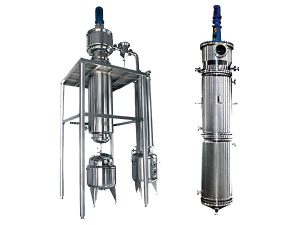
- Tubular heat exchanger
- Heating section
- Holding tube
- Cooling section
- Product pump
- Temperature sensors
- Flow-control valves
- Control system
- CIP connections
Zhongbo manufactures tubular pasteurizers for food and dairy processing and lists them for applications including milk, juice, beverages and other liquid products. The equipment can be configured according to processing requirements rather than relying on one fixed design.
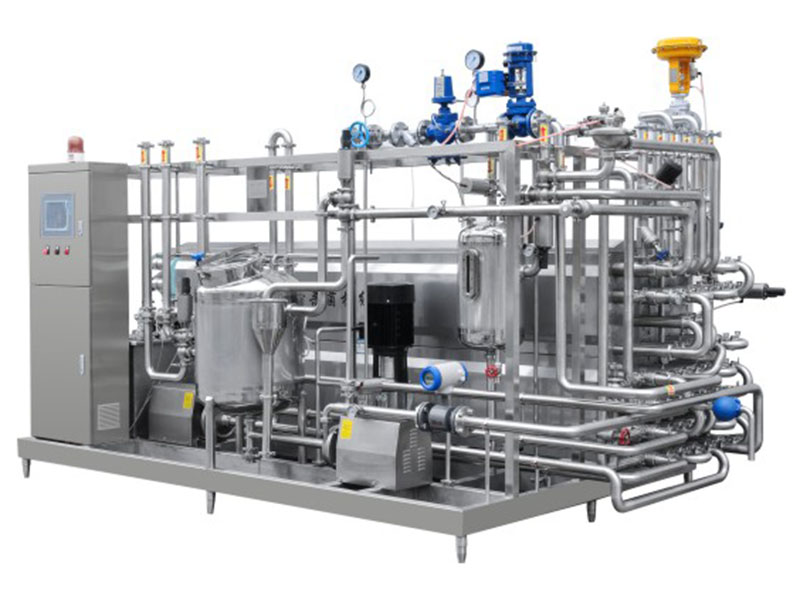
How Does a Tubular Pasteurizer Work?
The exact configuration varies between applications, but the basic process follows a straightforward sequence.
Step 1: Product Feeding
The product enters the pasteurization system through a sanitary pipeline, and a sanitary pump maintains the required flow through the heat exchanger.
Stable flow matters because pasteurization depends on both temperature and the time the product spends at that temperature. The pump, flow-control system and holding tube therefore need to be considered together.
Step 2: Preheating
Before reaching the main heating section, the incoming product can be preheated.
In many heat-treatment systems, heat from the already-pasteurized product is recovered and transferred to the incoming product. This is regenerative heat recovery: instead of discarding all the heat in the hot product, the system uses part of that energy to raise the temperature of the incoming cold product.
Less external heating. Better overall thermal efficiency.
Step 3: Heating
The preheated product enters the main heating section.
A heating medium, such as hot water or another suitable thermal fluid, transfers heat through the tube wall. The product itself never touches the heating medium directly.
The heating section is designed to bring the product to the required pasteurization temperature in a controlled manner. The exact temperature depends on the product and the selected pasteurization process.
Step 4: Holding
Reaching the target temperature is only half the job.
The product must remain at that temperature for a specified period. That’s what the holding tube is for: it provides the required residence time before the product moves to the next stage.
Flow rate, tube dimensions, temperature and holding time have to be coordinated carefully. Push a higher flow rate through the same holding tube and residence time drops, which can put the required thermal treatment at risk.
Step 5: Temperature Monitoring
Temperature sensors monitor the process continuously. If the product doesn’t reach the required treatment temperature, the control system can stop unsuitable product from continuing to the next processing stage.
In an automated system, temperature, flow rate, valves, pumps and other parameters are monitored and controlled through a central interface. That consistency matters in commercial production, where pasteurization has to hold from batch to batch or across continuous operation.
Step 6: Cooling
After the holding stage, the product normally needs to cool down.
The required final temperature depends on what happens next. Pasteurized milk may be cooled for refrigerated storage, while milk destined for yogurt production may be cooled to the temperature that suits culture inoculation.
So the cooling section can be designed around the downstream process rather than treated as a separate operation.
Tubular Pasteurizer Process Flow
A simplified process can be represented as:
Product Feed → Preheating → Heating → Holding → Regenerative Cooling → Final Cooling → Product Outlet
The actual configuration can include additional stages depending on the application. For example, a dairy system may integrate homogenization, balance tanks, pumps, valves and other equipment into the overall process.
Which is why the pasteurizer should be designed according to the entire production line.
Why Use Tubes Instead of Plates?
Tubular and plate heat exchangers both transfer heat indirectly. Their physical structures are different, and that difference decides which products each technology handles efficiently.
A plate heat exchanger uses a series of thin metal plates separated by channels, with product and heating or cooling media flowing through alternating channels. A tubular system uses tubes instead.
Plate Pasteurizer
Plate systems are widely used for relatively low-viscosity liquids such as milk and many beverages. The plates create a large heat-transfer area within a compact footprint, which makes heat transfer efficient.
Tubular Pasteurizer
Tubular systems can be advantageous when the product is:
- More viscous
- Particulate
- More prone to fouling
- Difficult to process through narrow plate channels
- Sensitive to excessive pressure drop
The question isn’t which technology is “better” in the abstract. It’s which heat-exchanger geometry suits the product.
Key Applications of Tubular Pasteurizers
-
Dairy Products
Tubular pasteurizers can be used for a variety of dairy applications, which may include:
- Milk
- Yogurt mixes
- Flavored milk
- Cream
- Dairy beverages
- Other formulated dairy products
For dairy processors, the system can be integrated with homogenization, fermentation, cooling, storage and filling equipment.
Zhongbo’s dairy processing portfolio includes pasteurization equipment alongside mixing tanks, sanitary pumps, CIP systems and other equipment used in dairy production. Zhongbo Dairy Processing Equipment
-
Fruit Juice
Fruit juice can contain pulp, fibers or suspended particles.
Depending on the product formulation, tubular heat exchange offers a practical way to process these liquids while maintaining continuous flow. The actual tube diameter and configuration need to be selected according to particle size, viscosity, solids content and the required processing conditions.
-
Beverage Processing
Tubular pasteurizers also handle various liquid beverages. The system can be configured for different heating and cooling requirements, depending on whether the product is a simple liquid, contains suspended solids, or runs at higher viscosity.
-
Sauces and Liquid Food Products
Some liquid food products are significantly thicker than milk or juice. A tubular system may be the option to consider when the product’s viscosity or solids content makes conventional plate channels less suitable.
That said, judge suitability on the product’s actual rheological properties rather than simply filing it under “thick.”
Key Advantages of Tubular Pasteurization
-
Suitable for a Wider Range of Product Properties
Flexibility with different liquid characteristics is the main reason to consider tubular equipment. Depending on the tube design, these systems handle products with higher viscosity or suspended particles more comfortably than some narrow-channel heat exchangers.
That helps in applications where a standard plate pasteurizer would run into its limits.
-
Lower Risk of Channel Blockage for Some Products
Pulp, fibers and particles cause trouble in small flow channels. The larger flow passages available in some tubular designs reduce the risk of blockage.
They don’t make the pasteurizer immune to fouling, though. Product formulation and operating conditions still matter.
-
Continuous Processing
A tubular pasteurizer can operate continuously rather than in separate heating and cooling batches, which suits industrial production where product flow has to stay consistent.
Continuous processing also simplifies integration with upstream and downstream equipment.
-
Efficient Heat Recovery
A well-designed pasteurization system recovers heat from the hot pasteurized product. The regenerative section transfers heat between the incoming and outgoing product streams, reducing the external energy the process needs.
Actual savings depend on the process configuration, temperature difference, flow rate and heat exchanger design.
-
Hygienic Design
Tubular pasteurizers for food and dairy applications are designed around sanitary product handling: smooth product-contact surfaces, sanitary connections, controlled flow paths and CIP compatibility.
Hygienic design doesn’t stop at the heat exchanger itself. The pumps, valves, pipelines, tanks and instruments around it have to meet the same standard.
-
Integration With Automated Process Control
Industrial pasteurizers can be equipped with automatic temperature and flow control, so the operator or control system can monitor the key process parameters continuously. Automation can also coordinate the pasteurizer with other equipment on the production line.
Zhongbo’s pasteurization equipment can be configured with automated or semi-automated control systems depending on the project requirements. Its tubular pasteurizer product is designed for continuous heat-treatment applications in food and beverage processing. Zhongbo Tubular Pasteurizer
Tubular Pasteurizer vs. Plate Pasteurizer
When selecting pasteurization equipment, the comparison usually comes down to tubular versus plate technology.
| Factor | Tubular Pasteurizer | Plate Pasteurizer |
| Heat-transfer structure | Tubes | Plates |
| Low-viscosity liquids | Suitable | Highly suitable |
| Higher-viscosity products | Often advantageous | Application-dependent |
| Products with particles | Often advantageous | More dependent on channel design |
| Compact footprint | Usually larger | Often more compact |
| Heat-transfer efficiency | Good | Often very high |
| Product flexibility | Broad, depending on tube design | Strong for suitable low-viscosity products |
| CIP | Available with suitable design | Available with suitable design |
| Typical applications | Dairy, juice, beverages, liquid foods | Milk, beverages, dairy, juice |
Don’t select either technology from the table alone. Actual product viscosity, particle size, solids content, required flow rate, temperature profile, cleaning procedure and available space all deserve attention before the final call.
What Factors Should You Consider When Selecting a Tubular Pasteurizer?
Product Characteristics
Start with the product itself. Important information includes:
- Viscosity
- Density
- Total solids
- Particle size
- Fiber or pulp content
- Protein and fat content
- Fouling tendency
- Heat sensitivity
These properties directly influence tube diameter, heat-transfer area, pumping requirements and cleaning strategy.
Processing Capacity
Specify the required production capacity in L/h. The pasteurizer should be sized around the actual process flow rather than a nominal capacity from a catalog.
Heating Temperature
The required pasteurization temperature depends on the product and the applicable process requirements. Settle it before the heating system is designed.
Holding Time
The holding tube must provide the required residence time at the target temperature. Flow rate and holding-tube dimensions cannot be designed independently.
Cooling Requirements
The final outlet temperature matters just as much. A pasteurizer that heats correctly but cannot deliver the required cooling duty can still become a bottleneck in the production line.
Cleaning Requirements
The system should be compatible with the plant’s CIP strategy. Cleaning flow, chemical compatibility, temperature and system configuration all need consideration.
Available Utilities
The design may need to account for:
- Steam
- Hot water
- Cooling water
- Chilled water
- Electricity
- Compressed air
Utility availability affects both equipment configuration and operating cost.
Tubular Pasteurization and CIP
Cleaning is a major consideration in any dairy or food-processing heat-treatment system.
As product passes through the tubes, deposits gradually accumulate depending on the product composition and operating conditions. Protein, fat, sugar, minerals, pulp and other components all contribute to fouling.
A properly designed CIP system circulates cleaning solutions through the product-contact surfaces without requiring complete disassembly of the equipment. For that to work, the pasteurizer should be designed with:
- Appropriate flow paths
- Drainability
- Suitable sanitary valves
- Effective cleaning circulation
- Compatible materials
- Correct connection points
Zhongbo also supplies CIP systems for dairy and food-processing applications, so the pasteurizer and cleaning system can be considered as part of the same processing project. Zhongbo CIP Equipment
Common Mistakes When Choosing a Tubular Pasteurizer
Choosing Equipment Based Only on Capacity
A 5,000 L/h pasteurizer is not automatically suitable for every product that needs to be processed at 5,000 L/h. Product viscosity, solids, particle size and heat sensitivity can change the equipment requirements significantly.
Ignoring the Holding Section
Pasteurization is temperature plus time. The holding tube is an essential part of the system, not an afterthought.
Focusing Only on Heating
The system also has to cool the product properly. Heating, holding, heat recovery and cooling should be designed as one thermal process.
Treating CIP as an Optional Extra
For dairy and food production, cleaning requirements belong in the original equipment design.
Selecting a Standard Configuration for Every Product
Different products require different heat-transfer and flow configurations. A good equipment specification starts with the product rather than a standard machine model.
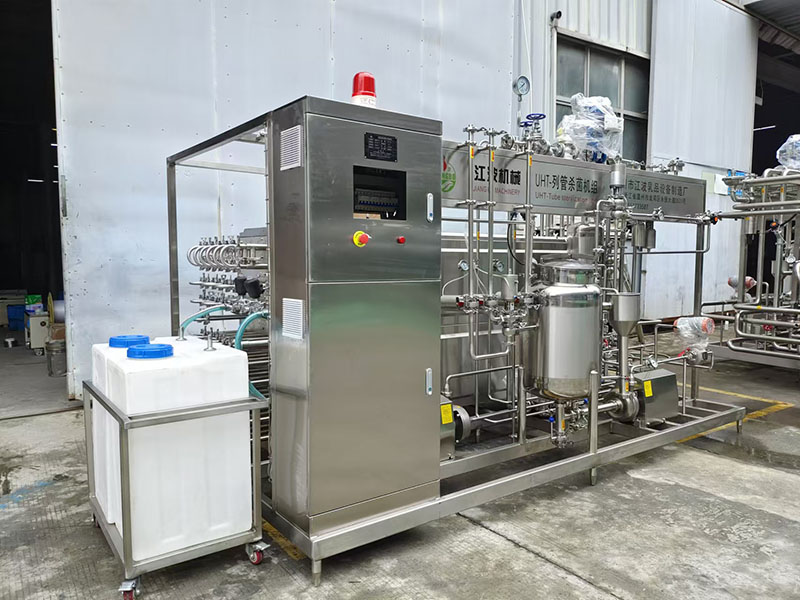
What Information Should You Give the Manufacturer?
Before requesting a quotation for a tubular pasteurizer, prepare:
- Product name and composition
- Processing capacity in L/h
- Product viscosity
- Solids content
- Particle or pulp size, if applicable
- Inlet temperature
- Required pasteurization temperature
- Required holding time
- Outlet temperature
- Available heating and cooling utilities
- CIP requirements
- Automation level
- Available installation space
- Downstream processing requirements
With this information, the manufacturer can design the heat exchanger and holding section around the actual process.
Q&A
Q1. What is a tubular pasteurizer?
A continuous heat-treatment system in which the product flows through tubes while a heating or cooling medium transfers heat through the tube walls. It’s used for dairy products, beverages, juices and other liquid foods.
Q2. How does a tubular pasteurizer work?
The product is pumped through the system, preheated, heated to the required pasteurization temperature, held at that temperature for a controlled period, and then cooled. Heat recovery may be incorporated to transfer heat between the incoming and outgoing product streams.
Q3. What products can be processed in a tubular pasteurizer?
Milk, dairy beverages, juice, fruit-based liquids, sauces and other food products. Tubular designs are particularly useful when products have higher viscosity or contain particles, though the actual design must be matched to the product characteristics.
Q4. What is the difference between a tubular and plate pasteurizer?
A tubular pasteurizer transfers heat through tubes, while a plate pasteurizer uses corrugated metal plates. Plate systems are often highly effective for low-viscosity liquids, while tubular systems offer advantages for some higher-viscosity or particulate products.
Q5. Does a tubular pasteurizer need a holding tube?
Yes, when the process requires a defined holding period at the pasteurization temperature. The holding tube provides the required residence time, and its dimensions need to be designed together with the product flow rate.
Q6. Can a tubular pasteurizer be used for milk?
Yes. Tubular pasteurization can be used in dairy processing, including milk and dairy beverages. The specific heat-treatment configuration should be determined according to the product and required processing conditions.
Q7. Can a tubular pasteurizer handle fruit juice with pulp?
It can be suitable for some fruit-based products containing pulp or suspended particles. The tube diameter and system configuration need to be selected according to the particle size, solids content, viscosity and fouling characteristics of the juice.
Q8. Is CIP available for tubular pasteurizers?
Yes. Tubular pasteurizers used in hygienic food processing can be designed for Clean-In-Place operation. CIP requirements should be considered when designing the tubes, valves, pipelines and other product-contact components.
Q9. How do I choose the right tubular pasteurizer capacity?
Start with the required product flow rate in L/h, then factor in product properties, inlet and outlet temperatures, pasteurization temperature, holding time, heating and cooling utilities, and CIP requirements. The nominal flow rate alone won’t tell you which equipment is right.
Q10. Can Zhongbo customize a tubular pasteurizer?
Yes. Zhongbo provides tubular pasteurization equipment for dairy, beverage, juice and other food-processing applications. The system can be configured according to processing capacity, product characteristics, heating and cooling requirements, automation, and the requirements of the complete production line. Zhongbo Tubular Pasteurizer
Conclusion
A tubular pasteurizer works by moving a liquid product through tubes and transferring heat indirectly through the tube walls. The basic process combines controlled heating, holding, heat recovery and cooling to achieve the required thermal treatment.
Its main value is flexibility. Compared with plate-based systems, tubular designs come into their own with products that have higher viscosity, suspended particles or more demanding fouling characteristics.
There is no universal pasteurizer configuration, though. Product properties, flow rate, pasteurization temperature, holding time, cooling requirements, CIP and available utilities all need to be considered together.
For dairy and food processors, the reliable approach is to select the heat-treatment system based on the actual product and complete process rather than capacity alone.
Zhongbo provides tubular pasteurizers together with other dairy and food-processing equipment, including sanitary pumps, mixing tanks, CIP systems, heat exchangers and related process equipment. That makes it possible to develop the pasteurizer as part of an integrated production line rather than as an isolated machine. Zhongbo Official Website
Planning a new pasteurization system? Contact Zhongbo with your product type, processing capacity, temperature requirements and CIP conditions to discuss a suitable tubular pasteurizer solution.