
Introduction
Sanitary pumps are essential for transferring liquids between tanks, processing equipment, heat exchangers, UHT systems, and filling lines in food and beverage production. However, different products require different pumping principles.
Centrifugal pumps, rotary positive displacement pumps, and high-shear emulsifying pumps each have different performance characteristics. The right choice depends on flow rate, pressure, viscosity, product composition, shear sensitivity, and the required level of mixing or emulsification.
This guide compares the three main sanitary pump types and explains how to select the right pump for your processing line.
What Is a Sanitary Pump in Food and Beverage Processing?
A sanitary pump is designed to transfer food, dairy, beverage, and other hygienic products while minimizing contamination risks and supporting effective cleaning.
Compared with general industrial pumps, sanitary pumps typically feature:
- Hygienic stainless-steel construction
- Smooth product-contact surfaces
- Sanitary connections
- Drainable designs
- CIP compatibility
- Materials suitable for food-processing environments
A sanitary pump may transfer products between:
Mixing Tank → Processing Equipment → UHT → Buffer Tank → Filling Machine
The pump must provide the required flow and pressure without unnecessarily damaging the product.
Types of Sanitary Pumps
Centrifugal Pumps
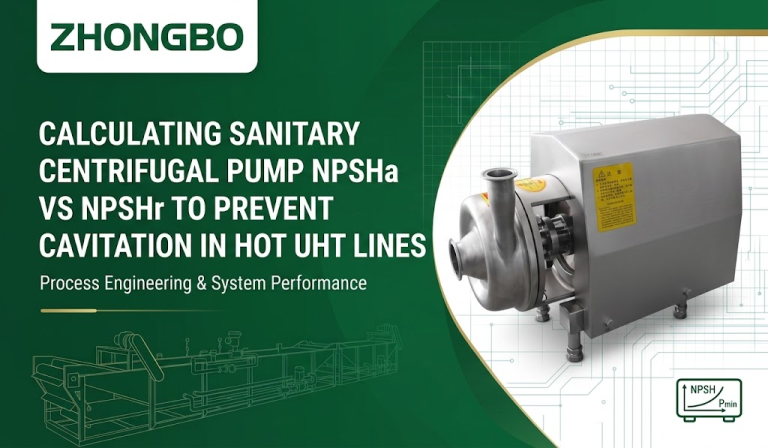
Centrifugal pumps use a rotating impeller to convert mechanical energy into fluid velocity and pressure.
They are generally well suited to low-viscosity liquids and high-flow applications.
Typical applications include:
- Milk
- Water
- Juice
- Liquid ingredients
- CIP solutions
- Other low-viscosity beverages
Advantages include:
- High flow capacity
- Simple construction
- Relatively compact design
- Good efficiency for low-viscosity liquids
- Suitable for many CIP applications
However, centrifugal pump performance can decrease as product viscosity increases.

Rotary Positive Displacement Pumps
Rotary positive displacement pumps transfer a relatively fixed volume of product during each rotation.
This makes them particularly suitable for medium- and high-viscosity products where maintaining stable flow is important.
Applications may include:
- Cream
- Yogurt
- Concentrated products
- Syrups
- Sauces
- Other viscous food products
Compared with centrifugal pumps, positive displacement pumps can provide more consistent flow under higher-pressure conditions.
They should, however, be selected according to the product’s viscosity, temperature, solids content, and sensitivity to shear.
High-Shear Emulsifying Pumps
High-shear emulsifying pumps combine pumping with intensive mixing and dispersion.
They generate strong localized shear forces that can break down droplets and disperse ingredients more effectively than conventional transfer pumps.
They are particularly suitable for:
- Emulsions
- Oil-water mixtures
- Fine dispersions
- Products requiring intensive homogenization during processing
- Certain high-viscosity formulations
Unlike a conventional centrifugal or positive displacement pump, a high-shear emulsifying pump is selected not only for fluid transfer but also for its mixing and emulsification function.
Centrifugal vs. Positive Displacement vs. High-Shear Pumps
Flow Rate and Pressure
Centrifugal pumps are generally preferred when high flow rates are required at relatively moderate pressures.
Positive displacement pumps are often more suitable when the process requires controlled flow against higher system resistance.
High-shear pumps must be evaluated according to both pumping requirements and the required shear intensity.
| Pump Type | Typical Strength | Suitable Flow Characteristics |
| Centrifugal | High flow | Low-viscosity liquids |
| Positive displacement | Stable flow and pressure | Medium/high-viscosity products |
| High-shear emulsifying | Pumping + intensive mixing | Emulsification and dispersion |
The pump should be selected based on the actual system curve, including pipeline length, elevation, valves, heat exchangers, and other pressure losses.
Viscosity and Product Characteristics
Viscosity is one of the most important pump-selection parameters.
For low-viscosity liquids such as water and many beverages, a centrifugal pump can often provide efficient transfer.
As viscosity increases, a positive displacement pump may become more appropriate because it can maintain effective product transfer under higher resistance.
Product characteristics should also include:
- Solids content
- Particle size
- Temperature
- Density
- Air content
- Shear sensitivity
For products containing delicate particles or shear-sensitive ingredients, excessive pump intensity should be avoided.
Shear and Emulsification Requirements
Not every product needs high shear.
If the objective is simply to move a beverage from one tank to another, a conventional centrifugal or positive displacement pump may be sufficient.
If the process requires fine emulsification or intensive dispersion, a high-shear emulsifying pump can provide an additional processing function.
The basic selection logic is:
Transfer Only → Centrifugal / Positive Displacement
Transfer + Fine Emulsification → High-Shear Emulsifying Pump
However, high shear can increase energy consumption and may affect shear-sensitive products. The required shear level should therefore be established from the formulation and process requirements.
Hygiene and CIP Compatibility
Regardless of pump type, sanitary design is essential in food and beverage processing.
Important features include:
- Food-grade materials
- Smooth product-contact surfaces
- Hygienic seals
- Sanitary connections
- Minimal dead zones
- Good drainability
- CIP compatibility
The pump should also be integrated into the CIP circuit so that cleaning solutions can circulate through the relevant product-contact areas.
For UHT and high-hygiene applications, pump selection should be coordinated with the entire hygienic process design rather than evaluated as an independent component.
How to Choose the Right Sanitary Pump?
Pump Sizing and Integration with Mixing, UHT, and CIP Lines
Correct pump sizing starts with the required flow rate and pressure.
Key parameters include:
- Required flow rate
- Total dynamic head
- Product viscosity
- Product temperature
- Pipeline diameter and length
- Valve and heat-exchanger pressure losses
- Tank elevation
- CIP flow requirements
A typical dairy or beverage process may look like:
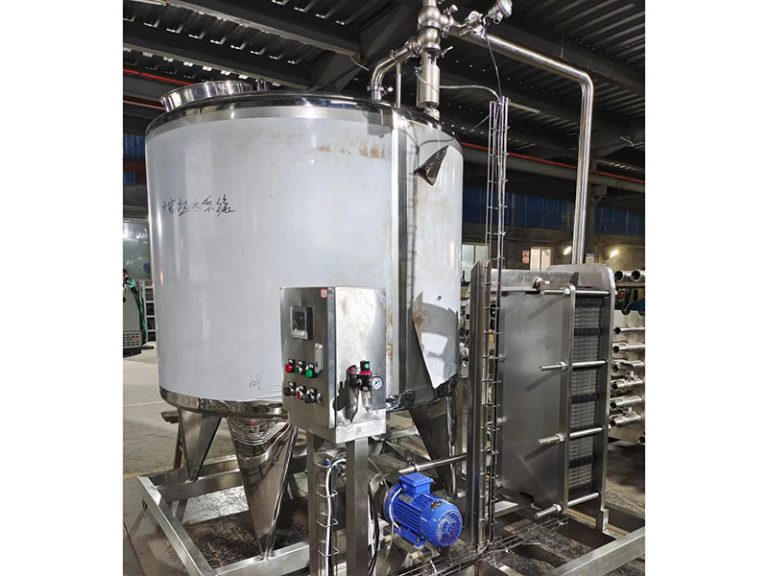
Mixing Tank → Sanitary Pump → UHT/Heat Exchanger → Buffer Tank → Filling
The pump must provide sufficient flow under normal production conditions while also supporting the required cleaning flow during CIP.
For this reason, pump selection should be coordinated with the process piping, mixing tanks, UHT system, buffer tanks, and CIP system.
A pump that is too small may fail to provide the required flow. An oversized pump can increase energy consumption and potentially expose the product to unnecessary shear.
Zhongbo Sanitary Pump Solutions
Zhongbo provides Centrifugal Pumps for sanitary liquid-transfer applications in food and beverage processing.
For applications requiring different pumping characteristics, Zhongbo also provides Stainless Steel Vacuum Pumps for specific processing and vacuum-related applications.
When selecting a sanitary pump, manufacturers should consider the complete process rather than simply choosing a pump based on nominal flow rate.
The pump should be matched with the product characteristics, piping system, mixing equipment, UHT or heat-treatment equipment, buffer tanks, and CIP system.
FAQs
- What is a sanitary pump?
A sanitary pump is designed for hygienic processing applications such as dairy, beverage, and food production, with construction and connections that support product safety and effective cleaning.
- When should I use a centrifugal pump?
Centrifugal pumps are generally suitable for high-flow, low-viscosity liquids such as water, milk, juice, and many beverage products.
- When is a positive displacement pump better?
A rotary positive displacement pump is generally more suitable for medium- or high-viscosity products and applications requiring stable flow under higher pressure.
- What is a high-shear emulsifying pump used for?
It is used when the process requires both fluid transfer and intensive dispersion or emulsification, such as certain oil-water emulsions and fine formulations.
- Which pump is best for high-viscosity products?
Positive displacement pumps are often preferred for high-viscosity products, although the final choice depends on viscosity, solids content, temperature, shear sensitivity, and required flow rate.
- Can sanitary pumps be used for CIP?
Yes. Properly selected sanitary pumps can be incorporated into CIP circuits to circulate cleaning solutions through processing equipment and pipelines.
- How do I size a sanitary pump?
Start with the required flow rate and total dynamic head, then account for viscosity, temperature, pipeline resistance, valves, heat exchangers, elevation, and CIP requirements.
- Can one pump be used for both product transfer and CIP?
It can be possible depending on the system design, but the pump must meet the hydraulic requirements of both production and cleaning cycles. In some plants, dedicated CIP pumping equipment may be preferable.
Conclusion
Selecting the right sanitary pump requires more than comparing flow rates. The key is matching the pumping principle to the product and process.
Centrifugal pumps are generally suitable for high-flow, low-viscosity liquids. Rotary positive displacement pumps are better suited to many viscous products and controlled-flow applications. High-shear emulsifying pumps are appropriate when pumping must be combined with intensive dispersion or emulsification.
Before making a selection, evaluate flow rate, pressure, viscosity, solids content, shear requirements, hygiene, CIP compatibility, and integration with mixing tanks, UHT equipment, buffer tanks, and filling lines.
For food and beverage manufacturers, Zhongbo’s Centrifugal Pump and other sanitary processing equipment can be considered as part of an integrated hygienic production system.