

Introduction
In a dairy or beverage plant, the process pipework is easy to overlook because it carries product silently between the headline machines. Yet the pipe finish, slope, and geometry of dead-legs decide whether the line can be cleaned in place and whether it harbors bacteria that the pasteurizer downstream cannot fix. This guide covers the three specs every hygienic piping design must lock down: wall roughness (Ra), drain slope, and the length-to-diameter (L/D) limit for dead-legs.
Why Surface Roughness (Ra) Controls Biofilm Risk
Surface roughness is the microscopic texture left after machining, welding, and polishing. In hygienic piping it is expressed as Ra in micro-inches or micrometres. The lower the Ra, the fewer microscopic valleys there are for bacteria and soil to hide. Typical benchmarks:
- 3A dairy standard: Ra ≤ 32 µin (0.8 µm) on product-contact surfaces.
- High-hygiene beverage lines: Ra ≤ 20 µin (0.5 µm).
- Pharma or extended-shelf-life dairy: Ra ≤ 15 µin (0.38 µm), often electropolished.
Electropolishing removes the surface layer after mechanical polishing and rounds the microscopic peaks, which both lowers Ra and improves the chromium-to-iron ratio in the passivation layer. A polished 316L pipe is the default for CIP-acid exposure, while 304 is acceptable for low-chloride, low-acid water circuits.
Slope and Self-Drainage
No matter how smooth the wall, a puddle left in a low spot becomes a growth niche. Hygienic design therefore demands that all product lines drain completely, usually toward a process outlet or a drop leg to drain. Industry practice:
| Application | Minimum slope | Preferred slope |
|---|---|---|
| Product lines | 1:200 (0.5 %) | 1:100 (1 %) |
| CIP return lines | 1:100 (1 %) | 1:50 (2 %) |
| Long horizontal runs | 1:100 | 1:50 with continuous fall to drain |
Every horizontal section must have a defined low point. Avoid flat runs, U-bends without drains, and loops that trap air or product. If the line cannot drain by gravity, the CIP procedure must include a turbulent rinse followed by compressed-air blow-down before the final ambient rinse.
Dead-Leg Limits: The L/D Rule
A dead-leg is any branch, blank, instrument pocket, or valve cavity where product can sit stagnant. Because CIP flow does not scour these pockets effectively, they are the most common source of post-pasteurization contamination. The standard hygienic rule is:
Product-contact dead-legs should have an L/D ratio ≤ 2:1, and never more than 3:1, where L is the length of the stagnant branch and D is its internal diameter.
In practice this means instrument tees should be short, sample valves should be flush or nearly flush, and unused branches should be capped with a short plug rather than extended nipples. For a 2-inch (50 mm) line, a 2:1 L/D limit means any dead branch cannot project more than 100 mm into the flow path.
Flow Velocity for CIP Validation
Wall shear is what actually removes soil. The 3A accepted minimum is a mean velocity of 1.5 m/s in the main lines during CIP. This corresponds to turbulent flow (Reynolds number Re > 4,000) for water-like fluids and must be maintained through the entire circuit, including the largest-diameter leg. If the line branches into smaller lines, the velocity in each branch must still meet the minimum, which often means balancing flow with orifice plates or dedicated CIP supply pumps.
Material, Welding, and Passivation
316L is preferred for dairy and acidified beverages because it resists chloride pitting from CIP acids and salted whey brines. Orbital welding with argon backing produces smoother internal beads than hand welding, and every weld must be inspected internally for pinholes, undercut, and excessive reinforcement. After installation, passivation with nitric or citric acid restores the chromium-oxide layer. A poorly passivated weld will roughen and corrode long before the base metal, so it is always the weak point.
Specifying Your Piping System
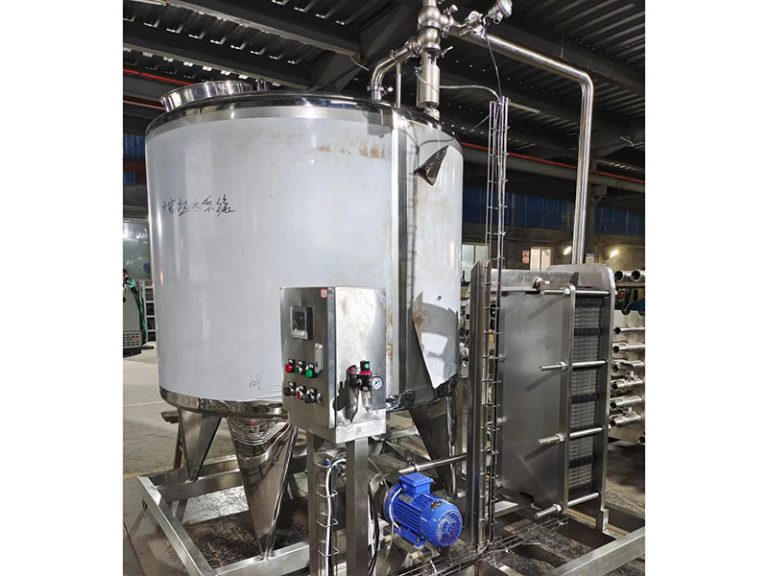
When you send a piping specification to a contractor or equipment supplier, include: design Ra per surface, slope and drain-point locations, L/D limits with a drawing note, material grade (316L or 304), weld spec and inspection method, CIP flow rate and velocity targets, and the passivation procedure. Equipment that is purchased with integrated pipework—such as a CIP cleaning system, pasteurizer, or tank skid—should be checked against the same spec before it ships.

Common Mistakes in Hygienic Piping
- Using 304 in chloride-heavy zones. CIP acids and brines will pit 304; specify 316L for product contact.
- Flat runs with no defined drain. They leave residual product that CIP cannot fully remove.
- Long instrument branches. A pressure transmitter with a 6-inch stem is a 3:1 dead-leg in a 2-inch line.
- Undersized CIP flow. Below 1.5 m/s the line may look clean but biofilm remains.
- Skipping weld inspection. A single pinhole weld defeats the whole surface-finish investment.
FAQ
What Ra is required for dairy product piping?
3A requires Ra ≤ 32 µin (0.8 µm) on product-contact surfaces; many premium dairy and ESL lines specify ≤ 20 µin with electropolish.
Can I use 304 stainless instead of 316L?
For low-chloride water and non-acid beverages, 304 is acceptable. For dairy, acid juices, CIP acids, or any chloride exposure, use 316L.
What is the maximum acceptable L/D for a dead-leg?
2:1 is the hygienic target; 3:1 is the absolute upper limit for product-contact branches. Beyond that, effective CIP is unlikely.
How do I prove CIP cleans the whole line?
Verify flow velocity ≥ 1.5 m/s in every leg, use temperature and conductivity sensors at the return, and swab-verify after the first validation runs.
Does slope matter on CIP supply lines?
Yes—CIP return lines especially need slope to drain the rinse water and detergent, preventing dilution and residual moisture.
Conclusion
Hygiene in a dairy or beverage plant is decided as much by the pipework as by the pasteurizer or tank. Specifying Ra ≤ 32 µin, a minimum 1:100 slope to drain, and an L/D dead-leg limit of 2:1 gives CIP a chance to work. Combine that with 316L material, orbital welding, and documented passivation, and the pipework stops being a contamination risk and becomes a reliable extension of every cleanable machine on the line.