Introduction
Water is easy to overlook in dairy processing.
Milk is obviously the main raw material, so most attention goes to pasteurizers, homogenizers, fermentation tanks, filling machines, and other production equipment. But water is involved in far more parts of a dairy plant than many people realize.
It may be used as a processing ingredient, for equipment cleaning, steam generation, cooling, boiler operation, utility systems, and other plant services. In some facilities, treated water is also an important part of the overall production process.
If the water quality is inconsistent, the effects can extend beyond the water system itself. Minerals can contribute to scale on heat-transfer surfaces, unsuitable water chemistry can interfere with cleaning, and microbiological contamination can create hygiene concerns.
For this reason, water treatment should be considered as part of dairy plant design, rather than as a separate utility installed after the main production equipment has been selected.
This article explains why water treatment matters in dairy processing, which water-quality issues deserve attention, and how to approach a suitable water treatment system for a dairy plant.
Why Is Water Important in Dairy Processing?
A dairy factory can use a substantial amount of water every day, and not all of it serves the same purpose.
Typical applications include:
- Ingredient or process water
- Equipment and pipeline cleaning
- CIP systems
- Boiler feedwater
- Cooling systems
- Hot-water generation
- Floor and facility cleaning
- Utility services
- Wastewater treatment
The quality requirement can also differ depending on the application.
Water used as an ingredient may have different requirements from water used for boiler makeup or general cleaning. Treating every water stream in exactly the same way may therefore be inefficient.
A good plant design starts by identifying where the water comes from, where it is used, and what quality is required at each point of use.
What Happens When Water Quality Is Poor?
Water quality problems do not always produce an obvious failure immediately.
Instead, they can gradually affect production efficiency, cleaning performance, equipment condition, and operating costs.
Several parameters are particularly important.
Hardness
Hard water contains dissolved calcium and magnesium.
When heated, these minerals can contribute to scale formation. Heat exchangers, boilers, hot-water systems, and other equipment can be affected when scaling becomes significant.
Scale acts as an additional thermal resistance layer, which can reduce heat-transfer performance and increase the energy required to achieve the same heating duty.
For a dairy plant that relies heavily on heat treatment, this can become an ongoing maintenance issue.
Suspended Solids
Water may contain particles such as sand, sediment, rust, or other suspended matter.
If these particles enter production or utility systems without adequate filtration, they can affect valves, pumps, pipelines, membranes, and other equipment.
The appropriate filtration method depends on the source-water characteristics and the intended application.
Microbiological Contamination
Microbiological quality is particularly important in food processing.
Even when water is not a direct ingredient, it may come into contact with food-processing equipment during cleaning or rinsing.
If the water system is poorly controlled, it can undermine hygienic conditions elsewhere in the plant.
Water treatment should therefore be considered together with sanitation, storage, distribution, and monitoring rather than treated as a single filtration step.
Dissolved Minerals and Salts
Some water sources contain relatively high concentrations of dissolved salts or other minerals.
Depending on the application, these may affect product formulation, equipment performance, membrane systems, boilers, or cleaning processes.
A detailed water analysis is therefore a much better starting point than choosing a treatment system based only on the name of the water source.
Water Treatment and Dairy Product Quality
The relationship between water and dairy product quality depends on how the water is used.
If treated water becomes part of the product formulation, its chemical and microbiological characteristics can directly influence the finished product.
For example, water used in the production of reconstituted milk or dairy beverages becomes part of the product itself. Its composition can therefore affect consistency and process control.
Even when water does not become an ingredient, it can still influence product quality indirectly.
Consider the cleaning process.
If a processing line is not cleaned effectively because of unsuitable water quality or excessive mineral deposits, residues may accumulate inside tanks, pipes, valves, and heat exchangers.
This can eventually affect both hygiene and production performance.
Water quality is therefore connected to dairy processing at several levels rather than only at the final product stage.
Water Treatment and CIP Systems
CIP (Clean-In-Place) is one of the most important areas where water quality matters.
A dairy CIP system typically uses water together with cleaning chemicals and controlled temperature and flow conditions to remove product residues from tanks, pipelines, pumps, heat exchangers, and other equipment.
The quality of the water used for rinsing and cleaning can influence the overall effectiveness of the cleaning cycle.
Hard water, for example, can contribute to mineral deposits under certain conditions. These deposits may become more difficult to remove and can complicate the cleaning process.
A well-designed dairy plant should therefore consider the relationship between:
Water Treatment → CIP → Process Equipment → Product Hygiene
Zhongbo supplies CIP equipment for dairy and food-processing applications, so water treatment can be integrated into a broader hygienic process design rather than considered independently.

Water Treatment for Boilers and Steam Systems
Steam is widely used in dairy plants for heating, pasteurization, hot-water generation, and other thermal processes.
The quality of boiler feedwater matters because dissolved minerals can contribute to scale and other operational problems.
Scale on boiler heat-transfer surfaces can reduce heat-transfer efficiency and increase energy consumption. Depending on water chemistry and boiler operation, other water-quality issues can also affect system maintenance.
A water-treatment system for boiler feedwater may therefore include processes such as:
- Filtration
- Water softening
- Demineralization
- Reverse osmosis
- Other treatment technologies selected according to the water analysis
The correct configuration depends on the source water and the requirements of the steam system.
It is important to distinguish between boiler feedwater treatment and process-water treatment. They may require different treatment targets.
Water Treatment for Cooling Systems
Dairy plants also require cooling.
After pasteurization or other heat-treatment stages, products often need to be cooled rapidly to the appropriate processing or storage temperature.
Cooling water or chilled-water systems therefore form an important part of plant utilities.
Poor water quality can contribute to deposits, corrosion, or microbiological issues in certain cooling systems.
The treatment strategy should consider the type of cooling system, whether the water is once-through or recirculated, operating temperature, and the materials used in the equipment.
Again, there is no single water-treatment technology that is suitable for every dairy plant.
Common Water Treatment Technologies
The treatment process should be selected according to the actual water-quality problem.
-
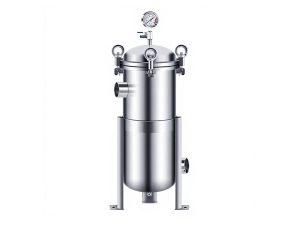
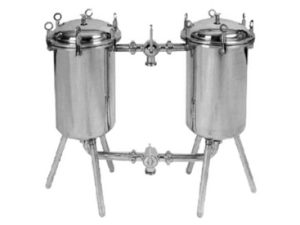
Filtration
Filtration removes suspended particles from water.
Depending on the application, different filtration technologies may be used for different particle sizes and water characteristics.
Filtration is often an important first step because removing larger particles can protect downstream equipment and treatment stages.

-
Water Softening
Water softeners are primarily used to reduce hardness caused by calcium and magnesium ions.
Softening can help control the formation of hardness-related scale in applications where hard water would otherwise create operational problems.
However, softening does not remove every dissolved contaminant, so it should not be treated as a universal purification method.
-
Reverse Osmosis
Reverse osmosis (RO) uses a semi-permeable membrane to reduce a broad range of dissolved substances.
RO is commonly considered when a dairy plant requires lower-mineral water for a particular process.
The required pretreatment is important because suspended solids, hardness, and other contaminants can affect membrane performance.
-
UV Treatment
Ultraviolet treatment can be used as part of a water-disinfection strategy.
It can provide microbial control without adding a chemical disinfectant directly to the treated water.
However, UV performance depends on factors such as water clarity and system design, so it is normally considered as part of a complete treatment train rather than as a replacement for all other treatment steps.
-
Other Treatment Processes
Depending on the source water, a dairy plant may require additional technologies, such as:
- Activated carbon
- Ultrafiltration
- Demineralization
- Ion exchange
- Ozone treatment
- Membrane filtration
The appropriate technology should be selected only after understanding the raw-water characteristics and the required treated-water quality.
How to Choose a Water Treatment System for a Dairy Plant
There is no standard water treatment system that fits every dairy factory.
The first step should be a water-quality analysis.
Important parameters may include:
- pH
- Total dissolved solids (TDS)
- Hardness
- Conductivity
- Turbidity
- Suspended solids
- Iron
- Manganese
- Chloride
- Sulfate
- Microbiological indicators
The exact test list depends on the source water and intended use.
Once the water analysis is available, the next step is to identify the different points of use in the factory.
For example:
| Application | Main consideration |
| Product ingredient | Chemical and microbiological quality |
| CIP | Cleaning performance and hygiene |
| Boiler feedwater | Hardness, dissolved minerals, corrosion/scaling control |
| Cooling system | Scaling, corrosion, and microbiological control |
| General cleaning | Appropriate sanitary quality |
| Process utilities | Equipment-specific requirements |
This approach is generally more useful than trying to treat the entire water supply to the highest possible specification.
How Much Water Does a Dairy Plant Need?
Water consumption depends heavily on the type and scale of the dairy factory.
A plant producing drinking milk will have different water requirements from one producing yogurt, cheese, condensed milk, or milk powder.
The production schedule also matters.
Instead of calculating only average daily water consumption, engineers should consider:
- Peak water demand
- Production shifts
- CIP cycles
- Simultaneous equipment operation
- Boiler demand
- Cooling demand
- Cleaning requirements
- Future expansion
Peak demand is particularly important when sizing pumps, treatment equipment, storage tanks, and distribution piping.
A system that works at average demand may not provide sufficient flow during a major CIP cycle or when several processing areas require water simultaneously.
Water Storage and Distribution
Water treatment does not end when the water leaves the treatment unit.
Treated water may need to be stored before being distributed throughout the factory.
The storage tank and distribution system should be designed according to the type of treated water and its intended application.
Important considerations include:
- Tank capacity
- Material
- Hygiene
- Temperature
- Recirculation
- Dead legs
- Pipe routing
- Pump capacity
- Monitoring
For hygienic dairy applications, the entire water-distribution system should be considered as part of the sanitary design.
A high-quality treatment unit cannot compensate for poor downstream storage or distribution practices.
Integrating Water Treatment into a Dairy Production Line
Water treatment should ideally be planned during the early stages of plant design.
This allows the engineering team to coordinate:
Raw Water → Treatment → Storage → Distribution → Production/CIP/Utilities
with the rest of the processing system.
For example, if the plant includes a pasteurization system, CIP station, mixing tanks, sanitary pumps, and hot-water system, their water requirements should be considered together.
Zhongbo’s portfolio includes water treatment equipment alongside dairy processing equipment such as pasteurizers, mixing tanks, pumps, CIP systems, and tanks. This makes it possible to consider water treatment as part of a wider dairy processing project.
Common Water Treatment Mistakes in Dairy Plants
Choosing Equipment Before Testing the Water
This is one of the most common mistakes.
Without a water analysis, it is difficult to know whether the plant actually needs softening, RO, filtration, disinfection, or a combination of processes.
Treating All Water to the Same Standard
Different applications have different requirements.
Treating every liter of water to the highest specification may increase capital and operating costs without providing additional value.
Ignoring Peak Demand
Average daily consumption does not tell the whole story.
CIP and other processes can create short periods of very high water demand.
Forgetting Pretreatment
Membrane systems such as RO often require suitable pretreatment. If the incoming water contains excessive suspended solids, hardness, or other problematic components, membrane performance and service life can be affected.
Treating Water and CIP as Separate Projects
Water quality and cleaning performance are connected.
The water-treatment system should be considered together with the CIP system and the product-contact equipment.
What Should You Ask a Water Treatment Equipment Manufacturer?
Before requesting a quotation, prepare the following information:
- Raw-water source — municipal supply, groundwater, surface water, or another source.
- Water analysis — laboratory results for relevant physical, chemical, and microbiological parameters.
- Required flow rate — both average and peak demand.
- Applications — product, CIP, boiler, cooling, or general plant use.
- Required treated-water quality.
- Operating schedule — hours per day and production shifts.
- Available installation space.
- Existing equipment — pumps, tanks, CIP, boilers, or other utilities.
- Automation requirements.
- Future expansion plans.
The more complete this information is, the easier it becomes to design a practical treatment system.
Q&A
Q1. Why is water treatment important in dairy processing?
Water is used for many purposes in a dairy plant, including processing, cleaning, CIP, steam generation, cooling, and other utilities. Poor water quality can contribute to scaling, equipment problems, cleaning difficulties, and hygiene risks.
Q2. Does water used in a dairy plant need to be treated?
The required treatment depends on the source water and its intended application. Some water supplies may require only limited treatment, while others may require filtration, softening, RO, disinfection, or several treatment stages.
Q3. What water quality problems are common in dairy plants?
Common concerns include hardness, suspended solids, high TDS, undesirable minerals, turbidity, and microbiological contamination. The actual treatment requirements should be determined through water analysis.
Q4. How does hard water affect dairy equipment?
Hard water contains calcium and magnesium that can contribute to mineral scaling, particularly in heated systems. Scale can reduce heat-transfer performance and increase maintenance requirements.
Q5. Is reverse osmosis necessary for every dairy factory?
No. RO is not automatically required for every dairy plant. Whether it is appropriate depends on the raw-water composition and the quality required for the specific application.
Q6. Does water treatment affect CIP performance?
Yes. Water quality can influence cleaning performance and mineral deposition. The water-treatment system should therefore be considered together with the CIP process and the materials and equipment being cleaned.
Q7. Can the same treated water be used for production and boiler feed?
Not necessarily. Different applications can have different water-quality requirements. The treatment and distribution system should be designed according to the requirements of each application.
Q8. How should I size a water treatment system for a dairy plant?
Start by calculating both average and peak water demand for production, CIP, boilers, cooling, and other utilities. Then combine this information with a laboratory analysis of the raw water to determine the appropriate treatment capacity and technology.
Q9. Can Zhongbo provide water treatment equipment for dairy plants?
Yes. Zhongbo has a dedicated water treatment equipment product category and also supplies dairy-processing equipment such as tanks, pumps, CIP systems, pasteurizers, and other process equipment. This allows water treatment to be considered as part of a broader dairy processing project.
Conclusion
Water is a fundamental utility in dairy processing, but its importance is easy to underestimate.
It can become part of the product, support cleaning and CIP, feed boilers, supply cooling systems, and serve many other functions throughout the factory. As a result, water quality can influence not only hygiene but also heat-transfer performance, equipment maintenance, cleaning efficiency, and operating costs.
The right approach is not to install the most sophisticated treatment system available. Instead, start with water analysis and a clear understanding of each point of use. From there, filtration, softening, reverse osmosis, disinfection, or other technologies can be combined according to actual requirements.
For a new dairy plant, water treatment should be planned alongside the processing line, CIP system, tanks, pumps, heating and cooling systems, and other utilities. This integrated approach can make the plant easier to operate and maintain over the long term.
Zhongbo provides water treatment equipment together with a range of dairy and food-processing equipment, supporting customers who need to integrate water treatment into a complete processing project.
Planning a dairy plant or upgrading your existing water system? Contact Zhongbo with your raw-water analysis, required flow rate, and intended applications to discuss a suitable water treatment solution.