A product-by-product selection guide for dairy manufacturers evaluating UHT sterilizers, homogenizer placement, and line configuration.
July 15, 2026 | By Zhongbo Engineering Team | 12 min read
Why One UHT Line Doesn’t Fit All Dairy Products
A common mistake in dairy plant procurement is treating all liquid dairy products as interchangeable. They are not. Milk, yogurt, and cream differ in three critical dimensions that directly determine which UHT equipment type will work — and which will fail:
| Factor | Milk | Yogurt (Drinking) | Cream (20–40% Fat) |
|---|---|---|---|
| Viscosity (cP) | 1.5 – 3 cP | 50 – 300 cP | 100 – 500 cP |
| Fat Content | 0.1 – 3.5% | 0.5 – 3% | 20 – 40% |
| Protein Sensitivity | Moderate | High (denatured proteins, fouling risk) | Low – Moderate |
| Fouling Tendency | Low – Medium | High (protein + acid coagulated) | Medium (fat deposits on hot surfaces) |
| Recommended Sterilizer | Plate | Tubular | Tubular |
If you are still deciding between HTST pasteurization and UHT sterilization for your production, start with our foundational guides: HTST vs UHT — What Is the Difference? and HTST vs UHT — Which Is Better for Your Plant?.
UHT Process Flow: The Components Every Buyer Must Understand
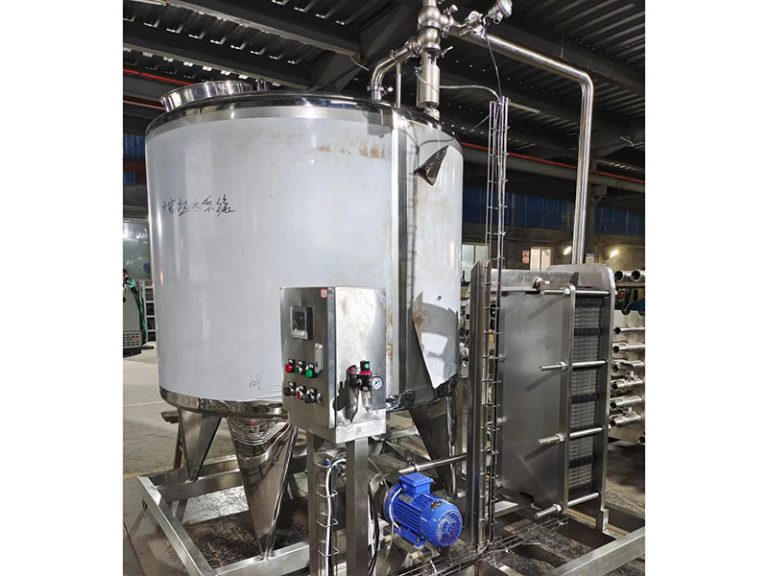
A UHT processing line is not a single machine. It is an integrated system of interconnected components. When evaluating suppliers, ask who manufactures each stage. Lines assembled from mixed third-party brands often have compatibility issues during commissioning. Suppliers that build the full flow in-house reduce integration risk, simplify spare parts management, and provide single-point after-sales support.
Here are the core components of a complete UHT dairy line:
| Component | Function | What to Check |
|---|---|---|
| Balance Tank | Maintains constant product head; receives diverted product during temperature deviation | SS316L, level sensor, CIP spray ball included |
| Feed Pump | Provides consistent line pressure for stable flow through heat exchangers | Positive displacement or centrifugal; VFD-controlled |
| Preheater | Raises product from cold storage (~5°C) to 65–75°C before homogenization | Regenerative section recovers heat; check heat recovery % |
| Deaerator | Removes dissolved oxygen; reduces off-flavors and oxidation during storage | Essential for cream and ESL products; optional for standard milk |
| Homogenizer | Reduces fat globules to 0.5–1.0 μm; prevents creaming and improves mouthfeel | Placement matters: upstream (milk) or downstream (cream) — see product sections |
| UHT Sterilizer | Heats product to 135–150°C for 2–8 seconds — the core sterilization step | Plate, tubular, or direct steam — match to product (see matrix below) |
| Hold Tube | Maintains product at sterilization temperature for the legally required time | Calculated for worst-case velocity; F₀ ≥ 3.0 minutes equivalent |
| Flow Diversion Valve (FDV) | Automatically redirects under-processed product back to balance tank | Must switch in <1 second; verify response time with supplier |
| Cooler | Cools sterilized product to ≤25°C for aseptic filling | Multi-stage: regenerative → chilled water → ice water |
| Aseptic Filler | Fills and seals product in sterile containers without recontamination | Usually the bottleneck — size the filler first, then match upstream |
| CIP System | Automated cleaning with alkaline, acid, and sanitizing cycles | CIP cycle time directly impacts daily output; 60–90 min per cycle |
Buyer tip: Define your target throughput at the filler output stage, then size the upstream sterilizer to match. A UHT sterilizer rated at 5,000 L/h means nothing if your aseptic filler bottlenecks at 3,000 L/h. The filler almost always limits the line, not the sterilizer.
UHT Milk Processing: Equipment, Parameters & Best Practices
Why Milk Works Best with a Plate UHT
Standard cow’s milk — whether whole, skimmed, or flavored — has low viscosity (1.5–3 cP) and no particulates. This makes it the ideal candidate for a plate heat exchanger (PHE). Plate systems achieve 90%+ heat recovery, meaning 90% of the energy used to heat incoming milk comes from hot outgoing milk — dramatically reducing steam consumption. They also have the smallest footprint per liter of capacity, which matters when floor space is at a premium.
Recommended Process Parameters for UHT Milk
| Stage | Parameter | Value |
|---|---|---|
| Raw Milk Intake | Temperature | 4 – 5°C |
| Preheating | Temperature range | 70 – 75°C |
| Deaeration | Vacuum level | 0.3 – 0.6 bar (recommended for longer shelf life) |
| Homogenization | Pressure & temperature | 200 bar total / 50 bar 2nd stage @ 65–75°C |
| UHT Sterilization | Temperature × time | 137 – 142°C × 3 – 4 seconds |
| Final Cooling | Outlet temperature | ≤ 25°C (ambient filling) |
| Shelf Life Target | Ambient storage | 6 – 12 months (aseptic packaging required) |
Recommended Equipment
For milk UHT production from 300 to 10,000 L/h, we recommend the Zhongbo Plate Pasteurizer — capable of reaching 140°C with hold times from 5 to 30 seconds. Available with either electric or steam heating and full-auto PLC control including integrated CIP. The plate design delivers the highest heat recovery rate in its class and the smallest footprint per liter of capacity.
Capacity Planning: Don’t Spec for Peak Rating Alone
A UHT line rated at 5,000 L/h will not deliver 5,000 L/h of packaged product per operating hour. Real-world utilization runs at 70–80% of rated capacity after accounting for:
- CIP cycles: typically 60–90 minutes per shift
- Pre-sterilization: 30–45 minutes before each production start
- SKU changeovers: 15–30 minutes between flavors or products
- Scheduled maintenance and unexpected stoppages
Rule of thumb: If your target net output is 8,000 L/h, spec a line rated at 10,000–12,000 L/h. The 20–30% buffer is not wasted money — it is the difference between meeting production targets and missing them.
UHT Yogurt Processing: Drinking Yogurt vs Set Yogurt Requirements
Why Yogurt Demands a Tubular UHT
Yogurt — whether drinking yogurt, stirred yogurt, or yogurt drinks — presents challenges that a plate heat exchanger cannot reliably handle. After fermentation, the product contains coagulated proteins and has significantly higher viscosity (50–300 cP). Passing this through narrow plate gaps (<5 mm) causes:
- Channel clogging — protein aggregates and fruit particles block narrow plate gaps
- High pressure drop — increased pump energy and risk of gasket failure
- Uneven heating — cold spots in blocked channels compromise sterility (F₀ < 3.0)
- Excessive fouling — denatured whey protein burns onto hot plate surfaces, shortening run time between CIP cycles
A tubular heat exchanger solves all four problems. Its wider, continuous-diameter tubes handle viscous flow without clogging. The smooth internal surface (Ra ≤ 0.8 μm, SS316L) reduces protein adhesion, extending production runs. And the design tolerates higher back pressure, which matters for downstream aseptic filling.
Process Parameters for Yogurt Products
| Product Type | Base Milk Treatment | Post-Fermentation | Packaging |
|---|---|---|---|
| Drinking Yogurt (Ambient) | 90 – 95°C × 5 min (base milk); cool to 42°C for fermentation | UHT 137–140°C × 4s (post-fermentation); aseptic homogenization at 20–30 bar | Aseptic carton / HDPE bottle |
| Stirred / Set Yogurt (Chilled) | 90 – 95°C × 5–10 min (base milk); cool to 38–43°C | No post-fermentation heat treatment (live cultures preserved) | Cup filling; cold chain required |
| Yogurt Drink (Acidified, Not Fermented) | UHT 137–142°C × 3–4s (plate or tubular) | Acidified with food-grade acid; not fermented. Lower fouling risk than cultured yogurt. | Aseptic carton / pouch |
Key distinction: Drinking yogurt for ambient distribution requires two heat treatment steps — base milk pasteurization before fermentation, then a second UHT treatment after fermentation to kill the culture and achieve commercial sterility. The post-fermentation UHT is where tubular systems become essential. The product at that stage carries live cultures, coagulated protein, and viscosities a plate system cannot manage.
Recommended Equipment
For yogurt products, we recommend the Zhongbo Tubular Pasteurizer — available in capacities from 300 to 10,000 L/h, reaching 140°C with hold times from 5 to 300 seconds. The wide hold-time range is particularly valuable for yogurt processing: 4 seconds for UHT sterilization of drinking yogurt, or 30–300 seconds for base milk pasteurization before fermentation, all on the same system.
UHT Cream Processing: Managing Fat Content & Emulsion Stability
Why Cream Needs a Tubular UHT — and Why Homogenizer Placement Is Critical
Cream (20–40% fat) is the most demanding dairy product for UHT processing. Its high fat content creates two fundamental challenges that rule out plate heat exchangers for all but the lowest-fat formulations:
- Fat separation under heat: At UHT temperatures (135–150°C), fat globules in cream tend to coalesce and separate. In a plate exchanger’s narrow channels, this creates localized high-fat zones that burn onto hot surfaces, rapidly fouling the system.
- High viscosity at cooling: As cream cools after sterilization, its viscosity spikes — especially formulations above 30% fat. Plate channels create excessive pressure drop at these viscosities, risking gasket blowout.
A tubular UHT solves both problems with its wider flow path and higher pressure tolerance. For the highest-fat creams (>35%), some plants even specify scraped-surface heat exchangers for the cooling section to physically prevent fat from adhering to tube walls.
Homogenizer Placement: Where It Sits Changes Everything
For cream, homogenizer placement is not a minor detail — it determines emulsion stability and shelf life. The decision tree is:
| Placement | Best For | Why |
|---|---|---|
| Upstream (before UHT) | Standard cream (20–30% fat); coffee cream; whipping cream base | Fat globules reduced to 0.5–1 μm before heat treatment. Prevents coalescence during UHT. Simpler system design. Most common configuration for dairy cream. |
| Downstream (after UHT, aseptic) | Premium cream (>35% fat); culinary cream; products where mouthfeel is a differentiator | Homogenization after sterilization achieves finer, more uniform fat distribution. No re-coalescence in the hold tube. Requires aseptic homogenizer — higher capital cost. |
Recommended Process Parameters for UHT Cream
| Stage | Parameter | Value |
|---|---|---|
| Preheating | Temperature | 55 – 60°C (optimal for homogenization) |
| Homogenization (Upstream) | Pressure | 150 – 200 bar total / 30–50 bar 2nd stage @ 57°C |
| UHT Sterilization | Temperature × time | 138 – 145°C × 2 – 4 seconds |
| Cooling | Outlet temperature | ≤ 20°C (lower than milk to prevent fat separation in storage) |
| Shelf Life Target | Ambient storage | 6 – 9 months (fat oxidation limits longer shelf life) |
Recommended Equipment
For cream processing, we recommend the Zhongbo Tubular Pasteurizer with larger-diameter tubes (φ38–51 mm) to handle the viscosity of high-fat cream without excessive pressure drop. The system includes multi-stage cooling with separate chilled-water and ice-water circuits — essential for rapid cooling that prevents post-sterilization fat coalescence.
Core Selection Factors: Milk vs Yogurt vs Cream Comparison
| Selection Factor | UHT Milk | UHT Drinking Yogurt | UHT Cream |
|---|---|---|---|
| Sterilizer Type | Plate (PHE) | Tubular | Tubular |
| Viscosity Range | 1.5–3 cP | 50–300 cP | 100–500 cP |
| UHT Temperature | 137–142°C | 137–140°C | 138–145°C |
| Hold Time | 3–4 seconds | 3–4 seconds | 2–4 seconds |
| Homogenizer | Upstream, 200 bar | Upstream (base milk) + aseptic post-UHT (20–30 bar) | Upstream, 150–200 bar; aseptic downstream for premium |
| Deaerator | Optional (recommended) | Recommended | Essential |
| Heat Recovery | 90–93% | 85–90% | 80–85% |
| CIP Frequency | Every 8–10 hours | Every 6–8 hours (higher fouling) | Every 6–8 hours |
| Shelf Life (Ambient) | 6–12 months | 6–9 months | 6–9 months |
| Zhongbo Model | Plate Pasteurizer | Tubular Pasteurizer | Tubular Pasteurizer |
UHT Equipment Type Quick Selection Matrix

Use this decision matrix to narrow down which UHT equipment type matches your product and production scenario. Start with your product in the left column, then verify the conditions across each row:
| Your Product | Viscosity | Contains Particles? | Heat Sensitivity | → Best Sterilizer |
|---|---|---|---|---|
| Whole / Skimmed Milk | Low (<5 cP) | No | Moderate | Plate |
| Flavored Milk | Low – Medium | No | Moderate | Plate (standard) / Tubular (chocolate/high-sugar) |
| Drinking Yogurt | Medium (50–300 cP) | Possible (fruit pieces) | High | Tubular |
| Yogurt Drink (Acidified) | Medium | No | Moderate | Tubular (or Plate if acidified, no culture) |
| Cream (20–35% Fat) | Medium (100–400 cP) | No | Medium – High | Tubular |
| Cream (>35% Fat) | High (400–500+ cP) | No | High | Tubular + scraped cooling section |
| Protein-Enriched Milk | Low – Medium | No | Very High | Tubular (indirect) or Direct Steam Injection |
Common Mistakes When Selecting a UHT Line
Mistake #1: Starting with the sterilizer capacity, not the filler output
The UHT sterilizer is almost never the bottleneck. The aseptic filler determines your actual packaged output. Define your required packs per hour first, then size the sterilizer to feed it — not the other way around.
Mistake #2: Ignoring real-world utilization
A line rated at 5,000 L/h does not produce 5,000 L/h of packaged product. After CIP, pre-sterilization, changeovers, and stoppages, realistic utilization is 70–80%. Always add a 20% buffer to your capacity specification.
Mistake #3: Buying a plate UHT for yogurt because it’s cheaper
A plate heat exchanger costs less upfront. But when it fouls after 4 hours on cultured yogurt and requires CIP, the production downtime costs far exceed the upfront savings. Match the equipment type to the product, not the price tag.
Mistake #4: Homogenizer placement as an afterthought
For cream, homogenizer placement — upstream vs downstream — can make the difference between a stable 9-month shelf life and fat separation within 30 days. Specify this in your RFQ, not during commissioning.
Mistake #5: Not testing with your actual product
Every dairy formulation behaves differently under UHT conditions. A supplier’s reference parameters for “milk” may not apply to your specific formulation — different fat content, protein level, added sugar, or stabilizers all change fouling behavior and required hold time. Always send a product sample for pilot testing before signing a contract. Any reputable UHT equipment manufacturer will offer this service.
Zhongbo UHT Solutions for Dairy
Zhongbo manufactures three UHT-compatible sterilizer types, each designed for specific product categories. All three are built with SS316L wetted surfaces, Siemens PLC control with touchscreen HMI, and integrated CIP compatibility. We support full-line integration — from balance tank and deaerator through homogenizer to aseptic filler and CIP system — as a single-source supplier.
| Model | Capacity | Max Temp | Hold Time | Best For |
|---|---|---|---|---|
| Plate Pasteurizer | 300 – 10,000 L/h | 140°C | 5 – 30s | Milk, flavored milk, drinking yogurt drinks (acidified), soy milk, juice, tea |
| Tubular Pasteurizer | 300 – 10,000 L/h | 140°C | 5 – 300s | Yogurt, cream, viscous products, protein-enriched milk, plant-based dairy |
| Coil Pasteurizer | 1,000 – 8,000 L/h | 130°C | 4 – 6s | Budget-conscious milk lines; ESL applications; small-capacity plants |
View our full UHT product range or contact our engineers for a product-specific line configuration tailored to your dairy plant.
FAQs
Q1: Can I use the same UHT line for milk, yogurt, and cream?
Technically yes, but with compromises. A tubular UHT can process all three products. The trade-off: milk on a tubular line loses the 90%+ heat recovery of a plate system, increasing steam cost per liter. If milk is your primary product (>80% of volume), dedicate a plate line to milk and use a separate tubular line for yogurt and cream. If your product mix is evenly split, a single tubular system with recipe-based PLC control is the practical choice. Contact our engineers for a multi-product line evaluation →
Q2: What capacity should I spec for a new UHT dairy line?
Start from your target packaged output, not the sterilizer rating. Determine how many liters per hour of filled, sealed product you need. Then add 20–30% buffer for CIP cycles (60–90 min/shift), pre-sterilization, changeovers, and stoppages. If you need 5,000 L/h of packaged output, spec a sterilizer rated at 6,500–7,000 L/h. Our Plate Pasteurizer and Tubular Pasteurizer both cover 300–10,000 L/h to match your scale.
Q3: Why does cream need a tubular UHT instead of a plate system?
At UHT temperatures, high-fat cream (20–40% fat) causes two failure modes in plate exchangers: (1) fat globules coalesce and burn onto hot plate surfaces, rapidly fouling narrow (<5 mm) channels, and (2) viscosity spikes during cooling create excessive pressure drop, risking gasket failure. Tubular systems with wider flow paths (φ38–51 mm tubes) eliminate both risks. Explore our Tubular Pasteurizer for high-fat products →
Q4: What is the correct homogenization placement for UHT dairy products?
It depends on the product. Milk and standard yogurt: homogenize upstream (before UHT) at 65–75°C, 200 bar. This is the most common and cost-effective configuration. Premium cream (>35% fat): consider aseptic downstream homogenization (after UHT) for finer fat distribution and better emulsion stability. Downstream requires an aseptic-rated homogenizer at higher capital cost. Coffee cream / whipping cream: upstream is usually sufficient. Request a process flow recommendation for your specific product →
Q5: How do I evaluate total cost of ownership for a UHT line?
Look beyond the purchase price. A complete TCO evaluation includes: energy cost (heat recovery rate determines steam consumption — 90% recovery on plate vs 85% on tubular), CIP chemical and water consumption (per cycle, per shift), production uptime (hours between CIP cycles for your specific product), spare parts (gasket replacement frequency for plate systems; tube bundle life for tubular), and maintenance labor (single-source vs multi-vendor line complexity). A 5-year TCO comparison often reverses the upfront price ranking. Request a quote with TCO breakdown →
Conclusion: Match the Line to the Product, Not the Catalog
A UHT processing line is a 10–15 year capital investment. The most expensive mistake is not overpaying for a line — it is buying a line that cannot reliably process your specific products. The selection logic is straightforward when you start from the product, not the equipment:
- Milk (low viscosity, no particles, moderate fouling) → Plate UHT: highest efficiency, lowest operating cost
- Yogurt (medium viscosity, protein-rich, high fouling) → Tubular UHT: handles viscosity, extends run time between CIP
- Cream (high fat, viscosity spike on cooling, fat separation risk) → Tubular UHT: wider tubes, higher pressure tolerance, precise homogenization control
Before you sign a contract, do three things: (1) define your output target at the filler, not the sterilizer; (2) spec capacity with a 20% buffer; (3) send your actual product sample to the equipment supplier for pilot testing. Any supplier who cannot or will not run a pilot test with your product should be disqualified.
Related Resources
- HTST vs UHT: What Is the Difference for Your Production Line? — Foundational technology comparison. Start here if you are still deciding between pasteurization methods.
- HTST Pasteurization vs UHT Sterilization: Which Is Better for Your Plant? — Decision framework based on your product, distribution, and shelf-life requirements.
- Zhongbo HTST & UHT Product Range — Browse our full line of plate, tubular, and coil sterilizers with specifications.
Coming soon in this series: Aseptic Filling vs Hot Filling | CIP Efficiency in UHT Lines | Energy Optimization & Heat Recovery | UHT for Plant-Based Dairy Alternatives
Need help selecting the right UHT line for your dairy plant?
Our engineering team will configure a UHT processing line matched to your specific product, capacity, and budget. Pilot testing with your product sample included.
Disclaimer: Process parameters provided in this article are general guidelines based on industry standards. Actual parameters for your specific product formulation should be validated through pilot testing. Zhongbo Machinery provides product-sample testing as part of the equipment evaluation process. ISO 9001:2015 certified.