When you operate in the chemical, pharmaceutical, or essential oil industries, choosing the right distillation equipment is crucial. You need solutions that optimize efficiency, protect product quality, and reduce energy costs. Understanding the difference between a wiped film evaporator and molecular distillation helps you make the best investment for your production line.
What is a Wiped Film Evaporator?
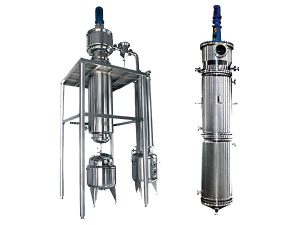
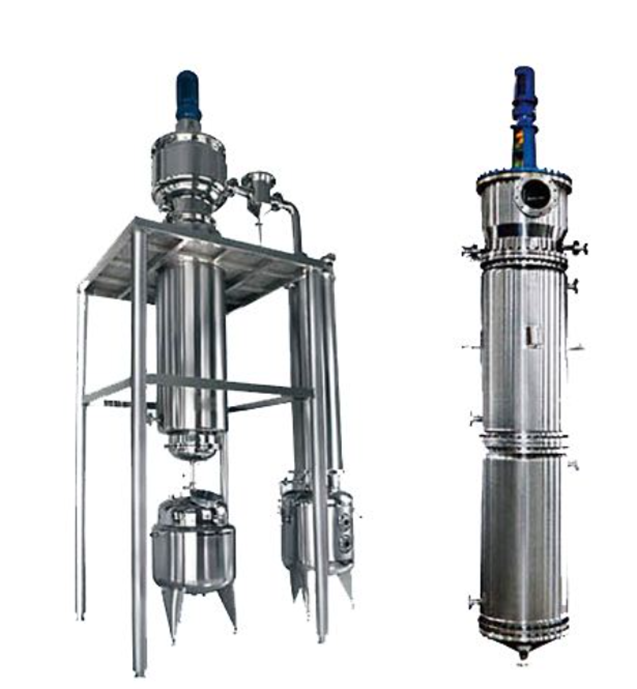
A wiped film evaporator (also called scrape film evaporator) is designed for continuous distillation of heat-sensitive and high-viscosity liquids. It features a vertical or slightly inclined cylindrical tube where the liquid forms a thin film, constantly scraped by rotating wipers. This ensures rapid evaporation and minimal thermal degradation.
Key Benefits:
-
High efficiency for viscous and heat-sensitive materials
-
Short residence time minimizes thermal decomposition
-
Continuous operation reduces downtime
-
Compact design suitable for limited floor space
Example Use Case:
A pharmaceutical company producing plant extracts switched to a Zhongbo scrape film evaporator. They reported a 30% increase in yield while maintaining product purity, demonstrating the system’s reliability and efficiency.

What is Molecular Distillation?
Molecular distillation is a type of short-path vacuum distillation, often used for highly sensitive compounds like vitamins, essential oils, or cannabinoids. It relies on extremely low pressure to separate components based on their molecular mean free path rather than traditional boiling points.
Key Benefits:
-
Ideal for ultra-pure separation of delicate compounds
-
Operates under high vacuum, preventing oxidation
-
Can handle very low boiling point substances
Example Use Case:
An essential oil manufacturer employed molecular distillation to isolate high-purity limonene. Although purity exceeded 99%, the process required higher maintenance and lower throughput compared to a wiped film evaporator.
Wiped Film Evaporator vs. Molecular Distillation: 7 Key Differences
| Feature | Wiped Film Evaporator | Molecular Distillation |
|---|---|---|
| Operation | Continuous | Usually batch or semi-continuous |
| Film Formation | Mechanical wipers create a thin film | Relies on molecular path under vacuum |
| Heat Sensitivity | Excellent for heat-sensitive liquids | Excellent, but slower throughput |
| Viscosity Handling | Handles high-viscosity liquids well | Limited to low to medium viscosity |
| Throughput | High | Low to medium |
| Maintenance | Moderate | Higher, requires careful vacuum control |
| Cost | Moderate | Higher initial and operational cost |
Detailed Comparison:
-
Operation Mode:
A wiped film evaporator operates continuously, allowing you to feed raw material without interruption, which increases overall productivity. Molecular distillation is mostly batch or semi-continuous, requiring multiple cycles for large volumes, which slows production. -
Film Formation:
In wiped film evaporators, mechanical wipers create a consistent thin film on the inner surface, ensuring uniform heat transfer and preventing burn-on for viscous liquids. Molecular distillation relies solely on molecular mean free path under vacuum, which is effective for low-viscosity, delicate compounds but less suitable for thicker liquids. -
Heat Sensitivity:
Both systems are designed for heat-sensitive materials. However, wiped film evaporators achieve short residence times and high heat transfer efficiency, minimizing thermal degradation. Molecular distillation works under high vacuum to reduce boiling points but generally requires slower operation, which can extend process time. -
Viscosity Handling:
Wiped film evaporators excel in processing high-viscosity liquids such as plant extracts, resins, or pharmaceutical slurries. Molecular distillation struggles with thick fluids because they do not spread evenly under the vacuum, limiting their efficiency. -
Throughput:
Wiped film evaporators can handle high volumes continuously, making them suitable for large-scale production. Molecular distillation usually achieves lower throughput due to its batch nature and slower processing under vacuum. -
Maintenance Requirements:
Mechanical components in wiped film evaporators require moderate maintenance, mainly for wipers and seals. Molecular distillation systems demand more intensive maintenance, including vacuum pumps, precision alignment, and careful monitoring of low-pressure conditions. -
Cost Considerations:
Wiped film evaporators generally have a moderate upfront and operational cost, making them cost-effective for continuous production. Molecular distillation involves higher initial and operational costs, especially when scaling up for commercial production.
Why Choose a Wiped Film Evaporator?
If your focus is on continuous production, high throughput, and efficiency, a wiped film evaporator from Zhongbo Machinery is the optimal choice. Its ability to process heat-sensitive and viscous materials while maintaining product quality makes it ideal for pharmaceuticals, food additives, and plant extract industries.
Case Example:
A herbal extract producer integrated Zhongbo’s scrape film evaporator into their production line. They achieved 20% faster processing and significantly reduced energy consumption compared to their old batch distillation method.
Product Link: Zhongbo Scrape Film Evaporator
Conclusion
By understanding the differences between wiped film evaporators and molecular distillation, you can choose equipment that maximizes efficiency and preserves product quality. For reliable, high-throughput processing, Zhongbo Machinery’s scrape film evaporator delivers proven performance. Invest smartly to enhance your production line and achieve superior results.
FAQs
Can a wiped film evaporator replace molecular distillation?
They serve similar but distinct purposes. Wiped film evaporators excel in continuous high-throughput processing, while molecular distillation is ideal for ultra-pure separations at very low pressures.
What materials can be processed in a scrape film evaporator?
Heat-sensitive, high-viscosity liquids like plant extracts, pharmaceuticals, polymers, and essential oils.
How much space does a wiped film evaporator require?
Its vertical design makes it compact, suitable for limited-floor-space facilities.
Does Zhongbo Machinery provide installation support?
Yes, Zhongbo offers professional guidance from setup to operation, ensuring your production line runs efficiently.