
Introduction
In the food processing industry, concentrating heat-sensitive liquids requires a delicate balance between efficiency and product quality preservation. Incorrect evaporation and concentration methods can destroy the nutritional value, aromatic characteristics and appearance of these liquids. Conversely, the right system can enhance the operational efficiency and product quality of various food processing plants. With the continuous growth of the global industrial evaporator market, understanding how to match evaporation technologies to the unique needs of heat-sensitive food liquids is a strategic decision that is crucial for long-term success.
Heat-Sensitive Food Liquids: Properties & Risks
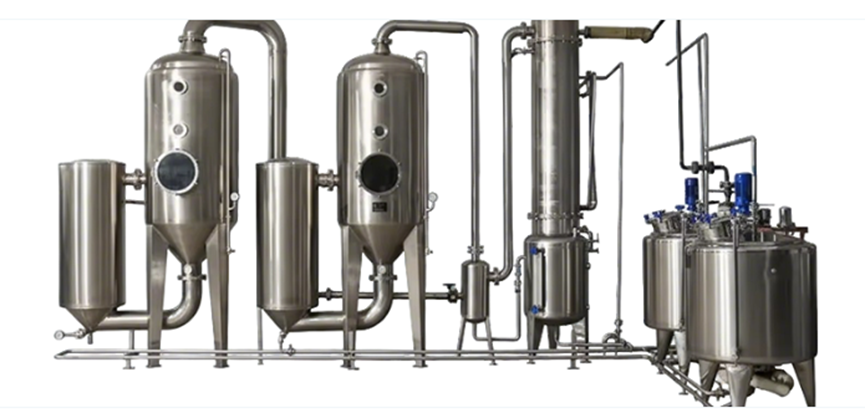
The characteristic of thermosensitive food liquids lies in their sensitivity to heat treatment. Their inherent properties require gentle processing throughout the entire concentration process.
Key Heat-Sensitive Properties
These liquids have irreversible characteristics and require specialized treatment:
Poor heat stability, with nutrients and flavor compounds decomposing at temperatures above 60 – 70 degrees Celsius.
Large fluctuations in flavor components, making them prone to volatilization.
Changes in viscosity during concentration increase the risk of scaling on heat transfer surfaces.
The characteristic of generating foam interferes with the gas-liquid separation process and reduces system efficiency.
Common Food Liquid Categories
Fruit and vegetable juices: citrus, berries, mangoes, tomatoes
Dairy products: milk, whey protein, cream, yogurt extract
Coffee/tea concentrates and plant-based milk: oats, soybeans, almonds
Natural flavor syrups and food additive solutions
Improper Processing Risks
Cutting corners during food processing can lead to irreparable losses for food manufacturers:
Exhaustion of nutrients and degradation of flavor
Poor color or turbidity reduces the market appeal of the product
Expansion of equipment scale and increase in failures due to corrosion and scaling.
Violation of the hygiene standards of the US Food and Drug Administration / US Department of Agriculture, which may lead to product recalls.
Core System Requirements for Processing
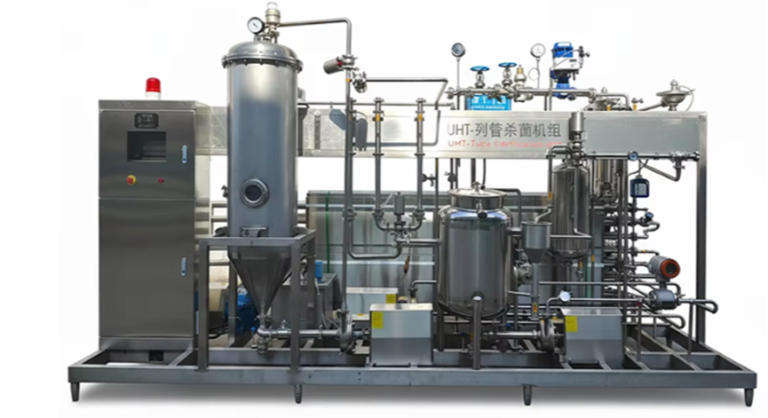
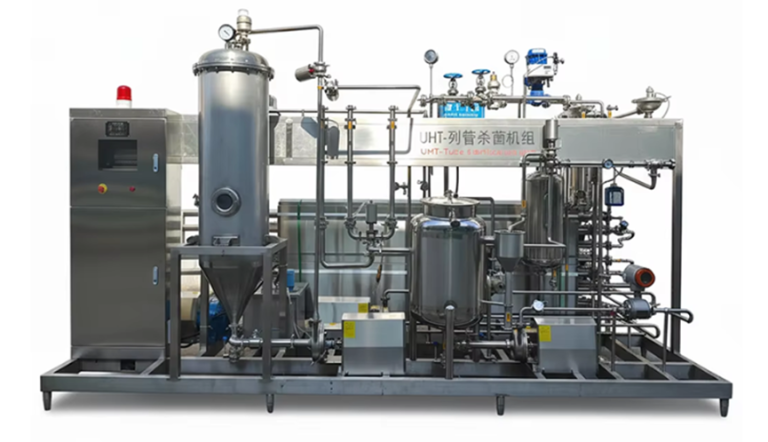
For food liquids that require low-temperature properties, industrial evaporation systems must meet strict and non-negotiable conditions to ensure product quality and operational efficiency.
Low-temperature operation: Utilize vacuum treatment to keep the temperature below 70°C. This minimizes heat exposure to the greatest extent.
Hygienic design: Manufactured with food-grade 304/316L stainless steel, it is compatible with CIP (in-line cleaning) and has no dead corners for bacterial growth.
Short residence time: Rapid processing to reduce the contact time with heat exchange surfaces.
Precise control: Utilize an automated system based on PLC to maintain concentration stability and prevent over-processing.
Material compatibility: Resistant to slight corrosion caused by acidic/alkaline liquids.
Ideal Evaporation System Types
Not all evaporation and concentration systems are suitable for heat-sensitive food liquids. The following types of designs are intended to ensure a gentle processing process while achieving reliable concentration efficiency.
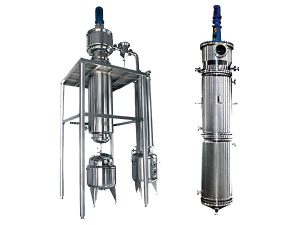
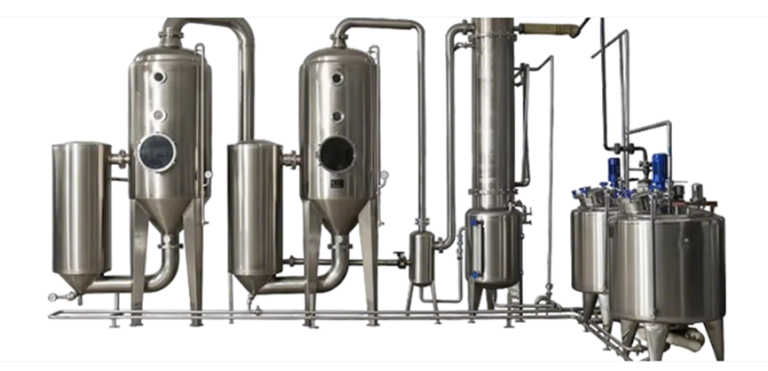
Falling Film Evaporators
For heat-sensitive liquids, these systems are considered standard equipment. They utilize the principle of gravity to evenly distribute the liquid in the form of a thin layer on the vertical heat transfer tubes. The liquid stays for only a few seconds. They are highly suitable for continuous juice and dairy product concentration processes and do not produce excessive dirt. This is very suitable for large food processing plants.
MVR Evaporators
The mechanical vapor recirculation (MVR) evaporator recycles the steam to generate heat. Compared to single-effect systems, its energy consumption can be reduced by 80% to 95%. In addition, its closed-loop design can maintain a low and stable temperature, making it very suitable for continuous processing of large amounts of whey and plant-based milk. Although the initial investment cost is high, the long-term energy savings can bring significant investment returns for continuous operation.
Wiped/Agitated Thin-Film Evaporators
For liquids with extremely high viscosity or prone to foaming and sensitive to heat, these systems use mechanical scrapers to evenly spread the liquid into a thin film. They can operate in ultra-low temperature environments and can handle high solid content materials. This is very suitable for small-batch, high-value liquid processing.
Low-Temperature Multi-Effect Evaporators
These systems transfer heat energy step by step through multiple evaporation stages, using the steam generated in each stage to heat the next stage. They combine low-temperature operation with high energy efficiency, making them very suitable for large-scale juice and dairy processing. When combined with MVR technology, they can also achieve higher energy-saving effects and supporting cost-effective scaling for growing Food Processing Plants.
Step-by-Step System Selection Framework
By adopting a systematic approach, you can ensure that your liquid concentration equipment is compatible with your specific processes and business requirements. By following these five steps for data-driven selection, you can avoid costly mistakes:
Clarify process requirements: Record the characteristics of the feed, the target concentration, the production capacity, and the available auxiliary facilities.
Assess product sensitivity: Test the maximum allowable temperature, residence time limits, and foaming/viscosity changes.
Assess operational factors: Consider the cleaning frequency, maintenance channels, operation time arrangement, and integration with the existing production line.
Calculate total cost of ownership: Besides capital investment costs, factors such as energy, maintenance, cleaning, and the labor costs throughout the system’s usage period should also be taken into account.
Reserve flexibility for future development: Choose a system that can support capacity expansion, product line changes, and the continuous evolution of sustainable development goals. This is crucial for the long-term development of the factory.
Operational & Design Optimization for Quality

Even with an appropriate evaporation and concentration system, conscious optimization is necessary to maximize the product’s shelf life and improve operational efficiency.
Vacuum control: Precisely regulate the pressure to maintain the processing temperature between 40 and 60 degrees Celsius. This is applicable to extremely sensitive liquids like fruit juices.
CIP protocol optimization: Utilize an automated, high-flow CIP cycle process while avoiding the use of strong chemical substances that could contaminate the product.
Maintenance of heat exchange surfaces: Conduct regular inspections and polishing to prevent scaling and ensure stable heat exchange and shortened residence time.
Enhancement of gas-liquid separation effect: Adding demister pads or cyclone separators can reduce waste and increase production.
Common Selection Mistakes to Avoid
Even experienced food processing personnel may make some avoidable mistakes when choosing liquid concentration equipment for liquids that are sensitive to heat.
Prioritize upfront costs over quality: Low-cost single-effect evaporators can save costs initially, but they will lead to a decline in product quality and even higher long-term costs.
Ignore residence time: Ignoring the requirement for short residence time will result in the loss of flavor and nutritional components.
Ignore scalability: Choosing a system that cannot be expanded as the production scale increases will lead to expensive renovations when the enterprise expands.
Ignore cleaning requirements: Choosing a system with difficult-to-clean heat exchange surfaces will increase downtime and scaling phenomena, thereby reducing the consistency of product quality.
Ignore regulatory compliance: Even if product quality is guaranteed, unhygienic design may still lead to violations of relevant regulations of the U.S. Food and Drug Administration (FDA) / U.S. Department of Agriculture (USDA).
Case Studies: Successful System Implementation
The actual cases have fully demonstrated how a reasonable industrial concentration system can bring about changes to the heat-sensitive food liquid processing processes of food processing plants:
Juice concentration: A large citrus juice producer replaced the traditional evaporator with a low-temperature drip + MVR system, achieving a 42% reduction in energy consumption and a 15% increase in production, while maintaining superior flavor. By merely saving energy in this way, the enterprise achieved an investment return within 18 months.
Dairy processing: A whey protein manufacturer adopted a scraper film evaporator, reducing the processing time by 60% while maintaining the amino acid content. The system’s cleaning interchangeability reduced the cleaning downtime by 30% and increased production.
Conclusion
Selecting an evaporation system for heat-sensitive food liquids is a decision that affects the entire production process for food processing plants. The key to a successful choice lies in achieving gentle processing while also considering energy efficiency, and ensuring that the system matches your production scale, budget, and future development goals. From drop film and muffle evaporators to wiped film evaporators, each technology has its specific application scenarios. And the progressive framework ensures that you find the most suitable solution for your specific needs in the evaporation and concentration process. JIANGBO is at the forefront in the field of evaporation and concentration, providing custom-designed systems to meet the unique processing requirements of heat-sensitive food liquids. They integrate innovative design, hygienic construction, and advanced automation technology to ensure reliable and high-quality results. If you wish to upgrade your existing system, optimize the processing effect for heat-sensitive food liquids, or design a new processing line for your factory, please contact JIANGBO immediately. They will provide you with professional consultation and tailor-made solutions to help you succeed.
FAQs
Which evaporation and concentration process is the most cost-effective for processing small-batch perishable food liquids?
Thin-film evaporators are highly suitable for handling small-batch production as they can handle high viscosity and foaming situations while maintaining product quality. Their flexibility compensates for the higher capital costs required for small-batch production.
In the industrial evaporation process for heat-sensitive liquids, how can energy efficiency be maintained while protecting the product?
One option is to choose multi-effect steam recompression evaporators or low-temperature multi-effect evaporators. These devices can recover steam at operating temperatures below 70°C to reduce energy consumption. Additionally, introducing precise vacuum control can further reduce heat exposure and ensure that there is no trade-off between efficiency and quality.
For liquid concentration equipment used for food liquids that are sensitive to heat, what maintenance measures can be taken to prevent scaling?
Use an automatic circulating cleaning program containing food-grade cleaners, inspect the heat exchange surfaces weekly, and grind the prone-to-scale areas monthly. For drop-film evaporators, ensure uniform liquid distribution to avoid dry areas, thereby preventing scaling.
Can this evaporation and concentration system be integrated with the existing food processing production line equipment?
The design of modern systems aims to integrate seamlessly with all standard food processing equipment. Key considerations include matching production capacity, synchronizing the automation system, and ensuring hygienic material transfer between the concentration stage and the subsequent processing stage.