When you operate a dairy, juice, or liquid-food processing business, microbial control directly shapes your product quality, safety, and shelf life. Understanding why UHT destroys microorganisms more efficiently than HTST helps you choose the right equipment to improve production stability, reduce spoilage, and expand your distribution market.
Why UHT Is Far More Efficient for Microbial Elimination
Ultra-High-Temperature (UHT) treatment exposes liquid food to 135–150°C for 2–4 seconds, creating an intense thermal shock that destroys both vegetative bacteria and heat-resistant spores. This rapid, high-temperature exposure is far beyond the microbial-kill capability of conventional HTST pasteurization.
The secret is not only the higher heat—but how fast, uniform, and deep the heat penetrates microbial cells. UHT disrupts:
-
Spore structures and protein bonds
-
Enzyme systems responsible for microbial survival
-
Cell membranes and metabolic pathways
As a result, UHT achieves commercial sterility, making the product safe for 6–12 months of ambient storage.
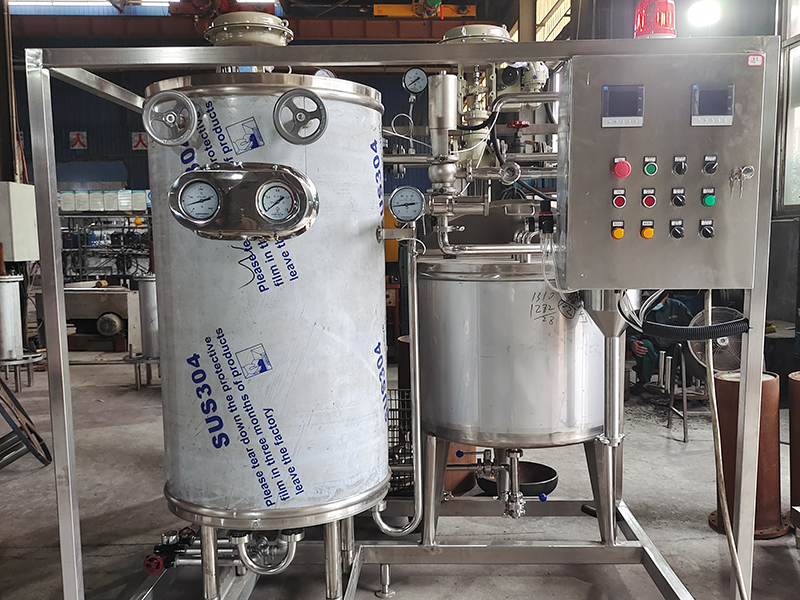
The Science Behind UHT’s Higher Kill Rate
High temperature breaks microbial resistance
Many microorganisms—including Bacillus, Clostridium, and thermoduric spores—can survive HTST temperatures (72–75°C). Their thermal resistance (D-value) is too high.
But at 135–150°C, UHT causes:
-
Instant protein denaturation
-
Structural collapse of spores
-
Rapid inactivation of heat-stable toxins
-
Destruction of enzymatic systems essential for growth
This level of destruction simply cannot be achieved at HTST temperatures.
Ultra-short time prevents heat damage
While UHT uses extreme temperature, the very short holding time protects product quality:
-
Less cooked flavor
-
Better nutritional retention
-
Reduced chemical reactions (like Maillard)
This creates a balance:
Maximum microbial kill with minimal product damage.
Faster heat penetration = higher efficiency
UHT systems (especially tubular or direct steam-injection designs) deliver heat more quickly and evenly. The rapid heat transfer ensures microorganisms cannot adapt or resist thermal shock.
Below is a simplified comparison:
| Factor | UHT (Ultra-High Temperature) | HTST (High-Temperature Short-Time) |
|---|---|---|
| Temperature | 135–150°C | 72–75°C |
| Holding Time | 2–4 seconds | 15–20 seconds |
| Can kill spores? | Yes | No |
| Shelf Life | 6–12 months (ambient) | 7–21 days (refrigerated) |
Engineering Features That Make UHT More Effective
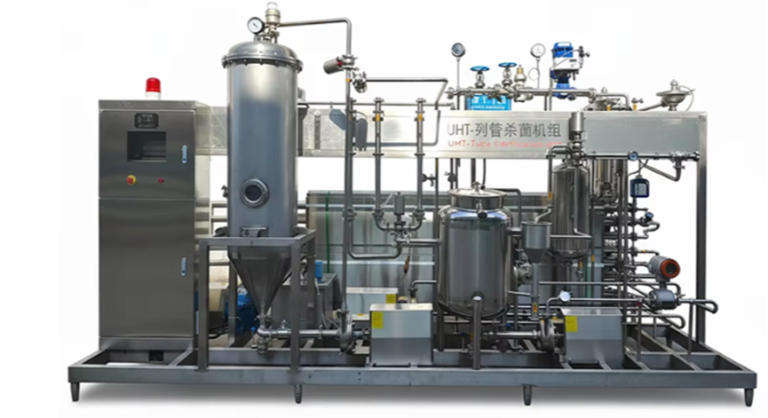
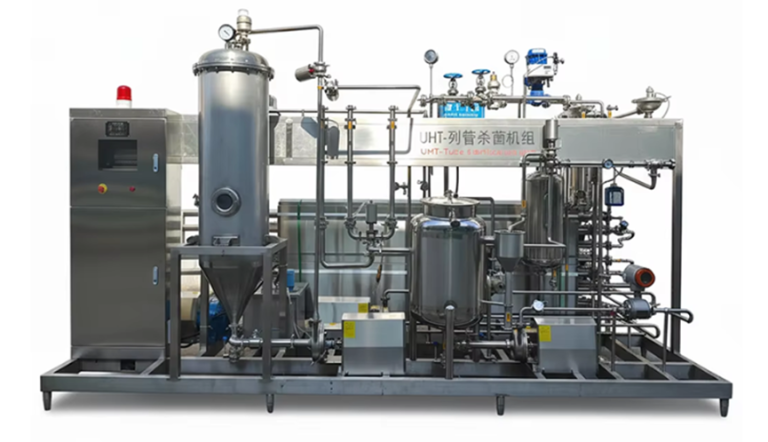
Your UHT pasteurizer’s design has a major impact on microbial reduction. Modern UHT systems incorporate:
Direct steam injection
Achieves extremely rapid temperature rise—ideal for spore inactivation.
High-efficiency tubular or plate heat exchangers
Guarantee uniform heating, preventing “cold spots” where microorganisms could survive.
Ultra-fast cooling
Stops thermal degradation and helps preserve nutrients and flavor.
Integration with aseptic filling
Even after sterilization, the product remains protected from recontamination.
This is a major reason UHT products remain shelf-stable for months.
Real Case Examples: Proving UHT’s Higher Efficiency
Case 1: Dairy Factory Eliminates Spore Spoilage
A dairy processor producing 20,000 L/day of milk struggled with sporadic spoilage due to spore-forming bacteria surviving HTST cycles. After upgrading to a Zhongbo Machinery UHT pasteurizer, they achieved:
-
99.99% microbial reduction
-
Zero spore-related spoilage
-
Shelf life increased to 9–12 months
-
Ability to export without cold-chain transport
Case 2: Juice Manufacturer Reduces Returns
A juice company faced market recalls because certain heat-resistant yeasts survived HTST.
Switching to a UHT tubular system solved the issue:
-
Yeast survival dropped from 2.8% to near zero
-
Product stability improved significantly
-
Customer complaints decreased by 80%
These real scenarios highlight why companies choose UHT when long shelf life and high microbial control are business priorities.
Why Choose Zhongbo Machinery UHT & HTST Pasteurizers
When you invest in thermal processing equipment, you need reliability, sanitary construction, and stable performance. Zhongbo Machinery provides:
-
High-efficiency UHT pasteurizers
-
Reliable HTST pasteurizers
-
Aseptic filling systems
-
Complete dairy and beverage processing lines
Our systems are engineered for microbial safety, longer product life, and continuous industrial operation.
View our UHT & HTST systems here:
https://www.zjzhongbo.com/product_category/htstuht-treatment/
Conclusion
UHT eliminates microorganisms more efficiently because its high temperature, ultra-short treatment time, and advanced engineering design destroy spores and heat-resistant bacteria that HTST cannot eliminate. When you need stronger microbial safety and longer shelf life, UHT technology—and Zhongbo Machinery’s system solutions—gives your production line a clear competitive advantage.
FAQs
1. Does UHT kill all microorganisms including spores?
Yes. UHT temperatures destroy both vegetative bacteria and heat-resistant spores, achieving commercial sterility.
2. Why can UHT products stay shelf-stable for months?
Because UHT combines spore inactivation with aseptic filling to prevent recontamination.
3. Does UHT change product flavor?
Modern UHT systems minimize flavor changes thanks to rapid heating and cooling.
4. Why isn’t HTST enough for ambient shelf life?
HTST cannot destroy spores, which can grow during storage unless the product is refrigerated.
5. Is UHT suitable for juice, milk, and plant beverages?
Yes. UHT is widely used for dairy, juice, tea, oat milk, soy milk, and other liquid foods requiring long shelf life.