


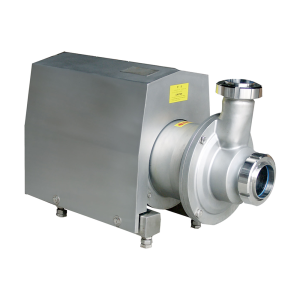

Core function
Draws fluid from the low point / outlet of vessels, tanks, filler bowls and pipelines.
Returns the soiled caustic/acid/rinse liquid to the CIP set so it can be re-heated, re-dosed and re-circulated, or sent to waste.
Keeps the return leg slightly under vacuum so lines drain completely and no cleaning fluid is left standing (which would cause re-contamination).
Why it is not just a normal centrifugal pump
The return stream is part-full, aerated and often below the pump (spray balls, tank vents and drains let air in). A standard centrifugal pump loses prime, air-locks or cavitates. So CIP return pumps are usually:
Self-priming centrifugal (side-channel / liquid-ring / volute with gas-separation chamber), or
Positive-displacement (twin-screw, lobe) for very aerated or viscous returns.
Typical construction
Wetted parts: SS316L, mirror-polished, Ra ≤ 0.8 µm, fully drainable, no dead legs.
Seals: single/double mechanical seal (SiC/SiC, EPDM/FKM/Viton), sometimes flushed; magnetic drive for zero leakage.
Connections: Tri-Clamp, DIN, SMS, RJT, IDF.
Elastomers rated for hot NaOH, HNO₃, peracetic acid, hot water and steam (if SIP follows CIP).
Supply pump vs return pump
Supply pump: flooded suction, steady duty, pushes fluid to spray devices at scouring velocity (~1.5 m/s in largest line).
Return pump: suction may be below pump, fluid contains air/foam, must self-prime and stay primed