

Two quotations for a plate pasteurizer can both say “15 seconds holding time” and still describe different machines. One tube is 18 metres of 1.5-inch pipe with two sensor bosses 40 mm from the bends; the other is a coil with a single probe at the outlet. Both can pass a factory check and one of them is much harder to defend in an audit. This guide shows you what to freeze in the RFQ so the holding tube you buy is the one you can measure, drain and document.
What the Holding Tube Is Responsible For on a Plate Pasteurizer
The holding tube is the part of the line where nothing happens on purpose. Product enters at pasteurization temperature, travels for a defined time, and leaves at the same temperature before the flow diversion valve decides whether it may continue. Its only job is to guarantee that every particle of product spends the required time at or above the required temperature.
That makes the tube a legal component rather than a process preference. If the time is short, the product is under-processed regardless of how good the plate pack is. If the time is long, you lose heat, flavour and throughput. The geometry is therefore a specification item, and on a plate pasteurizer it is often the item least described in the RFQ.
It also interacts with everything around it. The diversion valve responds to the sensor at the end of the tube, so the sensor position defines the time. The tube’s slope decides whether it drains. The bore decides velocity, pressure drop and whether the line can be cleaned. None of that can be left to a drawing issued after the order.
Geometry and Volume Data the RFQ Should Request
Ask for four numbers and one drawing: inside diameter, developed length, calculated internal volume, and the volume of the fittings included in the run. The drawing should be an isometric with dimensions, not a general arrangement.
Volume is what converts to time. At a given flow, holding time is internal volume divided by volumetric flow, so a supplier who quotes a length without a bore has told you nothing. A 3-inch tube holds four times what a 1.5-inch tube holds per metre, which is why the same 15 seconds can be 4.6 m or 18.3 m long.
| Tube inside diameter | Volume per metre | Length for 15 s at 5,000 L/h | Length for 30 s at 5,000 L/h |
|---|---|---|---|
| 25.4 mm (1 in) | 0.51 L/m | 41.1 m | 82.2 m |
| 31.75 mm (1.25 in) | 0.79 L/m | 26.3 m | 52.6 m |
| 38.1 mm (1.5 in) | 1.14 L/m | 18.3 m | 36.6 m |
| 50.8 mm (2 in) | 2.03 L/m | 10.3 m | 20.6 m |
| 63.5 mm (2.5 in) | 3.17 L/m | 6.6 m | 13.2 m |
| 76.2 mm (3 in) | 4.56 L/m | 4.6 m | 9.1 m |
| 101.6 mm (4 in) | 8.11 L/m | 2.6 m | 5.1 m |
Inside Diameter, Length and Fitting Volume
Bore is chosen by velocity, not by convenience. At 5,000 L/h a 1.5-inch tube runs at roughly 1.2 m/s, a 2-inch at about 0.7 m/s and a 3-inch at 0.3 m/s. Below about 0.5 m/s you lose turbulent scour and start to accumulate deposit in a line that is supposed to be clean; above about 2 m/s you pay in pressure drop and pump energy for no process benefit.
Then count the fittings. Elbows, reducers, sight glasses, valve bodies and the sensor boss itself all add volume that contributes to the time, but they also disturb the flow profile. Ask for the fitting volume as a separate line item in the calculation, and ask that dead legs longer than two pipe diameters be eliminated rather than counted.
Watch the tolerance: a holding tube calculated to 15.1 seconds has no margin. Ask for the calculated volume at the design flow, plus the minimum guaranteed volume, and require that the lower figure still meets the legal minimum with the flow meter at its calibrated accuracy.
Slope, Vents and Drainability
A holding tube that cannot drain is a holding tube that cannot be cleaned or inspected. Require a continuous fall of at least 1% in the direction of drainage, no local low points between supports, and a drain valve at the lowest point with a vent at the high end. On a line with a CIP cleaning system, the return path from the holding tube is part of the circuit, so a low point there is a permanent soil trap.
On long runs, thermal expansion matters. A straight 18-metre tube without expansion allowance will bow, and a bowed tube creates exactly the low points you were trying to avoid. Ask how expansion is accommodated and where the supports sit. Our piping specification note covers slope, roughness and dead-leg limits in more detail if you are writing the line specification at the same time.
Sensor Bosses and Why Their Location Changes the Meaning of a Time Claim
Holding time is not a property of the tube alone; it is a property of the distance between the point where product reaches temperature and the point where the sensor measures it. Move the boss 300 mm and you have changed the process by half a second at 2 m/s.
Specify the boss as a dimension from the tube inlet, not as “at the outlet”. The sensor face should sit flush with the bore or in a shallow well, never in a pocket that holds stagnant product. State the thermowell type, the insertion depth and the thread, because a replacement probe from a different supplier will not read the same in a deep well.
The inlet point needs the same treatment. The clock starts where the product reaches the required temperature, which is normally the outlet of the final heating section — not the outlet of the whole plate pack, and not the inlet of the holding tube if there is any unheated length between them. Put both dimensions on the drawing and make them part of the acceptance documents.
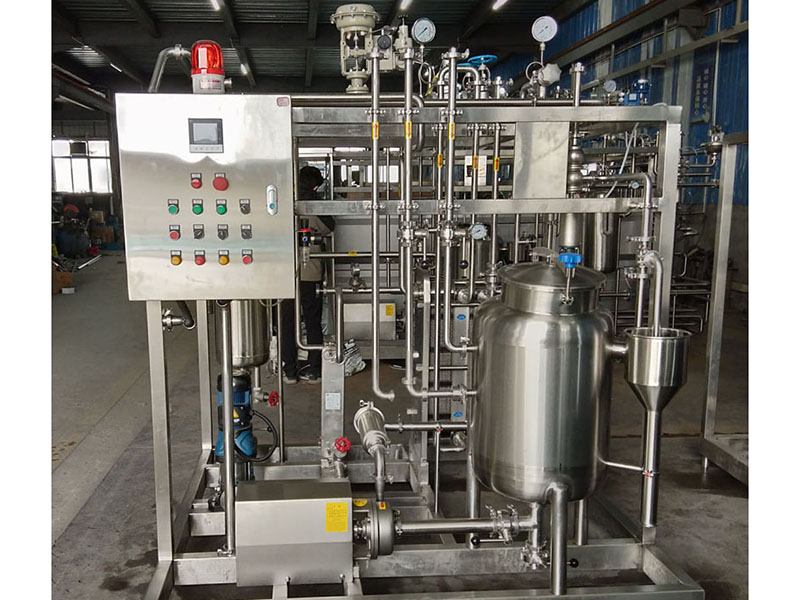
Why a Catalog Holding-Time Range Cannot Be Copied as a Process Guarantee
“Holding time 5–30 seconds” on a product page describes the range a platform can be configured for, across different flows and tube lengths. It is not a statement about your unit. Copy that range into an RFQ and you have asked for a family of machines, not one.
The same applies to any holding time quoted without a flow. Time and flow trade against each other: a tube sized for 15 seconds at 5,000 L/h gives 25 seconds at 3,000 L/h and 10 seconds at 7,500 L/h. If your line has to run at reduced flow during a filler changeover, the holding time at that flow is a different number and the process authority will want to see it.
Do not confuse holding time with the total residence time either. Temperature and time act together, and the time that matters for lethality is the time at or above the setpoint, not the time in the whole line.
A Bid-Comparison Table So Two Quotes Use the Same Basis
Put this table in the RFQ and ask each supplier to fill it in and return it with the quotation. The bids then compare on data rather than on adjectives, and the difference in price usually explains itself.
| Item to confirm | What the bid must state | Why it decides the comparison |
|---|---|---|
| Inside diameter | mm, and material grade | Sets velocity, volume per metre and pressure drop |
| Developed length | m, straight plus bends | With bore, gives the internal volume |
| Internal volume | L, including fittings | Converts to holding time at your design flow |
| Calculated holding time | s at design flow, and at minimum flow | Two numbers, because time moves with flow |
| Sensor boss position | mm from tube inlet, both ends | Defines where the clock starts and stops |
| Slope and drain point | % fall, drain and vent locations | Proves CIP and drainability |
| Surface finish | Ra value and weld treatment | Hygiene and cleanability evidence |
| Verification method | Volume check, tracer test or both | Shows how the number will be proven |
Comparing plate pasteurizer quotations?
Send us the two holding tube descriptions and the flow you run. We will mark the differences that change the process and the ones that only change the paperwork.
Documents to Attach to the Purchase Order
The purchase order should carry five documents, and each one should be referenced by revision number so there is no argument later about which drawing was approved.
Holding Tube Document Set
What to attach, and what each document has to show. Open an item for the content it must include.
1. Isometric with dimensions
Every straight length, every bend, the boss positions from the tube inlet, the drain and vent points. If the drawing shows only a straight run and a note reading “holding tube”, it cannot be checked.
2. Volume calculation sheet
Bore, length, fitting volumes and the arithmetic to a stated flow. It should show the holding time at design flow and at minimum flow, with the fitting allowance visible as a separate line.
3. Sensor schedule
Tag, boss dimension, thermowell type, insertion depth and instrument class for each point. This is the document an auditor will use to decide whether the time claim means anything.
4. Material and finish certificate
316L certificate for tube and fittings, plus the internal surface roughness value and the weld inspection method. A holding tube is a hygiene-critical surface even though it does no heat transfer.
5. Verification record
The factory volume check or tracer test result, signed, with the method stated. This is what you compare against when the unit arrives and someone asks whether the tube is the one on the drawing.
Reference each document by revision in the PO, and make the final payment milestone depend on receiving the set complete.
Frequently Asked Questions
Can we just write “holding time 15 seconds” in the RFQ?
It is a start, not a specification. Add the design flow, the inside diameter, the calculated volume including fittings, and the sensor boss position. Without those, two suppliers can both meet 15 seconds on paper with tubes that differ by several metres.
Is the 5–30 s range on a product page the operating window of every unit?
No. That range describes what the platform can be configured for across different tube lengths and flows. Your unit is built for one design point. Ask for the calculated holding time at your flow, and at the minimum flow you operate.
Does every plate pasteurizer use an external holding tube?
Not all. Smaller units sometimes hold product in a section of the plate pack or in a coil inside the frame. That is acceptable if the volume, the flow path and the sensor positions are documented, but it is harder to inspect and harder to drain, so ask to see how it is cleaned and verified.
Can the holding tube be shortened to save floor space?
Only by changing the bore, and that changes velocity. A shorter tube with a larger bore holds the same volume but runs slower, which can hurt cleaning. Decide which constraint matters more before the layout is frozen, not after the skid is built.
Do elbows and fittings count toward holding volume?
Their volume counts, but the flow through them is not plug flow, so the time they provide is approximate. Include them as a separate line in the calculation, keep the number of fittings low, and avoid dead legs altogether rather than counting them as volume.
Should the holding tube be insulated?
Usually yes, especially on long runs, to hold temperature between the heater and the diversion valve. The trade-off is that insulation hides the tube from inspection, so specify removable jackets or a documented inspection interval if your auditors expect visual access.
How is the holding volume proven in the factory?
Either by calculation from the isometric with a physical dimensional check, or by a water-fill test on the assembled tube. Ask which method is used and require the record. A calculation alone is acceptable when the drawing dimensions are verified on the finished unit.
Can holding time be verified on site with a tracer?
Yes. A salt or conductivity tracer injected at the start point with a probe at the holding outlet gives a residence time distribution. It is a strong check on the installed geometry, and it is worth doing once after commissioning, particularly if the tube was modified on site.
What slope and drainability should we require?
A continuous fall of at least 1% to a single low point, a drain valve at that point and a vent at the high end. No local low points between supports, and expansion allowance so the tube cannot bow into a trap when it heats up.
How is this different from specifying capacity or flow?
Capacity tells you how much product the line can process. Holding time tells you how long each particle stays hot. A unit can meet its capacity and still have the wrong holding volume if the bore was chosen for pressure drop rather than for time, which is why both numbers belong in the RFQ.
Final Thoughts
The holding tube is the cheapest part of a pasteurizer to specify properly and the most expensive part to fix afterwards. Put the bore, the developed length, the calculated volume, the boss dimensions and the drain slope in the RFQ, ask every bidder to return the same table, and require the verification record with the delivery. Then the 15 seconds you bought is 15 seconds you can measure, clean and defend, rather than a phrase on a quotation that nobody can reproduce.
Need your holding tube checked before you order?
Send the flow, the product and the required holding time. We will return the bore, the developed length and the volume calculation, with the boss positions marked on an isometric.
Related Resources
Equipment on this site
- Plate Pasteurizer — plate pack, external holding tube, diversion valve and CIP connections
- HTST & UHT Treatment Systems — complete thermal treatment lines sized around the holding duty
- CIP Cleaning System — cleaning circuits that have to reach the holding tube without dead legs
Further reading